The day of diagnosis — when they say the heart wall is thick
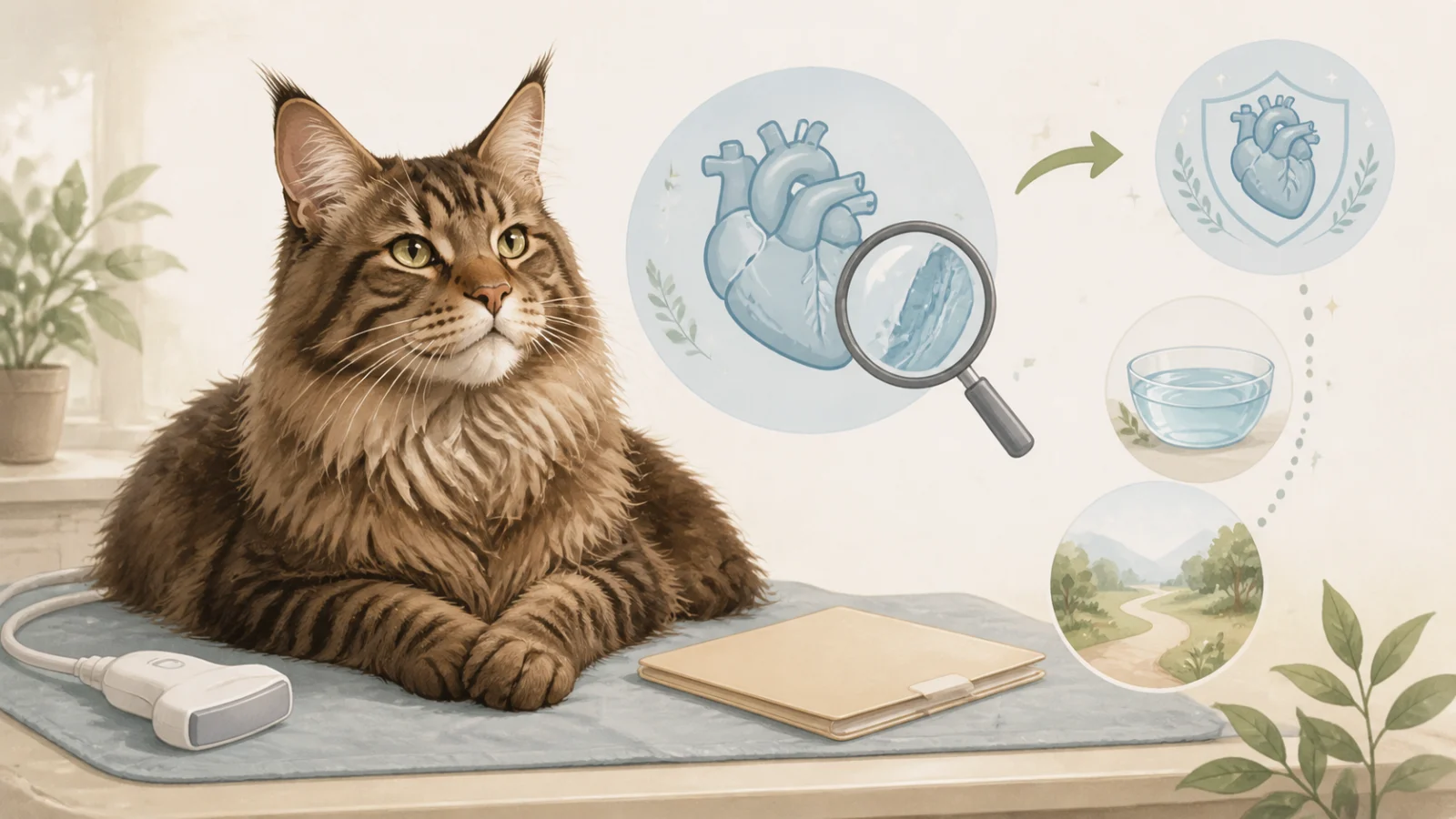
At a pre-neuter check, an anaesthesia work-up before a dental, or a routine wellness visit — that is how most caregivers meet this disease. "The heart sounds odd. The ultrasound shows a thickened wall. It's hypertrophic cardiomyopathy — HCM."
A heart disease, in a cat who was racing around the house yesterday. Search the name and the first words you meet are "sudden death" and "blood clot". This article is for that night — what this disease is, what to do today, and what you do not need to do.
1. The first truth — far more common than you think
In HCM the heart muscle (mainly the left ventricular wall) thickens inward. A thicker wall narrows the chamber and stiffens it, so what fails first is not the heart's power to pump blood out but its ability to fill.
How common? When 780 apparently healthy cats were screened with echocardiography (the CatScan study, 2015), 14.7% — one in seven — had HCM. Almost none of their caregivers knew. Today's diagnosis is not a rare misfortune; it is the most common heart disease of the cat, and a great many cats are living ordinary lives with it right now.
2. The truth about murmurs — sound can neither confirm nor clear
The road to this diagnosis is paved with misunderstandings; let us fix two before going on.
- "A murmur means heart disease" — no. Murmurs are heard in about 40% of healthy cats, and about 70% of those are "functional" — no disease at all. A cat can generate a murmur just by being nervous
- "No murmur means no heart disease" — also no. About 18% of HCM cats have no audible murmur (the REVEAL study). A quiet heart is not a guaranteed healthy heart
So the confirming tool is not a stethoscope but echocardiography: an end-diastolic left ventricular wall of 6 mm or more defines HCM, with 5–6 mm as a grey zone (ACVIM 2020). As a screening step before the echo, the blood test NT-proBNP is used — a substance released by stretched heart muscle, so a normal result leans reassuring and a high one says "get the echo".
3. Stages — the fork is the left atrium, not the wall
As CKD has IRIS stages, HCM has the ACVIM stages (2020). Find where what you heard in the consult room belongs:
| Stage | Meaning | Typical response |
|---|---|---|
| A | No disease, but predisposed (Maine Coon and other at-risk breeds) | Regular screening |
| B1 | HCM present but left atrium normal to mildly enlarged — low imminent risk | Usually no drugs; recheck every 6–12 months |
| B2 | No symptoms, but moderate or worse left atrial enlargement — rising risk of failure and clots | Discuss starting clopidogrel (clot prevention); shorter recheck interval |
| C | Has experienced congestive heart failure or a clot (ATE) even once | Full treatment (diuretics etc.). Stays C even after recovery |
| D | Heart failure no longer responding well to treatment | Intensive management |
Here is the principle that runs through this whole bible: the fork in this disease is not how thick the wall is, but how large the left atrium has become. Blood that cannot enter the stiff ventricle backs up into the left atrium; an enlarged atrium is the starting point of both heart failure (fluid backing up) and clots (pooled blood congealing). The most important number on the report is therefore LA/Ao (the left atrium-to-aorta ratio), and every recheck is largely about which way that number is moving.
4. Found without symptoms — the comfort and the tension in the numbers
From the long-term follow-up of 282 HCM cats in the UK (Payne 2013), both faces, exactly as reported:
- Comfort — cats diagnosed while asymptomatic (subclinical) had a median survival of 10.9 years. Many lived to old age and died of something other than the heart
- Tension — overall, 30.5% eventually experienced heart failure or a clot. Another study (REVEAL) put the 5-year risk of a cardiac event in preclinical HCM at roughly one cat in four to five
Carrying both numbers at once is the HCM caregiver's posture. "Most do fine" is not a reason to skip monitoring, and "one in four" is not a reason to live every day in fear. There are tools that lower the risk (clopidogrel at B2) and tools that catch the earliest signal (the breathing rate) — learning them is what the other eleven chapters of this bible are for.
5. What to do, starting today — six things
- ① Establish the resting breathing-rate baseline — the single most important habit in this disease. While your cat is deeply asleep, count chest rises for 30 seconds and double it. Normal is under 30 per minute. Measure for a few days from today to learn your cat's usual number — a rise in this number is the earliest sign of heart failure, and caught at home it means a clinic visit instead of an emergency room
- ② Write down three numbers from the report — wall thickness (mm), LA/Ao, and the stage (B1 or B2). These are the baseline the next echo will be compared against. Put them in the app's care log
- ③ Book the recheck — usually 6–12 months for B1, 3–6 months for B2. Settle "when is the next echo?" before you leave
- ④ Memorise the three emergency signs — sudden hind-leg paralysis with crying (a clot) / open-mouth breathing / resting breaths above 40 per minute. Any one of these means the hospital, even at night. Save the 24-hour hospital's number now
- ⑤ Announce the heart before any anaesthesia or fluids — dental cleanings, surgery, fluid therapy for another disease: the habit of saying "this cat is HCM stage B_" first. Thick hearts tolerate fluid overload poorly
- ⑥ Lower the stress load — in these cats, intense stress (carrier, bathing, strange places) can trigger sudden decompensation. Making the vet-visit routine calmer is itself cardiac care
6. What you do not need to do today
- Search "HCM life expectancy" — those results mix in cats first diagnosed in heart failure, so they mostly do not apply to a cat found asymptomatic. The 10.9 years in section 4 is the number for cases like yours
- Push for drugs at B1 — no drug has been shown to change the outcome of asymptomatic B1 disease (ACVIM 2020). "Watch without medication" is not neglect; it is the evidence-based standard
- Stock up on supplements — taurine deficiency belongs to a different heart disease (DCM); taurine does not reverse HCM in a cat eating normal commercial food. Omega-3 and the like are "not harmful", not treatment. If you use anything, decide it with your vet
- Agonise over exercise limits — let the cat play as much as it chooses. Unlike dogs, cats are not forced to exercise; stress management matters more than restriction
7. What to ask your vet
- "Is my cat B1 or B2? What was the LA/Ao?"
- "Were T4 and blood pressure checked? Have secondary causes of thickening been excluded?"
- "Is there a reason to start clopidogrel now — or a reason not to?"
- "When should the next echocardiogram be? Is this the point to see a cardiologist?"
- "At home, above what resting breathing rate should I call you?"
- "If anaesthesia is ever needed, what preparation does this heart require?"
8. Related
- The HCM Bible — contents — the map of this book: reading the numbers, stages, clots, the breathing rate. Entries marked "planned" will be filled in order
- CKD with other diseases — if your cat has both heart and kidney disease (the diuretic-and-fluids tightrope)