When another disease comes too — thyroid, heart, pancreas, diabetes, IBD
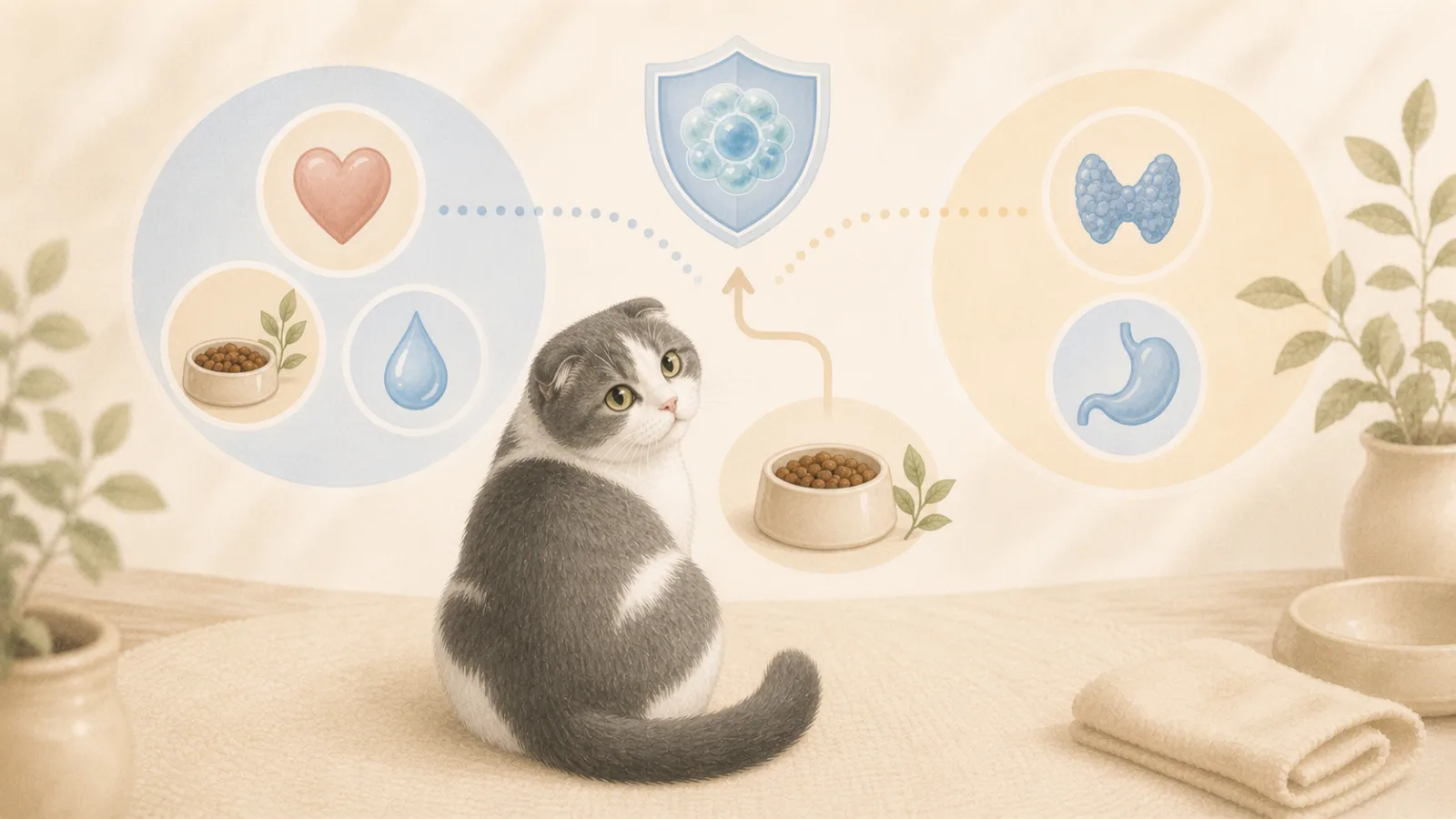
A cat with only CKD is actually the exception. By the age CKD arrives, other diseases tend to arrive with it.
The difficulty is when two diseases demand opposite things. The kidneys want more fluid; the heart wants less. The kidneys want protein moderated; the body wants more food. This chapter is about handling those collisions.
With comorbidities, the right frame is not "treat each disease optimally" but "start with whatever is hurting her most right now." Trying to treat both by the textbook usually fails at both.
1. Hyperthyroidism — the most common overlap, and the most confusing
It is the disease most often found alongside CKD in older cats, and the two hide each other, which makes it especially tricky.
Why CKD gets hidden
Excess thyroid hormone raises heart rate and renal blood flow, and artificially raises the glomerular filtration rate (GFR). The kidneys look like they are working better than they are.
On top of that, hyperthyroidism burns through muscle. Creatinine comes from muscle, so as muscle falls, creatinine falls with it. That is a double trap: failing kidneys with a normal-looking creatinine.
The misunderstanding this creates
Many owners feel that "treating the thyroid damaged the kidneys." In most cases the treatment did not cause kidney disease — it revealed the CKD that was already there.
The key rule — that is not a reason to under-treat
That said, a 2025 JAVMA study found cats that became azotemic after successful radioiodine treatment had shorter survival than those that stayed non-azotemic. This is not an argument against treating; it is an argument for always re-assessing the kidneys afterwards.
What must be avoided — iatrogenic hypothyroidism
Over-treating into hypothyroidism is clearly harmful to the kidneys — GFR falls and prognosis worsens. During thyroid treatment, ask for TSH alongside T4, not T4 alone.
SDMA earns its keep in this combination
SDMA is largely unaffected by muscle mass. When a hyperthyroid cat has lost muscle and creatinine reads falsely low, SDMA still shows the true kidney picture. If your cat is diagnosed hyperthyroid, ask for SDMA at the same time.
2. Heart disease (HCM) — a head-on collision with fluids
This is the hardest combination, because subcutaneous fluids — the backbone of home CKD care — are a direct risk to a compromised heart.
"Subcutaneous fluids are safer than intravenous" does not hold for a cat with heart disease. Fluid given under the skin still reaches the vascular compartment, and unlike an IV line it cannot be stopped once it's in.
Three practical rules
- In severe CKD, fluids are still worth it — they help maintain wellbeing
- In modest CKD plus heart disease, they are better avoided. The unavoidable sodium loading predisposes to volume overload and raises blood pressure. The cost outweighs the gain
- Fluids can unmask occult heart disease. If breathing changes after starting fluids, suspect the heart
The most valuable home monitoring — sleeping respiratory rate
It needs no equipment and it catches pulmonary edema earlier than anything else you can do at home.
Normal: under 30 breaths per minute
Repeated readings of 40 or more — contact your vet
Counting right after play or when it's hot gives a false number. Measure under the same conditions daily and write it down.
If you give subcutaneous fluids to a cat with heart disease, make it a habit to count breaths before and after. When the number starts climbing, it is time to adjust volume or interval.
Emergency signs
- Open-mouth breathing — in a cat, an unambiguous emergency
- Breathing where the belly heaves noticeably
- Sudden loss of use of the hind legs with crying out — suspect a clot (aortic thromboembolism). Emergency clinic immediately
- Pale or bluish gums or tongue
3. Pancreatitis — cats are not small dogs here
Feline pancreatitis is often quietly chronic and may present only as "she isn't eating well." Attributing every CKD cat's poor appetite to uremia alone will miss it.
The most common mistake — "pancreatitis means strict low fat"
Holding out for low fat until she eats nothing risks hepatic lipidosis, which is far more dangerous.
Diet priority for CKD + pancreatitis
The 2024 JAVMA nutrition review is clear — where possible, prioritise a lower-phosphorus hydrolysed protein diet. It is the point where both diseases' requirements meet.
And keep the order straight.
- She eats it — this is number one
- It is low in phosphorus
- Protein is appropriate
Triaditis
In cats the pancreas, bile duct and intestine are anatomically linked, so pancreatitis + cholangitis + IBD together is common. If one is diagnosed, ask about the others. Chronic pancreatitis also frequently progresses to diabetes.
4. IBD (inflammatory bowel disease)
It shows as chronic diarrhoea, vomiting and weight loss. Combined with CKD, weight becomes much harder to hold because nutrients aren't being absorbed in the first place.
- Diet starts with hydrolysed or novel protein
- With CKD alongside, look for one of those that is also low in phosphorus. The list narrows, but such products exist
- If steroids are used, blood pressure and blood glucose need watching
- B12 (cobalamin) deficiency is common. Supplementing sometimes improves appetite noticeably — ask for it to be measured
5. Diabetes
Both diseases cause drinking and urinating more, so once you know about one, it is easy to miss the other getting worse.
| Where they conflict | How it's handled |
|---|---|
| Diabetes wants high protein, low carb; CKD wants protein moderated | Early CKD → lean to the diabetic diet. Stage 3–4 → shift toward the renal diet |
| Heavy urination washes out potassium | Hypokalemia is common. Check it regularly |
| Dehydration pushes glucose higher | Staying hydrated benefits both |
| Insulin requirement changes as CKD advances | Failing kidneys clear insulin more slowly, creating hypoglycaemia risk. Re-evaluate the dose |
Glucose in the urine makes urinary tract infection much more likely. If it ascends to the kidney it becomes pyelonephritis and can worsen CKD sharply — ask for periodic urine culture.
6. Hypertension — it turns up in almost every combination
20–65% of CKD cats are hypertensive, and hypertension accompanies hyperthyroidism, diabetes and heart disease alike. It also accelerates kidney damage.
- Target: systolic below 160 mmHg
- Ask for blood pressure at every recheck. Many clinics don't measure it unless asked
- Hypertension is often silent until it presents as sudden blindness, which is frequently irreversible
- Persistently dilated pupils, bumping into things, or new fearfulness — get eyes and blood pressure checked immediately
7. How to set priorities
The order actually used when several diseases overlap.
- What threatens life now — breathing difficulty, severe dehydration, hyperkalemia, urinary obstruction
- What is most distressing now — nausea, pain, not eating
- What deteriorates fast if ignored — blood pressure, infection, thyroid
- What improves slowly — phosphorus restriction, diet transition, weight management
8. What to ask your vet
- "We're starting thyroid treatment — can we run SDMA alongside? I'd like to see what the kidneys do afterwards"
- "She's on thyroid medication — could we check TSH as well?" (to catch over-treatment)
- "Given her heart, can we re-set the fluid volume and interval?"
- "I'm counting sleeping respiratory rate at home — above what number should I call you?"
- "Can we tell whether the poor appetite is uremia or pancreatitis? (fPL test)"
- "Please include blood pressure at this recheck"
- "Does her current food suit both conditions, or which one should we prioritise?"
9. Related
- Nutrition strategy for concurrent diseases — this chapter is what to watch out for; that one is what to feed
- Subcutaneous fluids, safely at home — especially with heart disease
- Potassium — dangerous high and low
- How to read kidney values on a blood test — why SDMA matters
- When a cat suddenly stops eating