When another disease comes too — old cats rarely carry one illness alone
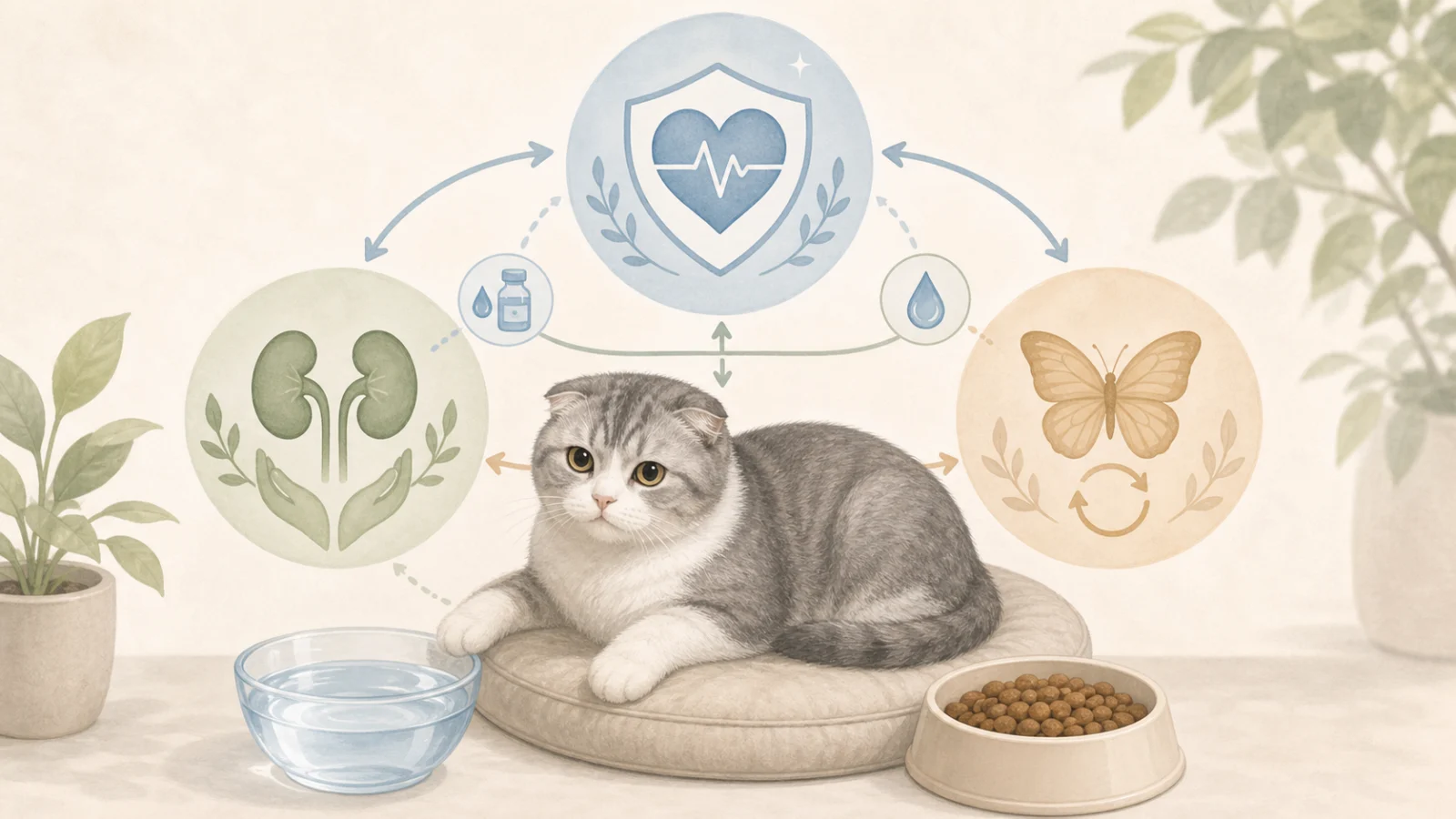
HCM is often found in older cats, and in an old cat's body, diseases rarely arrive alone. The kidneys may already be failing, the thyroid overactive, the blood pressure high — and these conditions make opposite demands. The heart asks for water to be taken away while the kidneys ask for more; the thyroid imitates the heart; hypertension disguises itself as heart disease.
This article is the map of that intersection. It is territory without perfect answers, so the goal is not memorising solutions but understanding the principles of negotiation — what to protect first, what to concede, and where the evidence for each call comes from.
One line — in a crisis, breathing (the heart) comes first; over the long haul, you negotiate with the kidneys.
And the common currency at that negotiating table is always the sleeping breathing-rate log.
1. Three ground rules of the intersection
- ① The disease that kills in minutes goes first — lungs flood on a scale of hours; kidney values worsen on a scale of weeks. When heart and kidneys collide acutely, secure the breathing, then help the kidneys recover
- ② In the chronic phase, trade "perfect" for "balanced" — with two diseases, both textbooks' targets cannot be hit at once. Kidney values held slightly high (permissive azotaemia) can be an intended compromise, not a failure
- ③ Two clinics, one information stream — cardiology at a referral centre, everything else locally is common. Keeping the full med list and latest results in the app, and sharing the whole picture at every visit on both sides, is the caregiver's most important job
2. Heart + kidneys — the water dilemma (the heart of this chapter)
| What the heart (HCM) wants | What the kidneys (CKD) want | |
|---|---|---|
| Water | Less — excess floods the lungs | More — dryness cuts filtration |
| Diuretics | The lifeline of heart failure | Dehydration and reduced flow push values up |
| Subcutaneous fluids | Dangerous — volume overload can trigger failure | The basic tool for correcting dehydration |
| Protein | Enough to protect muscle | Adjusted around phosphorus control |
The working rules of this dilemma:
- Diuretic at "the lowest dose that keeps the lungs dry" — higher doses raise creatinine (2024 data), and the case for reduction is a stable breathing-rate log. Details in Heart failure, section 4
- Subcutaneous fluids by cardiac permit, not kidney routine — what is standard for CKD alone can trigger failure in an HCM heart. Starting, continuing and dosing all require a vet who knows the cardiac stage and atrium; and while fluids are given, a rising breathing rate is the stop signal
- Redraw the kidney scale — for a cat on diuretics, the creatinine target is not "the normal range" but "this cat's stable line without symptoms." Slightly elevated and comfortable beats normal with wet lungs
- Consolidate rechecks — kidneys, electrolytes, blood pressure and urine in one visit; a recheck 1–2 weeks after any diuretic change serves both diseases
- The diet collision — cardiac feeding (ample protein) versus renal feeding (phosphorus restriction) is negotiated in the feeding article, section 6 and the CKD bible's comorbidity article — usually keep the phosphorus control, avoid cutting protein deeply, designed per cat
3. Heart + thyroid — the imitator, unmasked
- Over age 7, "thick heart walls" means check T4 first — hyperthyroidism whips the heart into an HCM-lookalike, and if the thyroid is the cause, the walls can thin again with treatment. The verdict on true HCM belongs to a repeat echo after the thyroid normalises
- Both together is common — if walls remain thick after thyroid control, stage it as concurrent HCM
- The butterfly effect of thyroid treatment — hyperthyroidism artificially props up kidney filtration, hiding CKD. Treat it and the hidden kidney numbers surface — that is disclosure, not deterioration. Comparing creatinine and SDMA before and after is standard, and this is the moment all three axes (heart, thyroid, kidney) are read together
- Severe tachycardia — atenolol may bridge the heart until the thyroid comes under control
4. Heart + hypertension — remove the disguise and the treatment appears
- High pressure also thickens walls — secondary hypertrophy from pushing against resistance. Here the real treatment is not a cardiac drug but amlodipine, and control can improve the walls
- The threshold — systolic 160 mmHg confirmed repeatedly warrants treatment (ACVIM/ISFM). Hypertension strikes eyes (acute blindness), brain and kidneys along with the heart — treating it pays broadly
- The measurement trap — "white-coat" rises of 20–30 from clinic stress are common. Quiet room, settling time, multiple readings; no lifelong prescription from a single 170
- Blood pressure is a standing item for any HCM cat — especially with CKD (hypertension's most common cause) on board
5. Designing the workup when diseases stack — once, together
- One integrated panel — kidneys (creatinine, SDMA, phosphorus, potassium) + T4 + blood pressure + CBC (including NLR·PNR) in one visit, one draw. Separate trips per disease multiply stress, cost and misses
- One recheck calendar — cardiac 3–6 months, renal 1–3, thyroid titration 2–4 weeks… bundle the overlapping cycles into "this cat's months are X and Y" and fix it in the app
- The med list as a living document — more drugs, more interactions. Every new prescription deserves the question "is this safe against the full current list?"
6. When anaesthesia becomes necessary — dental work and beyond
- Cardiac reassessment first — if the last echo is older than ~6 months, discuss updating it; stage and atrial status change the anaesthetic plan (drugs, fluid rates)
- Conservative fluid rates — intra-anaesthetic fluid overload is the classic trap. "Please keep fluids conservative because of the heart" is a sentence a caregiver is allowed to say
- Count the cost of postponing too — dental pain and infection burden the heart through appetite and inflammation (NLR!). "Too scared of anaesthesia, so we left it" is not automatically the safe choice — a prepared anaesthetic often beats neglect
7. What to ask your vet
- "Of heart, kidneys, thyroid and blood pressure, which have we actually checked in this cat? What is missing?"
- "(Heart+kidney) Is this a heart that can take subcutaneous fluids? If so, how much, and what is the stop signal?"
- "(Heart+kidney) Given this creatinine, where do we set this cat's acceptable line?"
- "(On thyroid treatment) When do we re-echo the heart and recheck the kidneys?"
- "Today's blood pressure — how many readings, and what were they? Could this be white-coat effect?"
- "(Before anaesthesia) What is the cardiac preparation and fluid plan?"
8. Related
- Heart failure — the cardiac half of the diuretic tightrope
- The CKD bible: when another disease comes too — the same crossroads, mapped from the kidney side
- Subcutaneous fluids at home — the technique itself
- Blood pressure at home — beating the white-coat effect
- Feeding the heart-disease cat — negotiating the diet collision
One line — when diseases stack, the goal is not "every number normal" but "this cat's point of balance."
Breathing first in a crisis, negotiation with the kidneys over the long haul — and the evidence at that table is the daily breathing-rate log.