Blood pressure — measuring it at home, and trusting the number
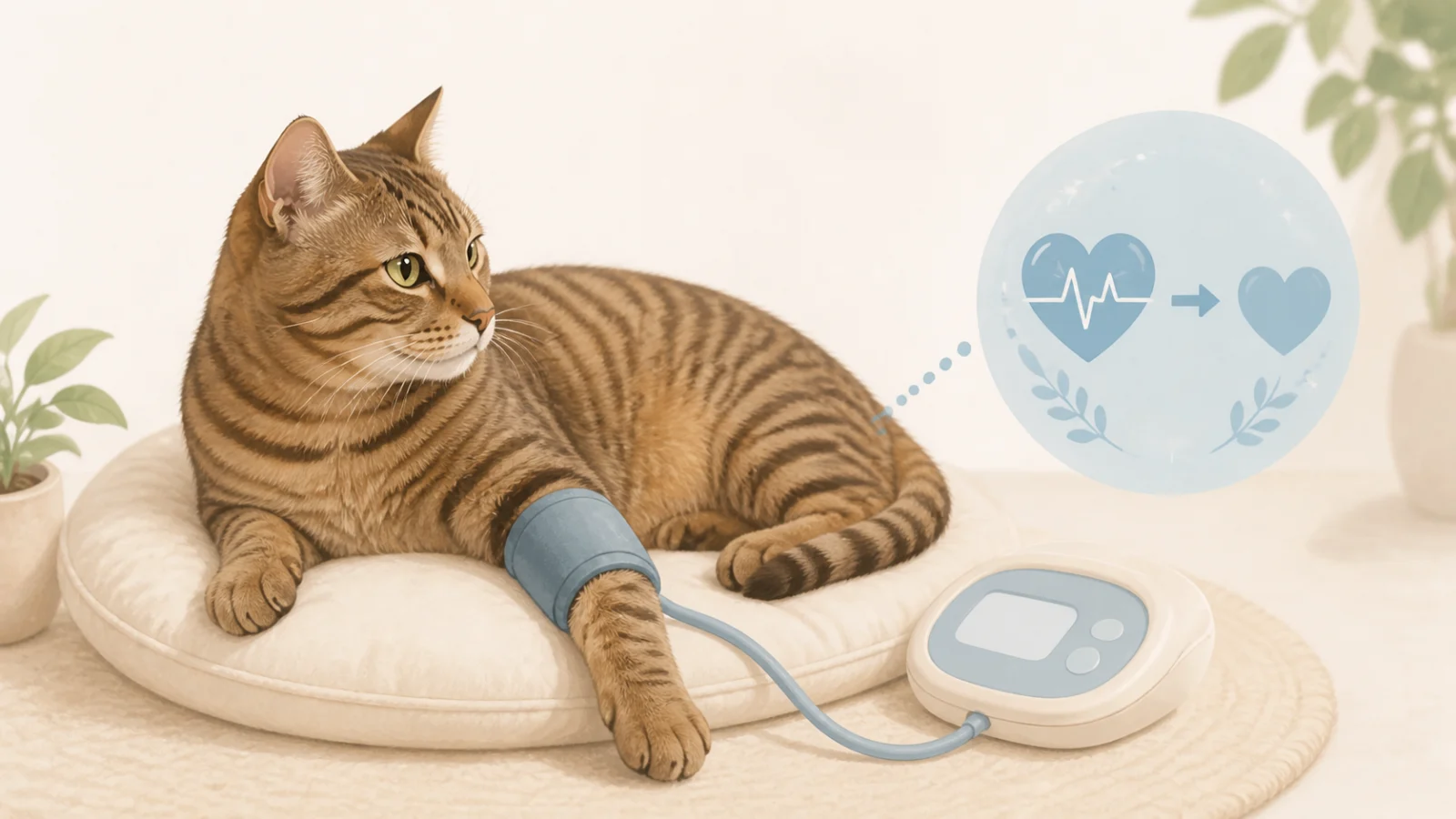
Several chapters in this book tell you to "measure blood pressure." Stage and goals. Proteinuria. Comorbidities.
What nobody explains is how — and once you start measuring, the numbers jump around enough that you don't know whether to believe them.
20–65% of CKD cats are hypertensive. Combine that probability with no symptoms and there is no way to know except to measure.
1. The numbers
Read on systolic pressure. The bands are set by risk of target organ damage.
| Systolic (mmHg) | Class | Organ damage risk |
|---|---|---|
| < 140 | Normotensive | Minimal |
| 140 – 159 | Prehypertensive | Low |
| 160 – 179 | Hypertensive | Moderate — treat |
| ≥ 180 | Severely hypertensive | High — blindness and seizure risk |
The target is under 160. But treatment starts on persistently above 160 — never on a single reading. The next section explains why.
2. Why the clinic number can't be trusted
White coat hypertension. A frightened cat reads far higher than she is. Carried in a box, sitting among unfamiliar smells — of course she does.
Which is why the ACVIM guidelines specify the conditions.
- A quiet room, away from other animals
- Before any other procedure — after a blood draw it's already too late
- After 5–10 minutes of acclimatisation
- With the owner present
- Multiple readings, averaged — the first is usually discarded
Few clinics follow all of this. Simply saying "could you give her a few minutes and take several readings?" changes the number.
3. Two kinds of device
| Doppler | Oscillometric | |
|---|---|---|
| Measures | Systolic only | Systolic, diastolic and mean |
| How | A person listens to flow and judges | The machine reads oscillations automatically |
| Cost | Relatively low | Higher |
| In cats | The reference method | Varies considerably by device and situation |
| Operator skill | Takes practice | Press a button |
Most feline blood pressure research uses Doppler as the reference. The trade-off is that a person has to interpret the sound, which takes practice.
So use the same device for the same cat. Comparing clinic readings with home readings depends on it.
4. Cuff size changes the number
The most common source of error — and rarely explained.
For a foreleg 8 cm around, that's a cuff 2.4–3.2 cm wide.
- Too narrow — reads falsely high
- Too wide — reads falsely low
Fix the site too — foreleg, hindleg or tail, but always the same one. Change the site and the number changes.
5. Measuring at home
The surest way around white coat hypertension is measuring at home. With one honest caveat.
So don't try to make your absolute numbers match the clinic's. The value of home measurement lies elsewhere — in the trend.
Measuring at home shows you things like:
- What her baseline actually is — so when the clinic reads 165 you can say "at home she's always 145"
- Whether a drug brought it down
- Whether a particular drug pushes it up — steroids, erythropoiesis-stimulating agents
How to measure
- Same time, same place, same position
- At least 5 minutes settled beforehand. Right after play is meaningless
- Take 3–5 readings and discard the first. Average the rest
- Drop any reading that jumps sharply — she probably moved
- Record how many readings the average came from
Home readings from a stage 3 cat. Her usual range was 143–157.
Then during a course of erythropoiesis-stimulating injections (DPO), readings ran 168 · 171 · 174 · 178 · 184, and once 196. After the injections stopped, it took 8–10 days to return to 143.
Monthly clinic readings would never show this shape. And knowing the pattern lets you decide when to start the antihypertensive before the next course rather than after.
6. Things that raise it
When a reading is suddenly high, first ask what happened that day.
| Cause | Note |
|---|---|
| ESAs (DPO, EPO) | A hallmark side effect. Persists for days after the injection |
| Steroids | Often in use for IBD or pancreatitis |
| Hyperthyroidism | Treating it can bring blood pressure down too |
| Pain and stress | Travel, strangers, other animals |
| Excess fluids | More circulating volume means higher pressure |
7. The drugs
| Drug | Dose | Where it sits |
|---|---|---|
| Amlodipine calcium channel blocker |
0.625–1.25 mg/cat once daily | First line. The strongest evidence where organ damage or severe hypertension is present |
| Telmisartan Semintra · ARB |
1 mg/kg once daily | Useful when proteinuria is also present. But efficacy has not been shown in severe hypertension or where ocular/CNS damage already exists |
- Expect a drop of about 20–30 mmHg with either
- Reassess at 14 days and adjust
- If amlodipine alone isn't enough, double the dose or add telmisartan
Persistently dilated pupils · bumping into things · sudden fearfulness · visible bleeding in the eye
Retinal detachment becomes irreversible with time. Go the same day.
8. What to ask your vet
- "Please include blood pressure today — before other procedures, after she's settled, several readings if possible"
- "Is this Doppler or oscillometric? I'd like the same method next time"
- "How many readings is this averaged from? Was the first discarded?"
- "At home she runs about 145 and today it's 165. Which should we act on?"
- "Could you do a fundic exam? I'd like to know whether the eyes are already affected"
- "If we start a drug, when do we recheck?"
- "Is anything she's currently taking raising her blood pressure?"
Added note · Attach the conditions to each BP reading
Below the average, note location, device, site, cuff, posture and medication time. A photo of cuff placement can help reproduce the setup. Recording measurement conditions is part of consensus guidance. ACVIM guidance
Include the time of pre-visit gabapentin. A 2024 study observed lower BP after its administration. Gabapentin/BP study Tagging those visits keeps the number connected to its context.
One next step: reuse a short note template at the next measurement. On a markedly different day, add medication changes, pain or travel stress. Your observations supply the part of the day that the measurement alone cannot describe.
9. Related
- Stage and goals — blood pressure is a substage attached to the stage
- Proteinuria — why UPC 0.4 is the line — why blood pressure comes first
- Subcutaneous fluids, safely at home — fluids raise blood pressure
- When another disease comes too — thyroid, heart and blood pressure