Proteinuria — why UPC 0.4 is the line
There's a value on the lab report that quietly gets skipped: UPC.
Take two cats with the same creatinine. Same stage, similar phosphorus. But one has a UPC of 0.15 and the other 0.6.
At the same stage, with the same creatinine.
And yet it often isn't measured unless you ask. And it can be treated. Those two facts are why this chapter exists.
1. Proteinuria is both a result and a cause
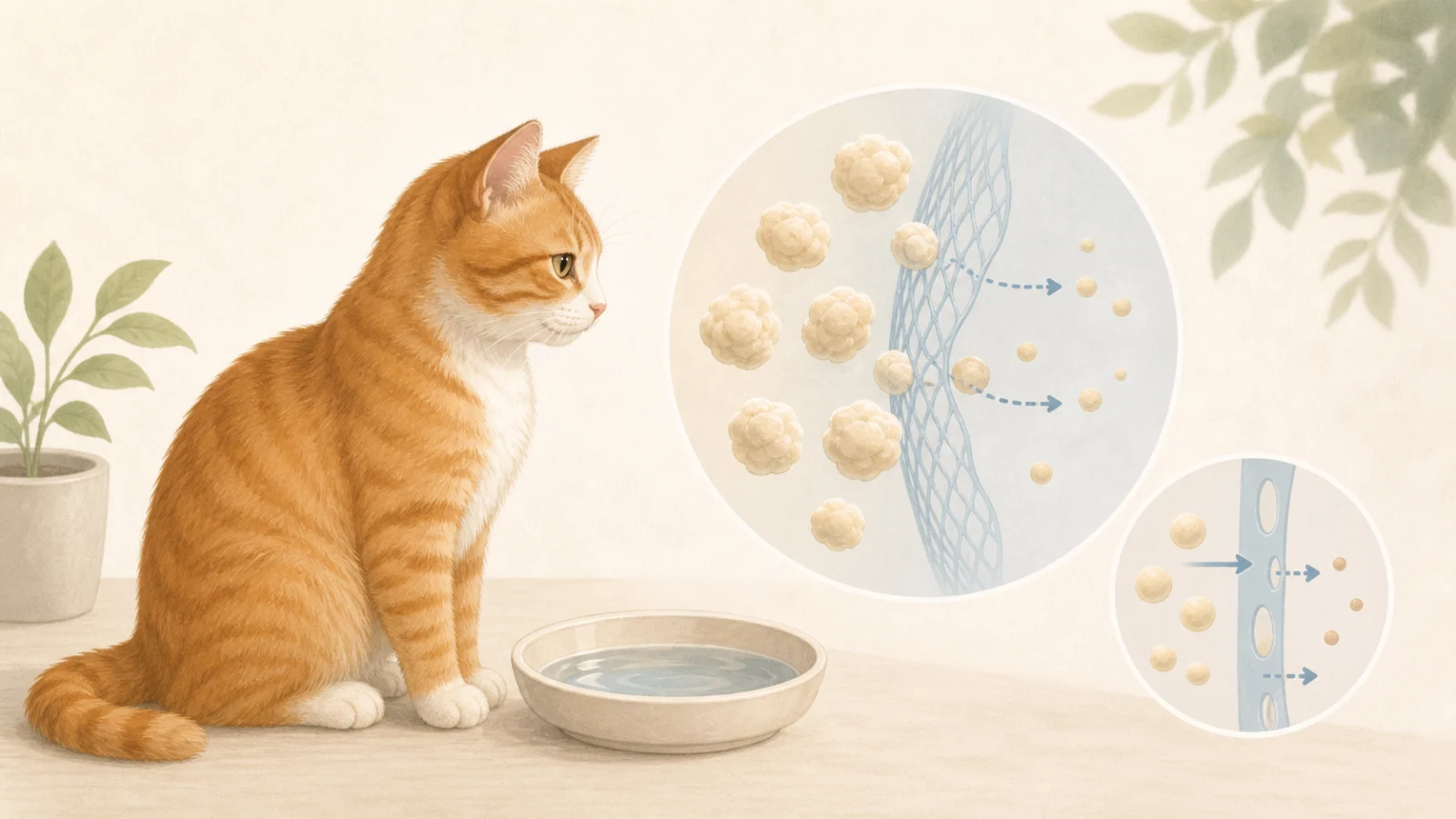
A healthy filtration barrier does not let protein through. Large molecules like albumin are meant to stay in the body.
When that barrier is damaged, protein leaks out. So far this is a consequence of kidney damage.
The problem is what happens next. The leaked protein passes through the tubules and damages them in turn. Inflammation follows, then fibrosis.
That's why proteinuria is treated as an independent risk factor — separate from stage, it pushes progression by itself.
Which is exactly why it's worth treating. If it were only a consequence there'd be nothing to do; because it's also a cause, the loop can be broken.
2. Reading the number
UPC = urine protein ÷ urine creatinine. Because it's a ratio, it holds whether the urine is concentrated or dilute — so it can be compared across visits.
| UPC (cats) | Class | Meaning |
|---|---|---|
| < 0.2 | Non-proteinuric (NP) | Normal |
| 0.2 – 0.4 | Borderline (BP) | Repeat and watch the trend |
| > 0.4 | Proteinuric (P) | Treat, regardless of stage |
3. This number moves more than you'd think
This is the most practical part of the chapter. UPC should never be judged on a single measurement — and the reasons are specific.
① Change the collection method and the number changes
A 2023 study compared cystocentesis with home-collected urine in the same cats.
The authors concluded that home collection is a valid alternative, but that the same method should be used for the same cat every time.
So if last time was cystocentesis at the clinic and this time you brought a home sample, you can't tell a real rise from a method change.
② A trace of blood raises it
Even microscopic haematuria significantly raises UPC. Cystitis, stones, or irritation during collection all count.
Which is why sediment analysis must be run alongside. If red cells, white cells or bacteria show up, that UPC may not be about the kidney at all.
③ The same cat varies day to day
There's genuine biological variation. This is why IRIS asks for two or more measurements at least two weeks apart to establish persistence.
① With sediment analysis (rule out infection and blood)
② By the same collection method
③ Two or more times, at least two weeks apart
One reading of 0.5 is not enough to start medication on.
4. Causes other than the kidney
Proteinuria comes from three places. Rule out the last two before calling it renal.
| Origin | What | How to tell |
|---|---|---|
| Pre-renal | Too much protein in the blood itself (uncommon) | Serum protein, electrophoresis |
| Renal | Damaged filtration barrier — what this chapter is about | What remains after excluding the other two |
| Post-renal | Cystitis, stones, UTI, collection trauma | Sediment, urine culture |
CKD cats commonly carry silent urinary tract infections. If proteinuria is newly found, ask for a urine culture too. If it's infection, that's a course of antibiotics — not a lifetime of medication.
5. Without blood pressure, you only have half the picture
Hypertension raises glomerular pressure and generates proteinuria directly. And 20–65% of CKD cats are hypertensive.
So there's an order.
- Measure blood pressure first
- If hypertensive, treat that first — proteinuria often falls on its own
- If blood pressure is normal and proteinuria persists, then consider antiproteinuric drugs
6. The drugs — telmisartan and benazepril
Both suppress the RAAS hormone axis, lowering pressure inside the glomerulus. Less pressure, less leakage.
| Drug | Dose | Notes |
|---|---|---|
| Telmisartan Semintra · ARB |
1 mg/kg once daily PO | Liquid, so easy to give. Licensed for feline proteinuria in several markets |
| Benazepril ACE inhibitor |
0.5–1 mg/kg once daily PO | Long track record. Tablets, so cheaper |
In practice, the one you can actually get into the cat usually wins.
Non-negotiables when starting
They lower glomerular pressure — and if blood volume is already low, filtration collapses and acute kidney injury follows. On days with vomiting or diarrhoea, and around anaesthesia, discuss pausing them.
- Start only when hydration is stable
- Recheck 5–7 days after starting — creatinine and potassium
- If creatinine jumps, reduce or stop
- Potassium can rise — these are the drugs mentioned in the potassium chapter
7. Diet and protein
A misunderstanding lives here. "She has proteinuria, so cut the protein" is the wrong direction.
Protein leaks because the barrier is damaged, not because she eats too much of it. If anything, proteinuria means albumin is continuously being lost, so she runs short.
Omega-3 (EPA/DHA) has evidence for helping proteinuria, which is why renal diets generally include it.
8. What you can do at home
Proteinuria has no symptoms. So your job is to make sure it gets measured.
- Ask for UPC by name at rechecks — it's often not in the default panel
- Keep the collection method consistent. If you've chosen home collection, stay with it. Non-absorbent litter works
- Watch for blood in the urine. If there was haematuria the day before, say so
- Ask for blood pressure at the same visit
- If a drug is started, book the 5–7 day recheck before you leave
9. What to ask your vet
- "Can we run a UPC? I understand proteinuria changes the prognosis"
- "Please include sediment analysis — it could be infection or blood"
- "UPC came back above 0.4 — should we repeat in two weeks to confirm it's persistent?"
- "What's her blood pressure? I read that treating that first can bring proteinuria down"
- "If we start a drug, is telmisartan or benazepril better for her?"
- "Should I keep giving it on a day she's dehydrated? Please give me a threshold for stopping"
- "When do we recheck after starting? Please include creatinine and potassium"
Added note · Make the size of a UPC change visible
Add the change from the previous result. Hypothetically, 1.0 to 0.6 is a reduction of 0.4, or 40% from baseline. Continue the series to see whether it persists. Attach collection method and sediment results to each point; consistent collection improves comparability. Feline sampling study
Mark medication starts and adjustments on the same graph. Use a different symbol when the collection method changes so the comparison conditions remain visible.
One next step: gather the latest two UPC results with dates, collection methods and nearby BP measurements. Repeated bundles provide a useful account of your cat’s response.
10. Related
- Stage and goals — proteinuria is a substage attached to the stage
- How to read kidney values on a blood test — why albumin matters here
- Potassium — dangerous high and low — these drugs raise potassium
- Getting the most from your vet — when and how often to run UPC