Blood pressure drugs — amlodipine and telmisartan, who does what
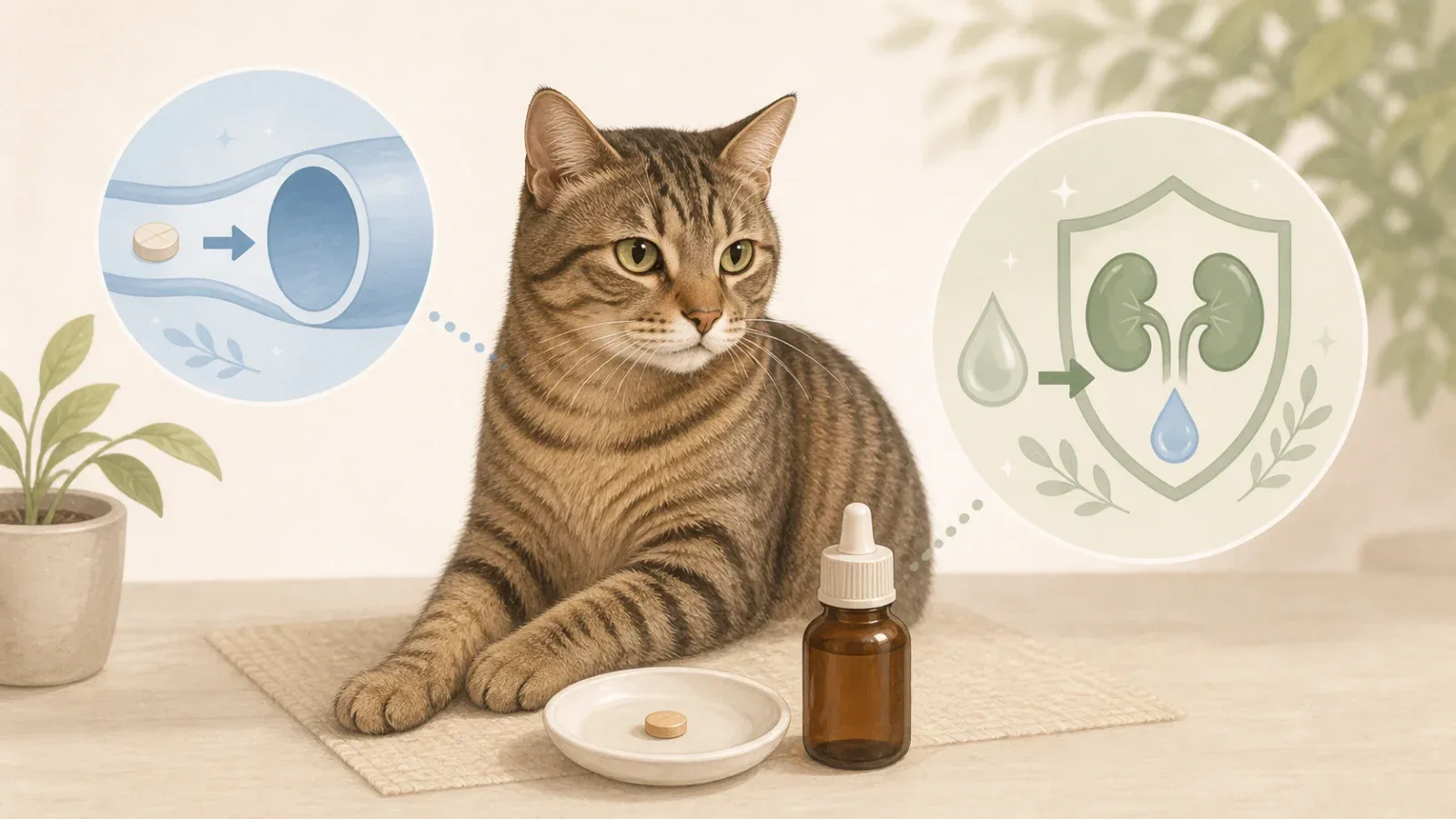
When blood pressure stays above 160 or proteinuria shows up, you will hear one of two names in the exam room: amlodipine, or telmisartan (brand name Semintra).
And that is where the first confusion starts. "If they're both blood pressure drugs, why are there two? Why is my cat on this one?" Some cats take one, some take both. This chapter sorts out who does what.
1. Why two drugs — they do different things
| Amlodipine | Telmisartan (Semintra) | |
|---|---|---|
| Class | Calcium channel blocker (CCB) | Angiotensin receptor blocker (ARB) |
| How it works | Widens blood vessels to drop pressure | Blocks the hormone system (RAAS) that squeezes the kidney |
| Best at | Reliably lowering high pressure | Reducing proteinuria, plus moderate BP control |
| Size of BP drop | Large (30–50 mmHg in responders) | Moderate (about 20–25 mmHg) |
| Typical scenario | SBP ≥180, risk to eyes/brain | Proteinuria (UPC>0.4), moderate hypertension |
For feline hypertension there are essentially only two accepted monotherapies — these two (ACVIM 2018). ACE inhibitors like benazepril, common in people, are comparatively weak on feline blood pressure and rank lower for that purpose.
2. Amlodipine — the drug that reliably lowers pressure
It is the first choice when systolic pressure persistently exceeds 180, or when eye or neurologic signs are already present. The reason is simple: its effect is the largest and the most predictable.
- Dose — usually started at 0.625mg per cat, up to 1.25mg if needed; roughly 0.2–0.4 mg/kg once daily, cautiously up to 0.6 mg/kg
- Onset — within days. Recheck at 7–14 days after starting
- Tolerability — clinically favored in cats because it rarely causes hypotension
Side effects are few. Gingival overgrowth and peripheral edema are reported rarely. Since this is a long-term drug, ask the vet to look at the gums during dental visits.
3. Telmisartan — the proteinuria drug that is also a second BP drug
Known as Semintra (10mg/ml oral solution). The key to this drug is that it has two doses:
| Purpose | Dose | Evidence |
|---|---|---|
| Reducing proteinuria | 1 mg/kg once daily | EU-licensed dose. Superior UPC reduction versus benazepril in a comparison trial (Sent 2015) |
| Treating hypertension | US label: 1.5 mg/kg twice daily × 14 days → 2 mg/kg once daily EU trials: 2 mg/kg once daily | The first FDA-approved drug for feline hypertension (2018). Placebo-controlled RCT: −23.3 vs −7.5 mmHg at day 14 (Coleman 2019); long-term control confirmed (Glaus 2019) |
So if your cat is on Semintra, the dose tells you the goal. Near 1 mg/kg it is aimed at proteinuria; near 2 mg/kg it is also aimed at blood pressure.
Being a liquid, it suits cats who refuse pills, and mixes easily into food. Some cats have vomiting or soft stool at first; it usually passes within days.
4. Which drug first
Two numbers — blood pressure and UPC — decide.
| Situation | Typical choice | Why |
|---|---|---|
| SBP 160–179, no proteinuria | Amlodipine or telmisartan | Both accepted as monotherapy; telmisartan alone is often enough for moderate cases |
| SBP ≥180, or eye/neurologic signs | Amlodipine | Largest drop — organ damage must be stopped fast |
| Proteinuria (UPC>0.4), normal BP | Telmisartan | Reducing proteinuria is this drug's main job |
| Both present | Depends on severity — severe hypertension gets amlodipine first, telmisartan added later | Put out the fire (pressure) first; protect the kidney (proteinuria) alongside |
5. Combination — the problem of amlodipine waking up RAAS
Some cats do not reach target on amlodipine alone. Rather than pushing amlodipine ever higher, telmisartan is often added — and the foreshadowing from section 2 pays off here.
- Amlodipine widens the vessels → the body turns RAAS up harder
- Activated RAAS raises glomerular pressure and can worsen proteinuria
- Telmisartan blocks exactly that RAAS
So this combination is not an accident — each drug covers the other's blind spot. One lowers the pressure; the other switches off the bad reflex that lowering it turned on.
6. A real record — watching the drug work in numbers
From the records of our lab's stage-3 CKD cat (17 years old). Proteinuria climbed over months to a UPC of 2.2; Semintra was started five days later.
| When | UPC | Note |
|---|---|---|
| December | 0.8 | Rising |
| Early February | 1.1 | |
| February 20 | 2.2 | Peak |
| February 25 | — | Semintra started |
| May 23 | 1.2 | −45% in three months |
Not a cure — 1.2 is still proteinuric (above 0.4). But the number is answering the question "is the drug working." A drop of nearly half counts as a treatment response.
7. Monitoring — the real work starts after starting
- Recheck at 7–14 days after starting or changing dose — blood pressure, and UPC where relevant
- A small creatinine rise is expected — RAAS blockers lower glomerular pressure, so values may rise slightly (roughly within 30%) at first. More than that, call the vet
- Check potassium — RAAS blockers push potassium upward. As covered in the potassium chapter, high is also a problem — add it to the recheck panel
- Signs of hypotension — wobbliness, sudden lethargy, collapse; especially on combination therapy or when dehydrated. Call the same day
① Starting a RAAS blocker (Semintra) during dehydration or an acute crisis — the rule is to pause during decompensation. Always decide with your vet.
② Stopping on your own because "the pressure looks good now" — these drugs do not cure; they hold. Stop, and it comes back.
8. What to ask your vet
- "Is this drug for blood pressure or for proteinuria? If it's Semintra — which dose range are we on?"
- "When do we recheck after starting? Will that visit include blood pressure, creatinine and potassium?"
- "If amlodipine alone doesn't control it, would you raise the dose or add telmisartan?"
- "Her UPC is (say the number) — is it time to start a RAAS blocker?"
- "She hasn't been eating well lately — is this a safe time to start this drug?"
Added note · Photograph the concentration on a new bottle
Record product, mg/mL, prescribed mL and daily frequency with a bottle photo. Semintra has 4 mg/mL and 10 mg/mL formulations. UK official product information
For arithmetic only, 0.5 mL contains 2 mg at 4 mg/mL, but 5 mg at 10 mg/mL. These are not prescribed doses; they explain why equal volumes can contain different amounts. Confirm the new bottle’s instructions and update the record from that date.
One next step: distinguish planned from actual administration times, noting spit-out or vomited doses. At BP/UPC review, this makes actual treatment delivery visible alongside the results.
9. Related
- Blood pressure — measuring at home — before the drug, learn to trust the number
- Proteinuria — why UPC 0.4 is the line — what telmisartan is protecting
- Potassium — a problem high or low — RAAS blockers and potassium
- When another disease comes too — thyroid and heart crashing the blood pressure party