

Stage and goals — where your cat stands now
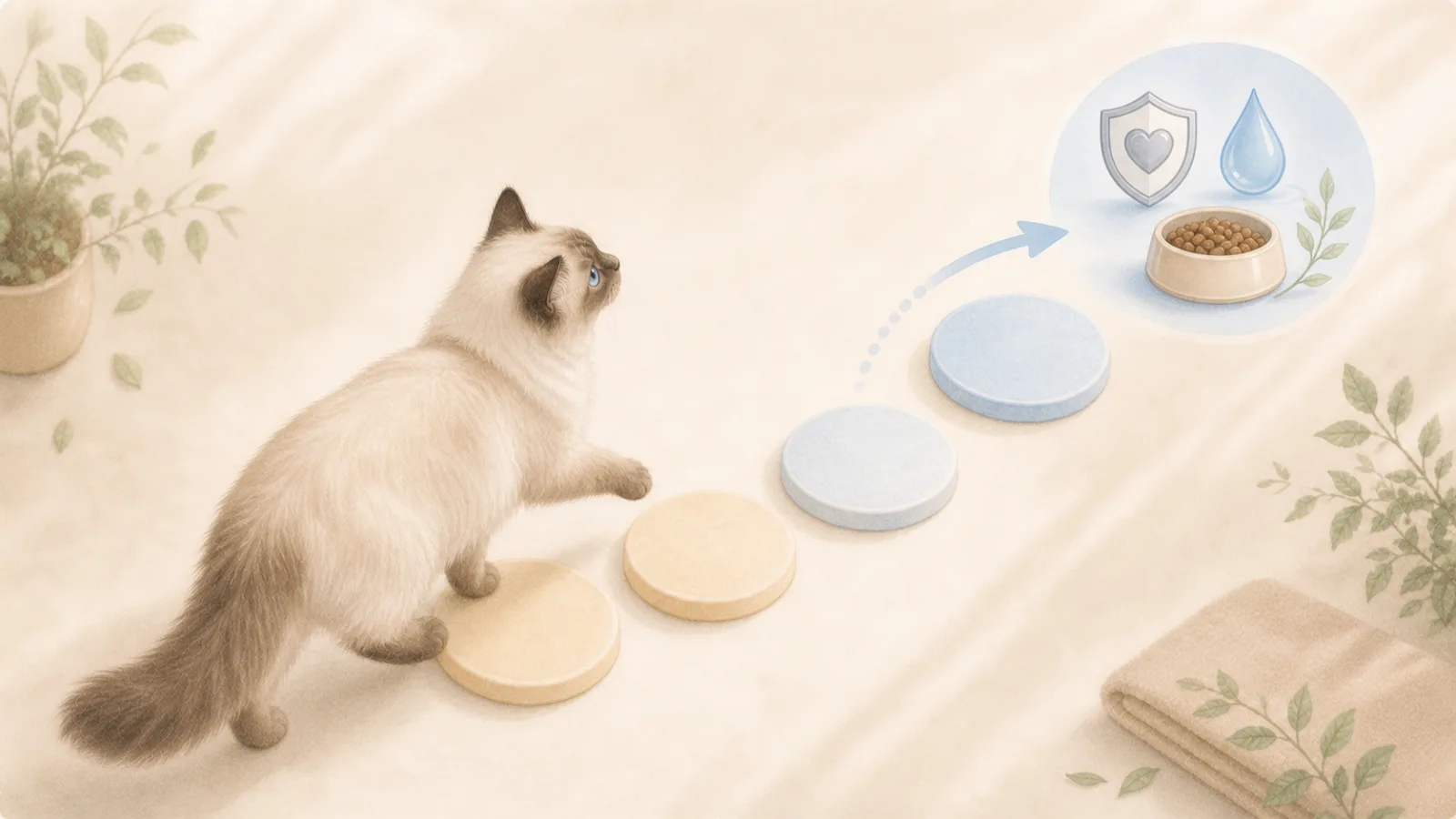
Hearing "she's stage 3" lands like a report card. There's a stage 4, so it feels near the end, and the number starts to feel like remaining time.
But staging isn't a report card — it's an instruction sheet. It was not built to rank how bad things are; it was built to decide what to do now. This chapter is about using it that way.
1. How the stage is determined
IRIS staging is set by creatinine and SDMA. The numeric bands are in the previous chapter.
The rule where SDMA raises the stage
Creatinine and SDMA frequently point to different stages. IRIS is explicit that in that case you follow SDMA.
| If this is the case | Stage it this way |
|---|---|
| Creatinine is in the stage 1 band (< 1.6) but SDMA is persistently above 18 |
Stage and treat as stage 2 |
| Creatinine is in the stage 2 band (1.6–2.8) but SDMA is persistently above 25 |
Stage and treat as stage 3 |
The rule exists because creatinine reads falsely low when muscle mass falls. It matters most in older cats who have lost condition, and in cats whose muscle has been burned off by hyperthyroidism.
IRIS asks for two or more measurements in a stable, hydrated patient with no acute decompensation. Values drawn from a dehydrated cat read high, and staging on them puts her a full stage too high.
2. The two letters after the stage — substaging
This is what most owners miss. IRIS staging doesn't end with a number. Two more things attach to it.
- Proteinuria — is protein leaking into the urine?
- Blood pressure — is there hypertension?
At the same stage 3, a cat with proteinuria and hypertension and a cat with neither have different outlooks. And both of those can be treated. The stage can't be reversed; these two can be acted on.
Substage ① Proteinuria (UPC)
Measured as the urine protein-to-creatinine ratio.
| UPC (cats) | Classification |
|---|---|
| < 0.2 | Non-proteinuric (NP) |
| 0.2 – 0.4 | Borderline (BP) |
| > 0.4 | Proteinuric (P) — needs managing |
- Proteinuria is an independent risk factor for progression. At the same creatinine, the higher UPC deteriorates faster
- Not judged on one sample — confirm on two or more at least two weeks apart to establish persistence
- If persistent, an ACE inhibitor (benazepril) or ARB (telmisartan) is considered
- Where there is proteinuria, also check whether a urinary tract infection is hiding behind it
Substage ② Blood pressure
Read on systolic pressure, banded by risk of target organ damage.
| Systolic (mmHg) | Classification | Organ damage risk |
|---|---|---|
| < 140 | Normotensive | Minimal |
| 140 – 159 | Prehypertensive | Low |
| 160 – 179 | Hypertensive | Moderate — treat |
| ≥ 180 | Severely hypertensive | High — risk of blindness and seizures |
Persistently dilated pupils, bumping into things, or new fearfulness — get it checked immediately.
The target is systolic under 160.
3. What actually changes as the stage advances
This is where staging earns its keep. It isn't the number that changes — it's the work.
| Stage 1–2 | Stage 3 | Stage 4 | |
|---|---|---|---|
| Central task | Slow progression | Manage complications | Symptom control · quality of life |
| Recheck interval | 3–6 months | 2–3 months | 1–2 months or more often |
| Diet | Lower phosphorus first don't over-restrict protein | Renal diet seriously considered | Eating comes first |
| Phosphate binder | If phosphorus is above target | Usually needed | Needed, but palatability wins |
| Subcutaneous fluids | Usually not needed | Considered from late stage 3 | Usually needed |
| Anemia | Uncommon | Start watching | Active treatment considered |
| BP · proteinuria | Checked and treated at every stage, regardless | ||
Restricting protein prematurely at this point costs lean muscle mass, and that makes her decline faster. Lost muscle also drags creatinine down falsely, which then makes the status easy to misread.
The priority here is phosphorus restriction, not protein restriction — see stage-by-stage diet strategy.
4. How long does she have?
The first thing everyone searches, and the least useful search there is.
CKD is now a common disease. Most clinics know how to manage it, and the range of genuinely useful drugs and supplements keeps growing. Found very late or left untreated, it can be short — but most cats go on for months to years.
The median in a survival study is an average across hundreds of cats, and the spread inside it is enormous. A cat with months and a cat with years sit in the same row of the same table.
Where your cat falls within that average is not something the table can tell you.
More important than the number — the slope
What actually speaks to prognosis is not one measurement but the rate of change.
- Creatinine essentially unchanged over a year is a good sign, whatever the stage
- Skipping a whole stage in a few months warrants concern even at a low stage
- Which is why measuring consistently in one place beats moving between clinics
5. So what is the goal?
That single sentence is the baseline for this entire book, and having it makes decisions easier.
- Be sceptical of anything promising to return the values to normal. Nephrons don't regenerate
- A choice that improves numbers while making her miserable is off-target
- Slightly worse numbers with good eating and good spirits is not a failure
Concretely, aim for these.
- Phosphorus within the target for her stage (the best-evidenced intervention there is)
- Blood pressure under 160
- Proteinuria reduced, if present
- No dehydration
- Weight and muscle held — never starve her
6. What to ask your vet
- "What stage is she? Is that on creatinine or on SDMA?"
- "Was this stage set on two measurements in a stable state?"
- "Can we run a UPC? I understand proteinuria changes the treatment"
- "Please take her blood pressure today — after she's settled, several readings if possible"
- "At this stage, what should we address first?"
- "Compared with last year, is she progressing fast or slow?"
7. Related
- How to read kidney values on a blood test — the staging table and phosphorus targets
- What the kidneys actually do — why it can't be reversed
- Stage-by-stage diet strategy — once the stage is set, the diet follows
- Getting the most from your vet — recheck intervals and tests by stage