

Acute kidney injury vs chronic kidney disease — what differs
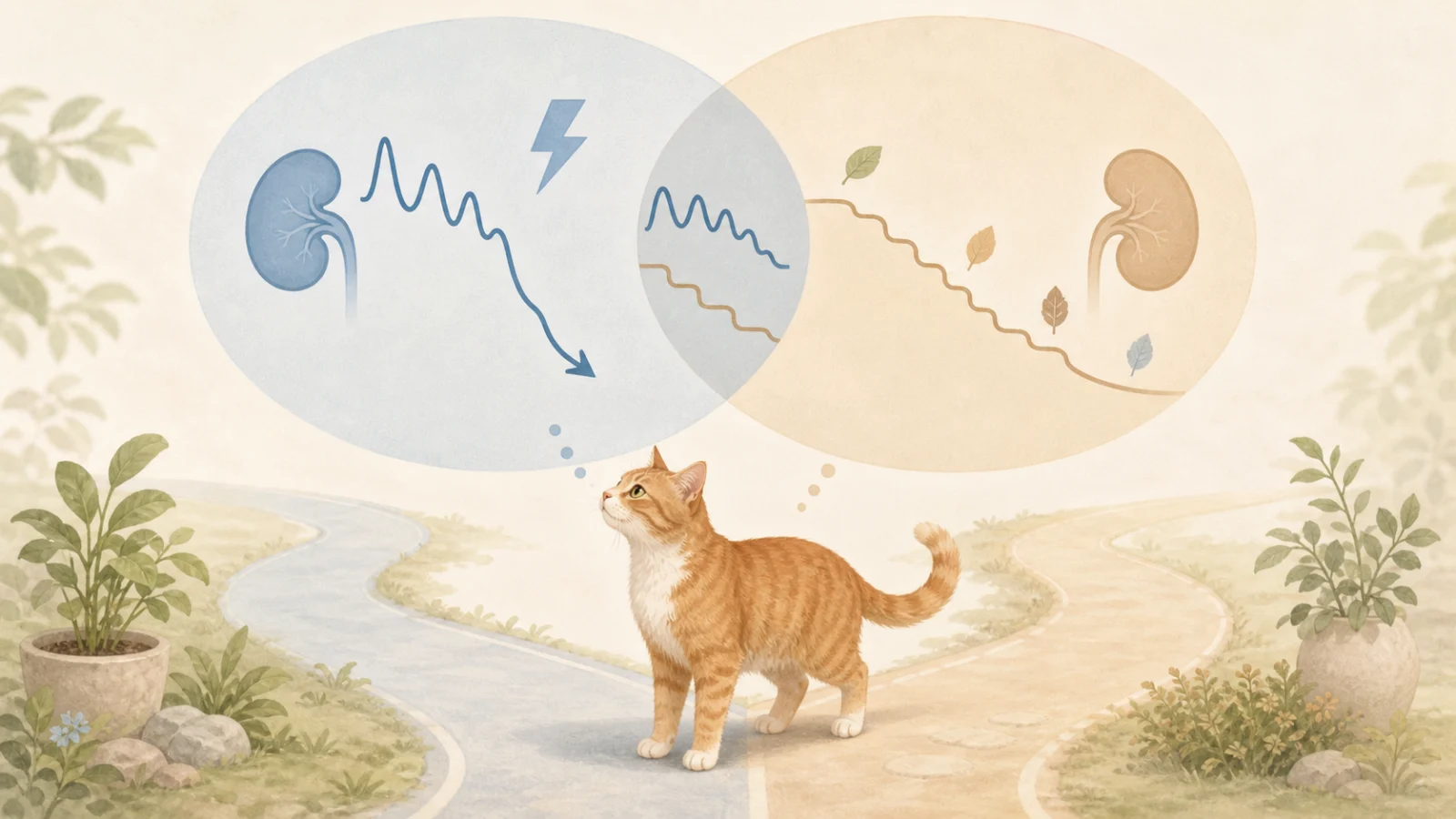
AKI or CKD in a cat: start with the timeline
Acute kidney injury (AKI) develops over a short period. Chronic kidney disease (CKD) is persistent kidney disease. A cat with CKD can also develop an acute problem on top of it — an acute-on-chronic episode.
A single high creatinine result does not tell you which pattern your cat has. Earlier blood tests, changes in eating and drinking, urine findings and imaging help build that picture. Gather previous results and note when the change began; these are useful even if the earlier test was normal.
Compare AKI and CKD · Clues that help tell them apart · When both occur together · Coming home after AKI
Understand the kidney values in your cat’s recorded blood tests. This supports understanding the results; it does not classify AKI or CKD automatically.
"The kidneys aren't doing well" actually covers two entirely different diseases. One is acute kidney injury (AKI) — it unfolds over days and decides life or death. The other is chronic kidney disease (CKD) — it advances slowly over years. The creatinine on the report may look identical, but what the next few days hold, and what you can hope for, could not be more different.
This article lays out the difference, how the clinic tells them apart, and the moment they overlap — the acute crisis that can hit a CKD cat. Most of this bible is about CKD; this article draws its outer boundary.
1. The core difference — time, and whether it can be undone
| Acute kidney injury (AKI) | Chronic kidney disease (CKD) | |
|---|---|---|
| Time scale | Hours to days | Months to years |
| What happens | Healthy kidneys stop suddenly — toxin, blockage, loss of blood flow, infection | Nephrons (filtering units) are lost slowly and permanently |
| Reversible? | Possibly — remove the cause fast and function can return | No — the goal is to protect what remains |
| Classification | IRIS grade I–V | IRIS stage 1–4 |
| Goal of the first days | Survival — hospital, IV fluids, remove the cause | Understanding — confirm the stage, diet and water, plan rechecks |
| What decides prognosis | The cause, how fast it was caught, whether urine is being made | Stage, proteinuria, blood pressure, phosphorus, weight trend |
The same "creatinine 5.0" means, in AKI, a kidney that was normal two days ago and has now stopped; in CKD, a kidney that took years to get here, with a body that has partly adapted. That is why acute cats often look far sicker than their numbers, and chronic cats look far better than theirs.
2. Acute kidney injury — the cause is the prognosis
Acute injury has three origins. Before the kidney (no blood flow — severe dehydration, low pressure under anaesthesia, heart failure), the kidney itself (toxins, infection, inflammation), and after the kidney (urine cannot leave — ureteral or urethral blockage). The causes seen most often in cats, with their outcomes:
| Cause | How it happens | Reported survival |
|---|---|---|
| Lily toxicity | Licking a flower, leaf, pollen or the vase water is enough. Uniquely lethal to cats | 87–100% — if treatment starts within 18 hours. Falls sharply after that |
| Ethylene glycol (antifreeze) | Sweet taste invites licking; tiny amounts are fatal | About 8% — the worst of feline AKI |
| NSAIDs | Human painkillers (ibuprofen etc.), or veterinary NSAIDs given to a dehydrated cat | Varies widely with dose and hydration |
| Ureteral stone obstruction | A kidney stone lodges in the ureter and urine cannot drain | About 90% discharged after SUB placement. Medical management alone clears only 23% of stone obstructions |
| Pyelonephritis (kidney infection) | Bladder bacteria climb upward. Common in CKD and stone-forming cats | About 90% discharged, about 46% alive at 1 year — better than other causes; responds to antibiotics (pyelonephritis box in section 5) |
| Ischaemia (anaesthesia, shock, severe dehydration) | Too long without enough blood reaching the kidney | Depends on duration and underlying disease |
Across all causes, feline AKI mortality is 53% (meta-analysis of 401 cats, 2018). Half are lost — but half come home, and what separates the halves is usually cause and speed. So when acute injury is suspected, the first question is not "how high is the number" but "what caused it, and can we remove that now?"
3. Chronic kidney disease — irreversible, but manageable
CKD is what the rest of this bible covers, so here only the contrast with AKI. A dead nephron does not regrow. The survivors take on more work, so bloodwork barely moves until more than two-thirds of function is gone. "Diagnosis day" is therefore not the day the disease began — it is the day it could no longer hide.
In return, CKD has something AKI never offers: time. Know the stage (stages and targets), then work one by one on the variables that change the speed — phosphorus, blood pressure, proteinuria, weight — and many cats spend years in stage 2–3. Where AKI is "decided within days", CKD is "adjusted a little every month".
4. How the clinic tells them apart — clues beyond the report
A single creatinine cannot separate acute from chronic. What the clinic looks for are traces of how long the kidney has been in this state.
| Clue | Suggests acute | Suggests chronic |
|---|---|---|
| History | Fine until days ago. Toxin, new drug, anaesthesia, outdoor access | Drinking and urinating more for months, gradual weight loss |
| Weight and muscle | Preserved (no time to lose it) | Weight loss, muscle wasting, dull coat |
| Kidney size (ultrasound) | Normal to enlarged, swollen, fluid around it | Small and irregular, bright (hyperechoic) |
| Anaemia | Usually absent | Non-regenerative anaemia (EPO production has been low for a long time) |
| Potassium | High (especially when no urine is made) | Low or normal (low potassium is more common through stage 3) |
| Urine output | Often reduced or absent (oliguria/anuria) | Often increased (cannot concentrate) |
| Previous results | Last test was normal | SDMA and creatinine had been creeping up for a while |
5. When they overlap — acute-on-chronic kidney disease (ACKD)
For CKD caregivers, this is the section that matters most. A cat with chronic kidney disease can still suffer a separate acute injury. This is called acute-on-chronic kidney disease (ACKD). A kidney with no reserve takes an acute hit — dehydration, a stone, an infection — and collapses under far less force than a healthy one would.
In a study of 100 ACKD cats (Chen 2020) the causes were unknown 66% · ureteral obstruction 11% · ischaemia 9% · pyelonephritis 8%, and 58% survived to discharge — similar to pure AKI (about 53%). In other words, the acute component can be reversed even in a chronic cat. But median survival after discharge was 66 days, and each 1.0 mg/dL of creatinine at discharge raised the risk of death 1.43-fold — the stage effectively rises by whatever the acute hit destroyed for good.
Common triggers: dehydration (heat, vomiting, diarrhoea, skipped fluids), ureteral stones (stones article), pyelonephritis, anaesthesia or surgery, NSAIDs, hypertensive crisis, pancreatitis. The first three are fixable if found.
This study followed 54 cats with suspected pyelonephritis at one Australian referral hospital for up to eight and a half years (Fletcher 2026). Cats were included when urine drawn from the bladder by needle (cystocentesis) grew bacteria, kidney values were newly raised or rising, and signs and lab findings fitted. Mean age was 11.6 years, 70% were female, and more than half (53%) already had CKD.
| Time point | Still alive |
|---|---|
| Discharge | 91% |
| 1 month | 74% |
| 3 months | 67% |
| 6 months | 52% |
| 1 year | 46% |
| Median survival | 390 days |
- It often arrives without urinary signs. The commonest signs were poor appetite (87%), lethargy (72%) and vomiting (53%). Lower urinary signs such as straining were seen in only 43%, and fever in only 25%. When a CKD cat suddenly stops eating and goes quiet, that is reason to check for infection with a cystocentesis urine culture even if nothing looks wrong with urination. The sample needs to be taken before antibiotics start, or the bacteria may not grow.
- Pre-existing CKD did not change survival. The 28 cats with CKD did not survive differently from the rest. Compared with the 66-day median survival after discharge in the mixed-cause acute-on-chronic study above, pyelonephritis looks more like an acute crisis you can find and treat. CKD stage, however, was not analysed separately.
- A creatinine fall of more than half in hospital is a good sign. Cats whose creatinine fell by more than 50% between admission and discharge (median stay 2 days) had a median survival of 774 days; those with a smaller fall or a rise had a higher risk of death. Cats alive at 30 days had a median fall of 31%, those that died within 30 days only 13%. How many times higher the risk is cannot be trusted, because the small numbers made the estimate swing from hundreds to hundreds of thousands; only the direction is reliable.
- The first month is the danger period. Most kidney-related deaths came within the first 100 days, and 13 cats died within 30 days. Compared with cats that passed the 30-day mark:
| At admission | Alive at 30 days (40 cats) | Died within 30 days (13 cats) |
|---|---|---|
| Body temperature | 38.5 °C | 37.5 °C (hypothermia below 36.7 °C in 31%, vs 3%) |
| Weight loss | 10% | 39% |
| Creatinine (admission → discharge or euthanasia) | 2.8 → 2.2 mg/dL | 5.3 → 6.5 mg/dL |
| BUN | 42 mg/dL | 126 mg/dL |
| Phosphorus | 4.6 mg/dL | 11.5 mg/dL |
| Urine specific gravity | 1.020 | 1.014 |
| Heart disease or hypertension | 3% | 39% (too few cats to rely on) |
- Bacteria and antibiotics. E. coli made up 57% of isolates, Enterococcus 18% and Proteus 10%. Which antibiotic was used was not linked to survival, and the median course was 14 days. Resistance differs by region, though: at this Australian hospital 93% of isolates were susceptible to amoxicillin-clavulanate, while in a US study of 32 cats (Whitehouse 2024) E. coli was resistant to it. That is why matching the drug to culture and susceptibility results matters.
The studies so far in one table
| Study | Cats | Findings |
|---|---|---|
| Chen 2020 | 100 cats with acute-on-chronic CKD (mixed causes, 8% pyelonephritis) | 58% discharged; median survival after discharge 66 days |
| Whitehouse 2024 | 32 cats with suspected pyelonephritis, 2 US teaching hospitals | 14 of 20 with follow-up alive at 3 months. Non-survivors had higher creatinine, BUN and phosphorus at admission. E. coli resistant to amoxicillin-clavulanate |
| Fletcher 2026 | 54 cats with suspected pyelonephritis (53% with CKD), 1 Australian referral hospital | 91% discharged, 46% at 1 year, median 390 days. A creatinine fall of more than 50% in hospital was the strongest prognostic sign. Pre-existing CKD, bacterial species and antibiotic choice were not linked to survival |
The gap between 58% and 91% discharged looks like a matter of cause, not era. Two thirds of the Chen cats had no cause found, while the pyelonephritis study only included cats with a treatable cause (infection) identified. US cats from a similar period (2014–2020) also had about 90% discharged with pyelonephritis. That is why, in an acute crisis, "can we find the cause?" matters more than "how bad is it?".
Limitations: "suspected" rather than confirmed cases (urine was not cultured directly from the kidney), a single hospital, and a retrospective design with non-standard treatment; euthanasia decisions are mixed into the survival figures.
After recovering from an acute crisis, the cat has a new baseline. The old numbers may not return, and the stage is reassessed. IRIS advises staging in a stable patient, from at least two measurements two or more weeks apart — precisely so that a stage is not assigned from numbers taken in the middle of a crisis.
6. After surviving AKI — when it becomes chronic
A substantial share of cats that recover from AKI do not regain full function and are left with CKD. Dead nephrons do not return, so the larger the acute injury, the less remains. Discharge from an AKI is therefore not the end; it is the start of three months of finding out whether this cat has become a CKD cat.
- Recheck creatinine, SDMA and urine specific gravity at 1–2 weeks, 1 month and 3 months after discharge — where the numbers stop falling is the new baseline
- If values remain elevated at 3 months, stage it as CKD and begin with this bible's diagnosis day
- Even if everything returns to normal, keep testing every 6–12 months — a kidney that has been injured once is more fragile next time
- If the cause was a toxin, remove it from the home (every lily species, antifreeze, human medications)
7. What to ask your vet
- "Is this acute, chronic, or acute on top of chronic? What tells you that?"
- "If there is an acute component, what is the cause, and can it be removed now? (blockage, infection, dehydration, a drug)"
- "What was the kidney size on ultrasound? Enlarged or shrunken?"
- "Is urine being produced? If output has fallen, what is the plan?"
- "I brought previous results (show them) — how much has this risen from baseline?"
- "Could this be pyelonephritis? Was urine cultured by cystocentesis before antibiotics?"
- "After discharge, when do we recheck, and when do we confirm the stage?"
A one-page plan for coming home
Take home the test results and a written home-care plan. Distinguish hospital medicines from take-home medicines, with each purpose, next dose time and planned duration. Include food, feeding method, hydration care and daytime and overnight contacts.
Start a dated record of intake, vomiting, urination and activity. Describe litter clump size, frequency and observation time using the usual litter. Write down what the next recheck will assess—renal recovery, electrolytes, or successful eating and hydration—so you know which observations to bring. Before discharge, explain the plan back to the team and fill in any gaps.
8. Related
- Diagnosis day — what to do today — start here once CKD is confirmed
- What the kidneys do — why nephrons do not regrow
- Stages and target values — staging from the new baseline
- Kidney stones and CKD — the most common fixable acute cause in a chronic cat
- Uraemic symptoms — the face of an acute crisis