Uremic symptoms — nausea, vomiting, mouth pain, and what to do at home
As CKD advances, what the kidneys can no longer filter builds up. The symptoms that follow are grouped together as uremia.
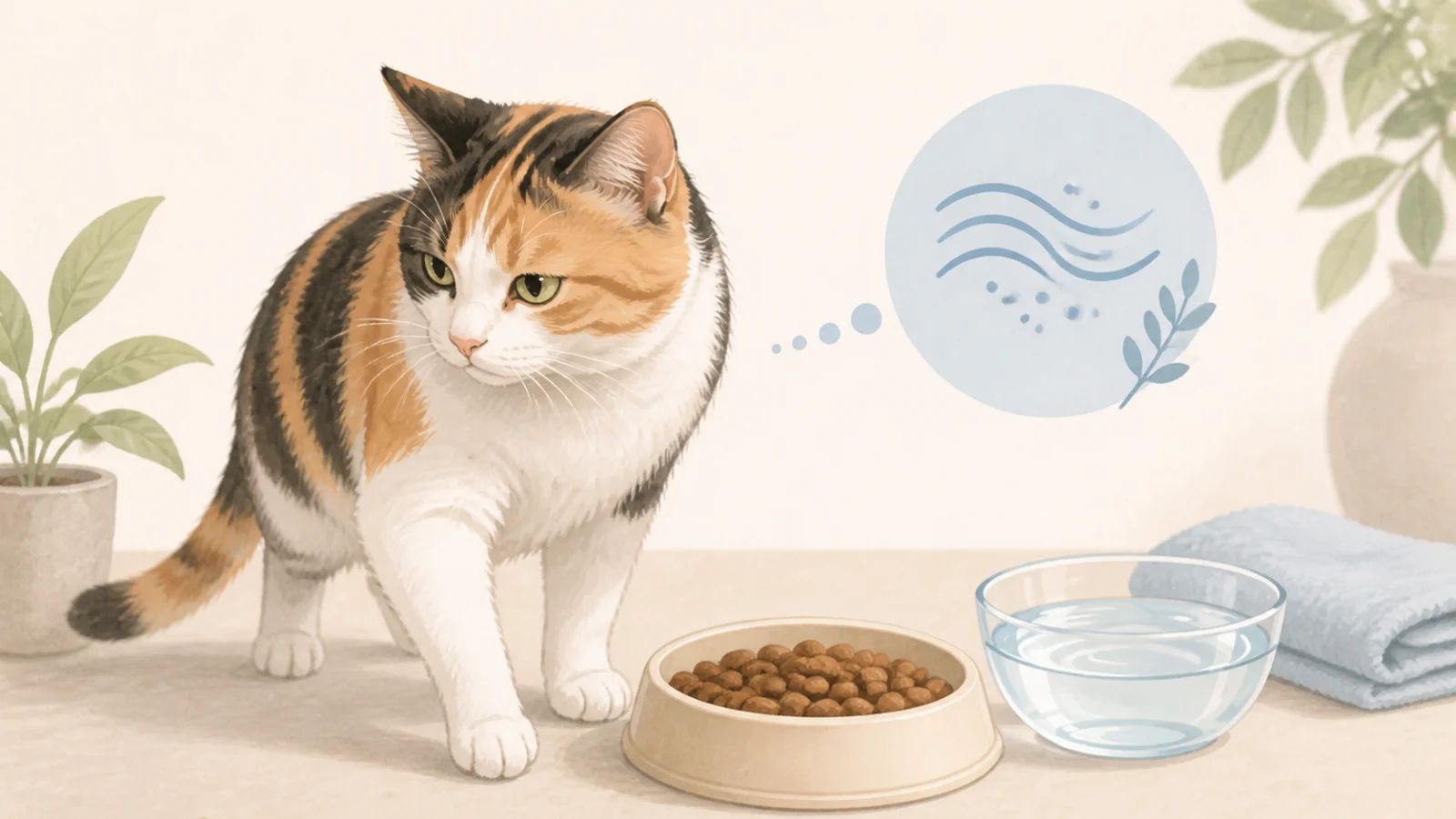
To an owner it usually looks like this — she walks up to the bowl and turns away. She isn't uninterested in food; she feels sick. Miss that distinction and it gets filed under "she's got fussy."
1. The nausea comes from the brain, not the stomach
This is the starting point for everything below.
Accumulated uremic toxins directly stimulate the chemoreceptor trigger zone (CTZ) in the brain. They act on the gut too, but the main switch is in the head.
Which is why the drugs aim there rather than at the stomach. Once you know this, the next section follows naturally.
2. Acid suppressants — long used, but the evidence in cats is weak
Famotidine, omeprazole. Routinely prescribed for CKD cats. The reasoning went:
Failing kidneys → gastrin accumulates → more stomach acid → ulcers → so suppress the acid
In people and dogs, that holds. But when cats were actually examined, it didn't.
| Study | What was found |
|---|---|
| McLeland 2014 JVIM · gastric histopathology |
CKD cats did not show the classic uremic gastropathy lesions (ulceration, oedema, vascular change) seen in humans and dogs. What they had instead was fibrosis and mineralisation. And hypergastrinemia did not correlate with ulceration or haemorrhage. |
| Tolbert 2017 JVIM · direct gastric pH |
Gastric pH in IRIS stage 3–4 cats was the same as, or higher than, healthy cats. The authors concluded that on pH alone, acid suppression may not be needed in cats with CKD. |
The symptoms look more like uremic toxins acting on the brain, which makes anti-emetic and anti-nausea drugs the better tool.
Read this carefully, though.
- This is not "stop the acid suppressant today." There are real reasons to use one — oesophagitis, a confirmed ulcer
- But using one simply because it's CKD is weakly supported. It's worth asking about
- Omeprazole can cause rebound acid hypersecretion if stopped abruptly — it should be tapered. Don't discontinue on your own
3. So what is used?
The evidence is not equal. Only maropitant and mirtazapine have Level 1 evidence (placebo-controlled trials).
| Drug | Dose | Notes |
|---|---|---|
| Maropitant Cerenia · NK1 antagonist |
Study dose 4 mg/cat PO once daily EU label: 1 mg/kg SC, up to 5 days |
Reduced vomiting in a placebo-controlled trial. Once daily, so practical at home |
| Mirtazapine appetite + anti-nausea |
Oral 1.88 mg/cat every other day Transdermal 2 mg/cat once daily |
Evidence for both appetite and nausea. The transdermal form suits cats who won't take tablets |
| Ondansetron 5HT3 antagonist |
0.5 mg/kg | Oral bioavailability is only ~35% and the half-life about an hour, so it needs to be given every 8 hours. Once daily is not enough |
Combining them
Because they act at different points, maropitant and ondansetron are sometimes used together. That's a decision for your vet when one alone isn't enough. Don't stack them on your own.
4. When it's the mouth
Uremia also causes stomatitis. With sore gums and tongue ulcers, a hungry cat still can't eat.
This is hard to tell apart from nausea — both look like turning away from the bowl. Here are the clues.
| More like nausea | More like mouth pain |
|---|---|
|
Sniffs and quietly turns away Frequent swallowing Lip-smacking Grooming the belly damp |
Goes to eat then jerks the head away Chews then drops it · chews on one side only Drooling · bad breath Takes soft food but refuses kibble |
5. What you can do at home
Start with how you feed
- Warm to body temperature — the aroma lifts and stimulates appetite. A microwave superheats unevenly and can burn her mouth; warm water around the container is safer
- Small and often — large portions worsen nausea. Split the same amount into four or five servings
- A shallow, wide bowl — many cats dislike their whiskers touching the sides
- Soft textures — with a sore mouth, pâté or mousse beats kibble
- Don't hide medication in food — one bitter mouthful and she rejects that food itself. CKD runs for years, and that lesson is expensive
Control the nausea first, then feed. That's the right order.
Don't let her get dehydrated
Dehydration concentrates uremic toxins and directly worsens nausea. Hydration management is nausea management — see subcutaneous fluids at home.
What to log
- Dates of vomiting — memory always undercounts. Just the date is enough
- Days you gave an anti-emetic — read alongside how much she ate the next day, the effect becomes visible
- Belly-grooming, yes/no — one character a day
Two or three weeks of those three answers the question "is the drug working?" It may feel like it isn't, but without a comparison you can't actually tell.
6. Signs that can't wait
Nothing eaten for over 24 hours — 48 hours enters hepatic lipidosis territory
Blood in the vomit, or dark coffee-ground specks
Heavy drooling, holding the mouth open
Limp and unresponsive, low body temperature
Seizures
Repeated vomiting through the day sets up a loop — dehydration → more concentrated toxins → more vomiting. That loop can't be broken at home. It needs IV fluids.
7. What to ask your vet
- "Can we tell whether turning away from food is nausea or mouth pain? Please examine her mouth"
- "Can we try maropitant? Please set the dose and duration"
- "She's on ondansetron — how many times a day should it be? I understand the half-life is short"
- "What about mirtazapine? Tablets are difficult — is the transdermal form an option?"
- "She's on an acid suppressant — is there a specific reason for her? I read the evidence in cats is weak"
- "With repeated vomiting, at what point should I bring her in?"
8. Related
- When a cat suddenly stops eating — the wider view, beyond uremia
- Porus One vs Kremezin — reducing uremic toxins in the gut
- Subcutaneous fluids, safely at home — dehydration amplifies nausea
- Saying goodbye — nausea control is central to palliative care