Metabolic acidosis — how to suspect it without a blood gas
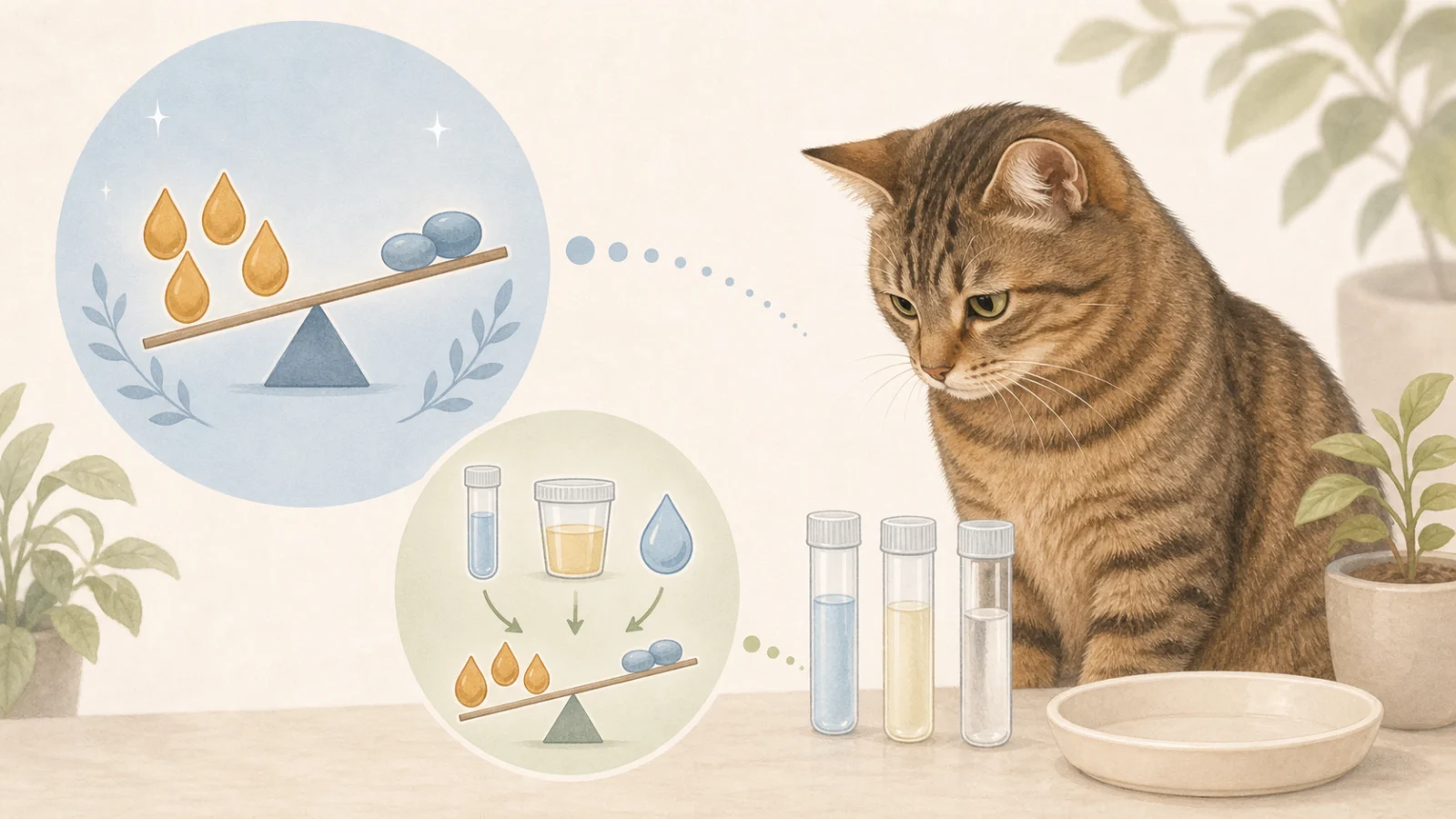
Read any kidney-disease book or the big overseas CKD sites and you will meet the line "check for metabolic acidosis." Then you walk into your local clinic, which has no blood gas analyser, or has one but tells you "that is for emergencies." So for many caregivers, acidosis becomes a number they know about but can never see.
This article is meant to close that gap: what acidosis is and why it matters in CKD, and — the core of it — the clues on an ordinary chemistry panel and urinalysis that let you suspect acidosis without a blood gas. At the end is a real record of how those clues were used at our lab.
1. What acidosis is — the kidney losing its job of dumping acid
Burning protein produces acid every day. A healthy kidney excretes that acid in urine (mostly as ammonium) and returns bicarbonate, the body's buffer, to the blood. As CKD advances, both the ability to excrete acid and the ability to regenerate bicarbonate fall, and the blood drifts acidic. That is metabolic acidosis.
How common? In a 2025 analysis of 618 cats, 38% of CKD cats had bicarbonate below 16 mmol/L — by stage, 33% in stage 2, 27% in stage 3 and 72% in stage 4. In Elliott's classic 2003 work, about half of cats with creatinine above 4.5 mg/dL were acidotic. So: roughly one in three through stage 3, three in four at stage 4. Not a rare complication.
Why does it matter? In an acidic environment the body does three things:
- Breaks down muscle to make buffer — acidosis contributes to the rapid muscle loss of CKD cats (the spine you can suddenly feel)
- Pulls calcium and phosphate out of bone — bone is the body's largest alkali store
- Suppresses appetite and causes nausea — overlapping with uraemic signs, so it gets filed under "the kidneys are just worse"
In people, correcting acidosis slows the decline in kidney function (the UBI study and others). Evidence of that strength does not yet exist in cats, but it is why IRIS recommends correcting acidosis at every stage.
2. The direct marker — tCO₂ does not need a blood gas
Here is the fact many caregivers never hear: the bicarbonate value that defines acidosis can be measured without a blood gas machine. It is the tCO₂ (total CO₂) item on an ordinary chemistry panel. More than 95% of blood CO₂ travels as bicarbonate, so tCO₂ is effectively a bicarbonate estimate. The 618-cat study above used exactly this chemistry-panel tCO₂, not blood gases.
| tCO₂ / bicarbonate (mmol/L) | Meaning | Response |
|---|---|---|
| 18–24 | IRIS target range | Maintain — check at each recheck |
| 16–18 | Borderline | Review diet and hydration, recheck in 4–8 weeks |
| Below 16 | Acidosis (bicarbonate deficiency) | Discuss alkalinising treatment (section 4) |
| Below 12 | Severe | Needs prompt correction; consider hospital fluids |
① It is not on every panel. Many in-house basic panels omit it while reference-lab panels include it. Asking "please add tCO₂ or bicarbonate" usually works.
② Serum left open to air reads low because CO₂ escapes. A sample run promptly is reliable; a sample sent out may read 1–3 mmol/L below the true value. Confirm borderline results with a repeat.
So the first move is not "please run a blood gas" but "please add tCO₂ to the next panel." It also costs far less.
3. Indirect clues — reading the report when tCO₂ is missing
Sometimes even tCO₂ is out of reach — you only have old reports, or the clinic cannot change its panel. Then you read the clues below together. No single one proves acidosis, but two or three pointing the same way is ample reason to get tCO₂ checked.
| Clue | What suggests acidosis | Why | Trap |
|---|---|---|---|
| Potassium (K) | An unexplained rise, or a trend toward the high side | In acidic blood, cells take up hydrogen ions and push potassium out. Especially in stage 4, when the kidney cannot excrete it | CKD cats are more often low in potassium (20–30%), so acidosis can hide behind a "normal" value. Telmisartan (Semintra) and ACE inhibitors also raise potassium |
| Chloride (Cl) | Above range, or the gap to sodium narrower than usual | When bicarbonate falls, chloride rises to keep charge balance (hyperchloraemic acidosis) | Dehydration, diarrhoea and some fluids also raise chloride. Read as a trend |
| Urine pH | Persistently around 6.0 or below despite an alkalinising renal diet | Under an acid load the kidney makes urine as acidic as it can. On a renal diet you would expect roughly 6.5–7.0 | Swings with time since meals, hydration, infection. The reverse — acidosis with alkaline urine — points to renal tubular acidosis or a urinary infection, and matters more |
| Phosphorus (P) | High | In the 618-cat study, bicarbonate and phosphate were inversely correlated in every group — two faces of the same loss of function | Strongly diet-dependent; use for direction only |
| BUN/creatinine ratio | Higher than the cat's usual (dehydration) | Dehydration does not directly create acidosis, but a dehydrated kidney excretes less acid and chloride concentrates. That is why fixing hydration is step one of fixing acidosis | High-protein meals and GI bleeding also raise BUN |
| Stage and trend | IRIS stage 4, or creatinine rising fast recently | 72% at stage 4 — the prior probability is simply different | — |
| The cat | Muscle loss out of proportion to intake, poor appetite, nausea, dullness, rarely fast deep breathing | Acidosis breaks down muscle and suppresses appetite | All overlap with uraemia; not distinguishable alone |
4. Potassium is the fork — which drug corrects it
Once acidosis is confirmed, treatment is simple: give alkali. There are two drugs, and potassium decides which.
| Potassium citrate | Sodium bicarbonate | |
|---|---|---|
| When | Potassium low or normal — treats hypokalaemia and acidosis with one drug | Potassium high — when adding more potassium is unsafe |
| Usual dose | Start 75 mg/kg twice daily, adjust to tCO₂ | 8–12 mg/kg three times daily, adjust to tCO₂ |
| Pros | Gentle on the stomach; citrate also helps prevent calcium oxalate stones | Cheap; no potassium load |
| Cons | Contraindicated when potassium is high | Sodium load (blood pressure, heart), bad taste and frequent refusal, gas when it meets stomach acid |
| Target | Keep tCO₂/bicarbonate 18–24; recheck 2–4 weeks after starting or increasing (tCO₂ + potassium + sodium) | |
Two things come first. ① Hydration — correcting dehydration often lifts tCO₂ by 1–3 on its own. If you give subcutaneous fluids, ask which fluid — normal saline only adds chloride; Hartmann's (lactated Ringer's) is alkalinising but depends on liver metabolism and carries less buffer; acetate-based balanced fluids (Plasma-Lyte type) carry more buffer and act quickly in peripheral tissue. The record in section 5 is exactly this difference. ② Diet — renal diets are mostly designed to be alkalinising. Conversely, "urinary" diets (struvite prevention, acidifying) and some acidified adult dry foods add to the acid load. A CKD cat that is acidotic while eating a urinary diet has its first correction right there.
5. A real record — finding acidosis without a blood gas, and fixing it with the right fluid
From our lab's stage 3 CKD cat, 17 years old. The clinic had no blood gas analyser and the routine panel had no tCO₂. The caregiver had two clues:
| Clue | What showed | Reading |
|---|---|---|
| Potassium | A value that had sat in range for months climbed above the reference limit | Unexplained hyperkalaemia at stage 3 → suspect acidosis |
| Urine pH | 5.0 on a renal diet | The body straining to excrete acid |
Neither proved acidosis alone, but both pointed the same way. What matters more in this record is what fixed it. There were three attempts.
| Attempt | Result | Why |
|---|---|---|
| ① Subcutaneous Hartmann's (lactated Ringer's) | Hydration improved, but acidosis did not correct as hoped | Lactate has to be converted to bicarbonate in the liver, and its buffer content is limited at 28 mEq/L. In an old, inappetent cat that conversion is slow |
| ② Oral sodium bicarbonate | Little effect — under-dosed | The taste made it impossible to get the full dose in — the practical limit of this drug |
| ③ Switch to an acetate-based balanced fluid (Plasma-Lyte type) | Urine pH responded first — 5.0 → up to 7.5 → then settled at 6.5. Potassium gradually returned to range | Acetate and gluconate are metabolised quickly in muscle and other peripheral tissue, not the liver, and the buffer content is about 50 mEq/L — nearly double lactated Ringer's |
6. Monitoring — what, and how often
- tCO₂ (bicarbonate) — on the routine panel from stage 3. If stable, at the usual recheck interval (every 3–4 months in stage 3, 1–2 months in stage 4); 2–4 weeks after starting or increasing treatment
- Potassium — always alongside tCO₂. Alkalinising treatment pushes potassium back into cells, so a cat that started high can flip to low
- Sodium and blood pressure — if using sodium bicarbonate
- Urine pH and specific gravity — home pH strips are useful for direction (not absolute values). A sudden swing to alkaline means check for infection
- Weight and muscle — the benefit of correcting acidosis often shows first as muscle that stops disappearing. Monthly weight is the minimum
7. What to ask your vet
- "Does our chemistry panel include tCO₂ (or bicarbonate)? If not, can we add it next time?"
- "Potassium is up from last time (give the numbers) — could acidosis be part of it? How do we separate that from the Semintra effect?"
- "Urine pH keeps coming back low on a renal diet. Can we read that as an acid load?"
- "Which fluid are we using for subcutaneous fluids? Is there a reason to change it if there is acidosis?"
- "If we treat, given this cat's potassium, is it potassium citrate or sodium bicarbonate?"
- "After starting, how soon do we recheck tCO₂ and potassium?"
8. Related
- Potassium — trouble high or low — how acidosis and potassium move each other
- Stages and target values — where tCO₂ 18–24 belongs
- Uraemic symptoms — how far acidosis signs overlap
- Subcutaneous fluids at home — how fluid choice affects acid–base