Porus One vs Kremezin: Choosing the Right Uremic Toxin Adsorbent
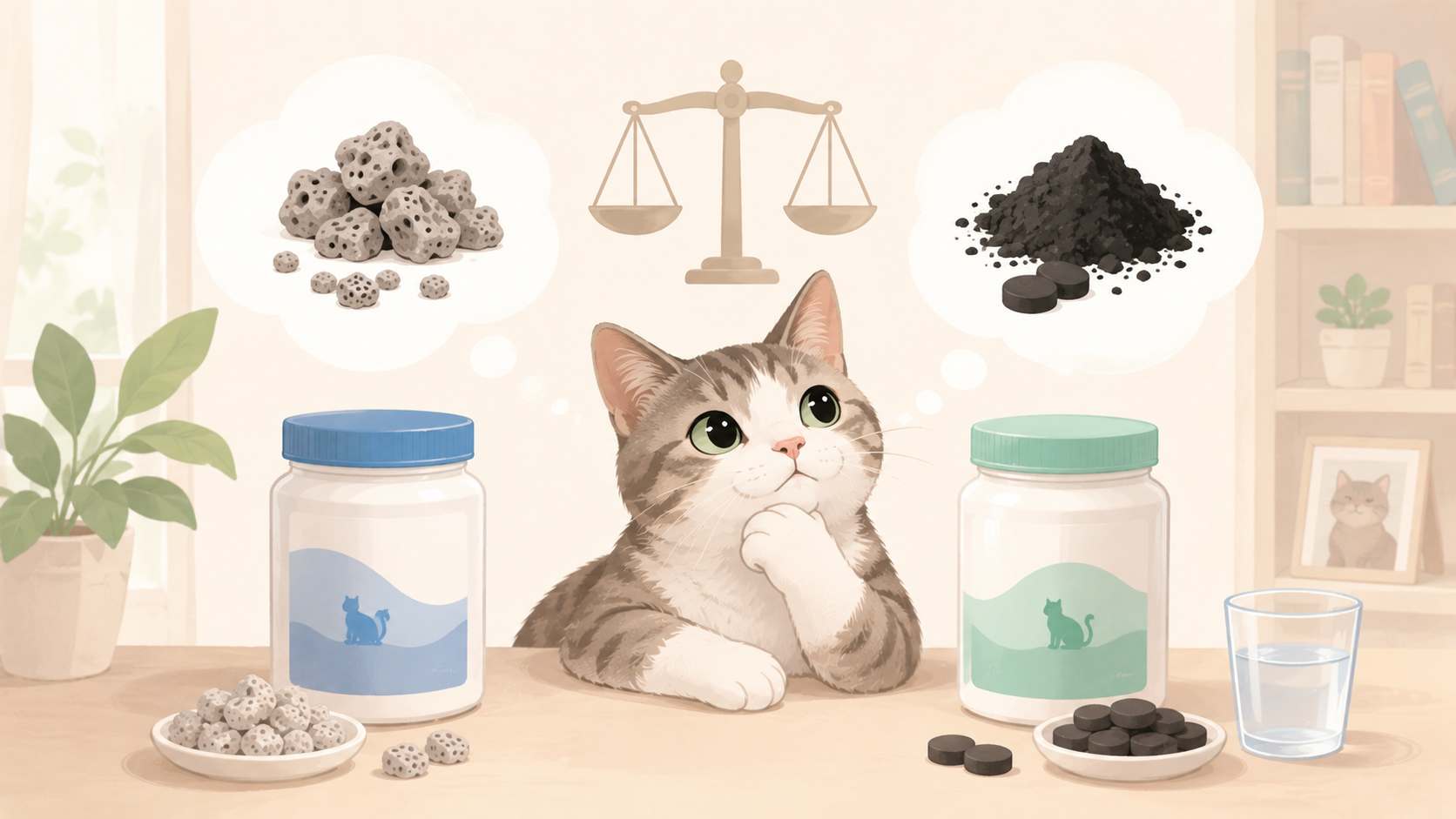
Intro: a new lens on uremic-toxin management
Today we take a deep look at Porus One, Kremezin, and uremic-toxin management in cats with kidney disease. This is based on blood-test data and veterinary principles experienced first-hand while caring for our own cat (Seungri).
- 5/7 bloodwork: BUN 132.1, CRE 4.0
- 7/9 bloodwork: BUN 141.1, CRE 5.0
A flare period when BUN/CRE spiked (June: BUN 172.5, CRE 6.0) overlapped, making a precise efficacy judgment difficult — but this is the information we gathered while deciding to retry Porus One, comparing it with a recent Renadyl dosing experience.
1. Porus One vs Kremezin/Renamezin: what is different?
Both manage uremic toxins in the gut, but their mechanism and target are clearly different.
| Item | Porus One | Kremezin/Renamezin |
|---|---|---|
| Main ingredient | Renaltec (inactive porous carbon) | Spherical activated carbon |
| When it acts | Before toxin formation (adsorbs the precursor) | After toxin formation (re-adsorbs circulating toxins) |
| Target substance | Indole - selective adsorption | IS, pCS, and broad uremic toxins/nutrients |
| How to give | Can be mixed into food (selective) | Must be time-separated from drugs/meals (non-specific) |
2. The mechanism of uremic-toxin production and excretion
- Protein intake: the amino acid tryptophan is broken down by gut bacteria.
- Indole formation: the breakdown produces indole.
- Porus One's role: it immediately adsorbs this indole in the gut, removing the "raw material" of the uremic toxin itself.
- IS formation: indole that is not adsorbed travels to the liver and becomes indoxyl sulfate (IS).
- The vicious cycle: IS that spreads into the blood damages the kidneys, and accumulates more as kidney disease progresses.
- Kremezin's role: to reduce circulating toxins, the body secretes some back into the gut (the enterohepatic loop), and Kremezin captures that gut-secreted IS and excretes it.
3. Three classes of uremic toxins in kidney disease
BUN and creatinine are not the only things that matter.
- Small-molecule toxins: urea, creatinine, etc. Almost non-toxic — they serve as "markers" of kidney function.
- Protein-bound toxins (the key target): IS (indoxyl sulfate) and pCS (p-cresyl sulfate). Not even filtered out by dialysis; the higher the levels, the sharper the rise in mortality and anemia risk.
- Middle-molecule toxins: toxins related to inflammation and the immune system.
4. Amino-acid intake guide: rediscovering turkey
Controlling intake of the uremic precursors tryptophan, tyrosine, and phenylalanine is central to diet management. Here is a per-100g comparison based on USDA data.
| Meat (100g) | Protein | Tryptophan | Tyrosine | Phenylalanine |
|---|---|---|---|---|
| 🍗 Roasted chicken breast | 31g | 362mg | 1047mg | 1231mg |
| 🦃 Roasted turkey | 30.1g | 287mg | 801mg | 869mg |
| 🐇 Roasted rabbit | 29.1g | 384mg | 1035mg | 1193mg |
| 🐟 Cooked tuna | 29.9g | 335mg | 1010mg | 1168mg |
| 🥚 Egg white | 12.3g | 208mg | 499mg | 750mg |
Turkey breast has the lowest uremic-precursor content relative to its protein, making it an excellent choice when composing a diet for a cat with kidney disease.
5. Gut microbiome and management strategy
It is ultimately the harmful gut bacteria that produce indole. When gut health is good (beneficial > harmful bacteria), toxin production is naturally suppressed.
- Pre/probiotics: feeding dietary fibers like inulin, FOS, and GOS along with appropriate probiotics is essential.
- The value of combining: using Porus One and Kremezin together at low doses can minimize each one's side effects (like constipation) while maximizing effect.
- Gut health first: supplements work differently for each cat because the gut environment differs. For cats with enteritis or pancreatitis, restoring gut health is a prerequisite for uremic-toxin management.