Phosphate binders — which one, how much, and when
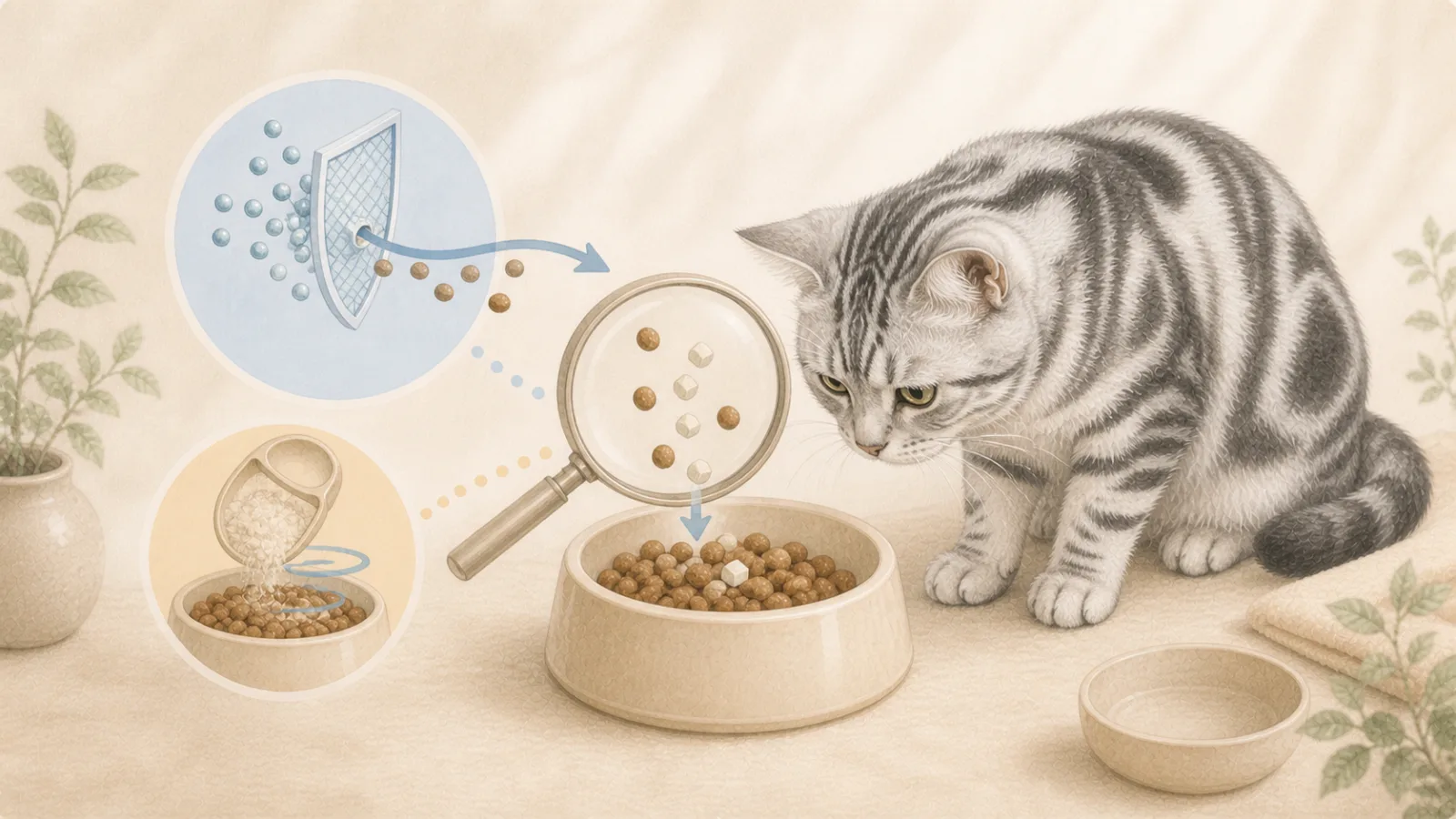
Phosphorus control is the best-evidenced intervention in CKD. Not fluids, not appetite stimulants — phosphorus.
Yet once you're told "phosphorus is high," what comes next is unclear. Changing the food often doesn't get you to target, and that's when binders come up — but which one, how much, and when is written down almost nowhere.
1. When to start — diet comes first
There is an order. Binders are for when diet isn't enough, not a first move.
- Switch to a lower-phosphorus diet — hold for 4–8 weeks
- Re-measure
- Still above target → start a binder
| IRIS stage | Target blood phosphorus (mg/dL) |
|---|---|
| 1–2 | 2.7 – 4.5 |
| 3 | 2.7 – 5.0 |
| 4 | 2.7 – 6.0 |
"Within the lab's reference range" and "within the stage target" are different things. A report may print 3.0–6.0 as normal, but at stage 3 anything above 5.0 needs managing.
2. Binders are not equally strong
This is the core of the article. One gram of one binder does not capture the same phosphorus as one gram of another.
Human nephrology uses a relative phosphate-binding coefficient (RPBC), comparing binding per unit weight with calcium carbonate set at 1.0.
| Compound | Relative binding calcium carbonate = 1.0 | To bind the same amount |
|---|---|---|
| Lanthanum (elemental) | 2.0 | Half the weight |
| Magnesium carbonate (anhydrous) | 1.7 | About 0.6× |
| Aluminium hydroxide | 1.5 | About 0.67× |
| Magnesium carbonate (hydrated) | 1.3 | About 0.77× |
| Calcium carbonate | 1.0 | Baseline |
| Calcium acetate | 1.0 | Same as baseline |
| Sevelamer | 0.75 | About 1.3× more |
Lanthanum is 2.7× stronger than sevelamer. That means far less powder for the same effect — and with cats, the volume you have to get into them is the whole game.
Product labels usually state total lanthanum carbonate, a much larger number. Check whether the label gives elemental content separately. Confusing the two leads to badly under-dosing.
3. What has actually been measured in cats
Two feline studies exist. The numbers are more modest than you might expect.
Lanthanum carbonate (Lantharenol)
| Faecal phosphorus excretion | Increased dose-dependently (p < 0.0001) |
| Phosphorus digestibility | At 1.6 g/kg of feed: reduced by 15% on average, up to 22% |
| Safe ceiling | No adverse effects up to 1 g per kg body weight |
| Toxicity onset | 2 g per kg body weight — repeated vomiting in 7 of 10 cats, food refusal in 3 |
"Blocks about 15% of the phosphorus eaten" — that is the real magnitude. A binder doesn't remove phosphorus; it stops some of it entering. Which is exactly why diet still comes first.
Iron-based binder (Lenziaren)
An insoluble complex of iron(III) oxide-hydroxide with starch and sucrose.
| Daily dose | Reduction in urinary phosphorus |
|---|---|
| 0.5 g | about 7.6% |
| 1.0 g | about 19.5% ← most effective |
| 2.0 g | about 5.7% (more binder, less effect) |
More is not better. Too much binder reduces how much the cat eats, and once intake falls the comparison collapses. The recommended range is 0.5–1.0 g per day.
4. Compound-by-compound
| Compound | Starting dose | Strengths | Cautions |
|---|---|---|---|
| Lanthanum carbonate Lantharenol, Fosrenol |
30 mg/kg/day | Strongest binding. Small volume. No calcium or aluminium load | Constipation. Especially risky if already constipated |
| Aluminium hydroxide | 30–45 mg/kg/day up to 100 if needed |
Strong and cheap. Long track record | Aluminium accumulates in bone and nerve. Long-term use is linked to microcytic anemia and neurological signs. Needs monitoring |
| Calcium carbonate | 150 mg/kg/day | Cheap and available | Hypercalcemia. Stage 3+ cats already run high calcium; adding more damages the kidney further |
| Chitosan + calcium carbonate Ipakitine and similar |
Per product label | Palatable. Powder mixes well into food | Contains calcium — same caution as above. Weaker than lanthanum |
| Iron-based Lenziaren |
0.5–1.0 g/day | No calcium or aluminium load | Darkens the stool (normal). More does not mean better |
Advanced CKD tends to raise calcium by itself. Adding a calcium binder can tip a cat into hypercalcemia, which damages the kidney further.
If you use one, measure total calcium — and ionised calcium where possible — alongside.
5. When to give it — where most people fail
A binder works by latching onto phosphorus from food inside the gut. So it has to be there at the same time as the phosphorus.
On an empty stomach it does almost nothing — there is no phosphorus to bind.
Four common mistakes:
- One dose a day — that covers one meal's phosphorus. Split it across every meal
- Forgetting treats — treats contain phosphorus too. Untreated treats mean untreated phosphorus
- Giving all medications together — binders interfere with absorption of other drugs. Space them at least 2 hours apart
- Skipping when she won't take it — if palatability is the problem, change the compound. That beats missing doses
6. Titrating the dose
Don't start hard. Start low, recheck every 4–6 weeks, and step up.
- Begin at the low end of the range
- Recheck phosphorus in 4–6 weeks
- Within target → hold. Still high → step up
- Once in target, maintain and recheck on schedule
What to watch alongside
- Phosphorus — the target itself
- Calcium — essential with any calcium-based binder
- Stools — lanthanum and aluminium cause constipation, on top of the constipation dehydration already causes
- HCT — with long-term aluminium, watch for microcytic anemia
- How much she eats — if the binder reduces intake, you've lost more than you gained
7. What to ask your vet
- "Is her phosphorus within the target for her stage? What number are you aiming at?"
- "We've done 4–8 weeks on diet alone and it hasn't come down. Is it time for a binder?"
- "Which compound suits her? Given her calcium, is a calcium-based one safe?"
- "Please set a dose by body weight. Across how many meals?"
- "When do we recheck? Please include calcium, not just phosphorus"
- "What do I do if she gets constipated?"
8. Three lines
② With food, split across every meal. On an empty stomach it's wasted
③ Start low, step up every 4–6 weeks. Aim for the band, not the floor
Reading an FGF23 report in context
FGF23 adds information about phosphorus metabolism. Early assessment of dietary phosphorus needs and monitoring during treatment address different questions. Record pg/mL, laboratory, assay and sampling date.
The IRIS interpretation uses Kainos intact FGF23 ELISA data. Review the result alongside phosphorus, calcium, anaemia and inflammation. IRIS FGF23 explanation
Bring food, treat and binder records covering the same period. Put diet-change dates beside test dates to identify which adjustment preceded a result. Link an existing report and keep it as a baseline for comparison.
9. Related
- Added inorganic phosphate in cat food — the same number absorbs differently. This comes before binders
- Stage-by-stage diet strategy
- Stage and goals — why the phosphorus target moves by stage
- Porus One vs Kremezin — adsorbents are a different thing from binders