
Same 26% protein, different renal diets — phosphorus per gram of protein and the animal-protein share
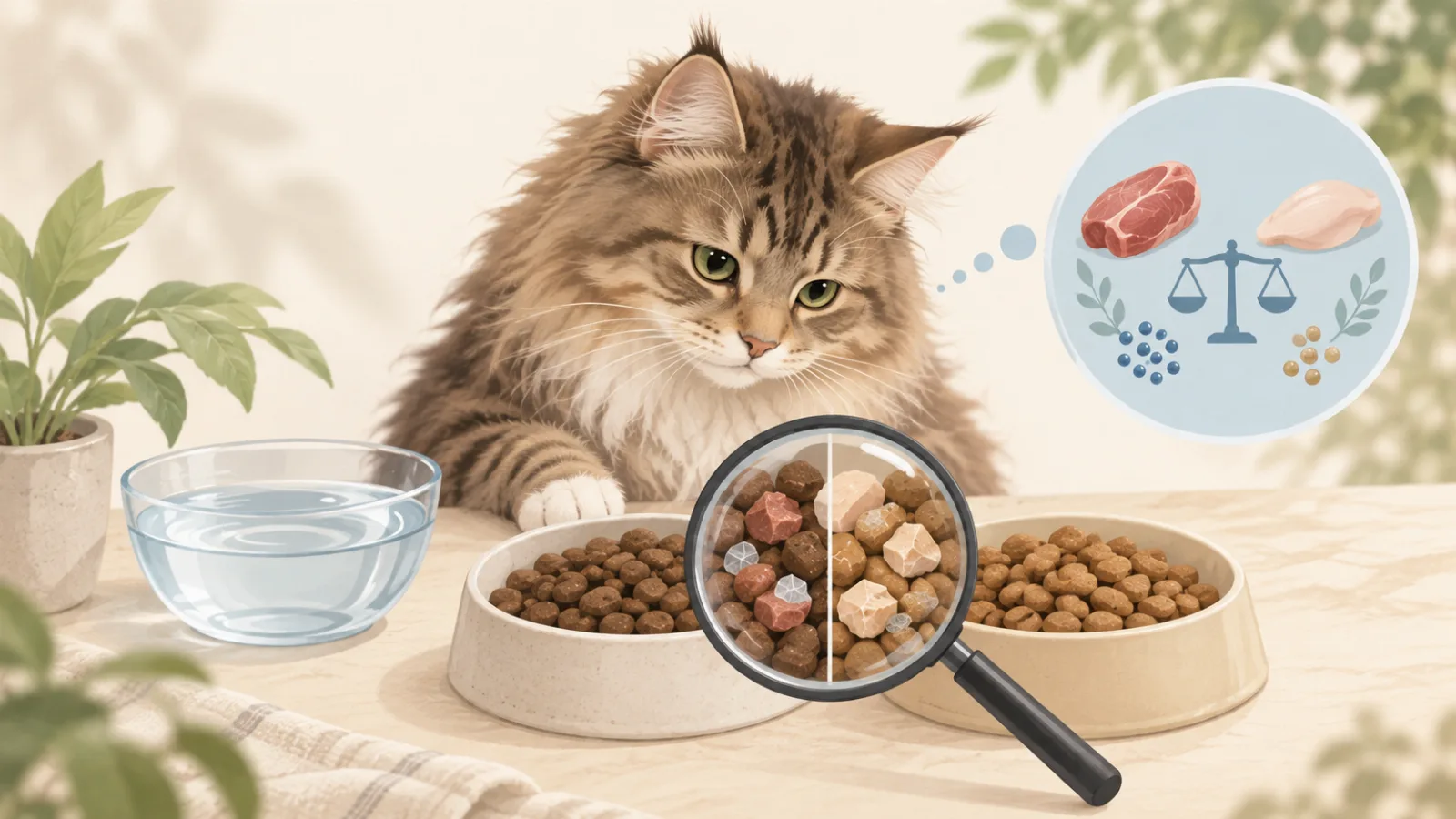
We put the labels of three renal dry foods side by side. Protein: 26%, 26%, 26.4%. Phosphorus: 0.41%, 0.40%, 0.46%. Almost identical. Yet in one of them three quarters of the protein comes from meat, and in the other two only one eighth does.
In the previous article (Choosing a commercial renal diet) we set the order of choice as “wet → ingredients → phosphorus per protein → extras”. This article turns the middle two steps into numbers: phosphorus per gram of protein and the animal-protein share.
- Phosphorus per gram of protein = label phosphorus % ÷ protein % × 1000. You do not need the calories; two numbers on the label are enough.
- Under 15 mg is low, 15–22 mg is average, over 22 mg is high. The median of the 79 renal diets in our database is 16.6 mg.
- When phosphorus per protein is similar, pick the higher animal-protein share. Half of renal dry foods are under 40%; renal wet foods have a median of 85%.
- Only 22 wet foods and 1 dry food do well on both. Wet food comes first here too.
- Lower phosphorus is not always better. One study found hypercalcaemia with very low phosphorus plus a high calcium ratio (section 5).
| Who | Decides |
|---|---|
| You, at home | Comparing the two numbers across candidate foods, checking your cat actually eats it, tracking weight |
| Together | How far to restrict protein — looking at weight, muscle and blood work together |
| The clinic | Blood phosphorus targets, starting and dosing phosphate binders, diagnosing food allergy or IBD |
1. Same label, different food
We added one more product for comparison. Values per 1000 kcal and phosphorus per protein are calculated from the label; the animal-protein share is our estimate from ingredient order and the composition of each ingredient.
| Product (dry) | Label protein · P | Protein g /1000 kcal | P mg /1000 kcal | P per g protein | Animal share | Where the protein comes from |
|---|---|---|---|---|---|---|
| Animonda Integra Protect Renal | 26% · 0.40% | 64.5 | 993 | 15.4 mg | ~76% | Greaves meal, dried poultry protein |
| Royal Canin Renal Hypoallergenic | 26% · 0.41% | 63.4 | 1,000 | 15.8 mg | ~13% | Hydrolysed soy protein |
| Hill's k/d Ocean Fish | 26.4% · 0.46% | 64.7 | 1,125 | 17.4 mg | ~13% | Corn gluten, pea protein |
| Recipe V Renal Cat | 21% · 0.50% | 63.5 | 1,513 | 23.8 mg | ~61% | Chicken meal |
Two things stand out.
- Label percentages mislead. Recipe V looks lowest in protein at 21%, but it is a lower-calorie food. Per 1000 kcal its protein matches the others and only the phosphorus is 1.5 times higher.
- The top three have nearly the same protein and phosphorus, but the protein comes from different places. Animonda lists corn first and is still 76% animal. Corn is only about 9% protein, so it leads by weight but adds little protein; greaves meal and dried poultry protein (about 60% protein) in second and third place supply most of it.
Whether renal diets work already has an answer. In a randomised study of 45 stage 2–3 cats (Ross 2006), uraemic crises occurred in 26% on a maintenance diet and 0% on a renal diet. So the question left is not “a renal diet or not” but “which renal diet” — and that is what these two numbers decide.
2. Number one — phosphorus per gram of protein
A renal diet has to cut phosphorus while protecting protein. If you look at phosphorus alone, a food that cut protein to get there also looks good. So we ask how many mg of phosphorus come along with each gram of protein. The measure was first used in human kidney nutrition (Kalantar-Zadeh 2010).
- Label: protein 26%, phosphorus 0.40%
- Phosphorus per gram of protein = 0.40 ÷ 26 × 1000 = 15.4 mg
- Calories cancel out because you are dividing two numbers from the same food. Wet food works the same way, and you can leave the moisture as it is.
Bands and the real spread
| P per g protein | Meaning | Of 79 renal diets |
|---|---|---|
| Under 15 mg | Low — protein kept, phosphorus cut | 28 (dry 4 · wet 24) |
| 15–22 mg | Average | 44 |
| Over 22 mg | High — more phosphorus than the name suggests | 7 (dry 5) |
There is no established mg/g target for cats. These bands are our starting line for comparing products, and the 'P per protein' filter in food search uses the same cut-offs. The median is 17.4 mg for dry and 15.3 mg for wet.
The number is set by the ingredients. From our ingredient composition table, phosphorus per gram of protein is roughly:
| Ingredient | P per g protein |
|---|---|
| Wheat gluten · corn gluten · rice protein | about 3.5–7.5 mg |
| Egg white · chicken breast · fresh meat and fish | about 4.5–12 mg |
| Dried chicken, meat meal · liver · heart | about 14–16 mg |
| Bone and cartilage | about 100 mg |
Plant protein concentrates are lowest, and the more bone goes in, the higher it climbs. Add inorganic phosphate additives and the number rises further, in a form that is also well absorbed. That is why the second number matters: you need to know whether phosphorus was lowered with plant protein or with good meat.
3. Number two — the animal-protein share
This is the part of the food's total protein that comes from meat, fish, egg and other animal ingredients. It is not on the label, so we estimate it from ingredient order and each ingredient's protein content and show it on the product page.
Why it matters — for cats, the make-up of protein matters as much as the amount.
- Lysine: per 100 g of protein, dried chicken has about 6–7 g; wheat and corn gluten about 1–2 g.
- Taurine: absent from plant protein.
- So foods built on plant protein end their ingredient list with a run of synthetic amino acids — L-lysine, taurine, DL-methionine. That meets nutrient standards, but it also tells you the food is designed differently from one built on meat.
The amount of protein matters as well. In a study of 24 healthy adult cats (Laflamme 2013), nitrogen balance was maintained at 1.5 g per kg body weight per day, but keeping lean (muscle) mass took 5.2 g or more. A 4 kg cat eating 200 kcal a day of a food with 64 g protein per 1000 kcal gets 12.8 g a day, or 3.2 g per kg. That does not mean 5.2 g is right for a cat with kidney disease, but it does show that renal-diet protein is not a generous amount for keeping muscle. The tighter the amount, the more the quality counts.
The first ingredient alone will mislead you
- Corn first, yet 76% animal — Animonda Renal (section 1). Concentrated animal proteins sit second and third.
- Chicken first, yet about 21% animal — Hill's k/d Early Support. Fresh chicken is over 70% water, so it brings little protein, and the corn gluten and wheat gluten behind it supply most of it.
The spread is wide. The 24 renal dry foods have a median animal share of 40%, with half below that. The 52 wet foods have a median of 85%, and 43 of them are at 70% or more.
4. Put the two numbers together and you get four boxes
| P per g protein under 15 mg | P per g protein 15 mg or more | |
|---|---|---|
| Animal share 70%+ | The best box — built on meat, low phosphorus. 23 foods (22 wet · 1 dry) | Plenty of meat but phosphorus comes with it — suspect bone, meat meal or phosphates. 25 |
| Animal share under 70% | Phosphorus lowered with plant protein. 4 | Weak on both. 24 (17 dry) |
The 76 renal diets in our database that have an animal-share estimate, as of October 2026. Because the animal share is an estimate, treat differences of about ±10 percentage points as the same.
How we use them, in order:
- Wet first. 22 of the 23 foods in the best box are wet.
- Filter by phosphorus per protein. Under 15 mg is ideal; up to 17–18 mg if that is all your cat will eat.
- Then the higher animal share. When phosphorus per protein is within 1–2 mg, the animal share decides. Animonda and Royal Canin Hypoallergenic in section 1 are exactly this case (15.4 vs 15.8 mg, 76% vs 13%).
- Last: does your cat eat it? However good the numbers, a food that is not eaten scores zero. Work down the list.
5. When this happens, do this
- If your cat is losing weight — look at total protein first. Start with foods at 70 g or more per 1000 kcal, and decide with your clinic whether to handle the extra phosphorus with a phosphate binder. If your cat is simply eating less, nutritional support comes first.
- If your cat has a food allergy or IBD — hypoallergenic renal diets use hydrolysed soy protein on purpose. A 13% animal share is the point, not a flaw. In that case, leave the animal share out of your criteria.
- If calcium rises after switching to a very low-phosphorus food — suspect the food. In a study of stage 1–2 cats (Schauf 2021), 5 of 17 cats (13 by ionised calcium) fed 840 mg phosphorus per 1000 kcal with a calcium-to-phosphorus ratio of 1.9 became hypercalcaemic — even though their phosphorus per protein was a 'good' 14.2 mg.
- If the label phosphorus and the app's estimate differ a lot — the product page shows both the label value and an estimate calculated from the ingredients. If the estimate is about twice the label, check whether the label is a typical value or a guaranteed minimum or maximum, and confirm with your cat's blood phosphorus trend.
6. Where opinions differ
How far should protein be cut?
Why opinions differ — The study behind renal diets (Ross 2006) used a diet that cut protein and phosphorus together. More recent work paints a different picture. In Schauf 2021, cats fed 59 g protein and 0.84 g phosphorus (per 1000 kcal) saw FGF23, a phosphorus-load hormone, rise 2.72-fold, while cats fed 76–98 g protein and 1.4–1.6 g phosphorus saw it fall to 0.58-fold, with SDMA at 0.75-fold. In Machado 2022, 25 cats (10 healthy, 15 at stage 1–2) fed a dry renal diet with 87 g protein and 1,200 mg phosphorus per 1000 kcal for 60 days showed no significant change in lean mass, although the 9 stage 2 cats lost weight, mostly as muscle.
Where we stand — cut phosphorus, trim protein less. That is why we look at phosphorus per protein rather than phosphorus alone. Both recent studies were manufacturer-funded and had around 20 cats each, though, so they are not enough to justify raising protein to maintenance levels.
How to check in your own cat — 4–8 weeks after a switch, compare weight, muscle (feel the spine and hips) and blood phosphorus and calcium with before. If weight holds and phosphorus is on target, the food suits your cat.
Is plant protein bad?
Why opinions differ — One side says cats are carnivores and plant protein does not suit them. The other says plant protein concentrates are well digested and carry little phosphorus per gram of protein, which actually helps a renal diet. Much of the phosphorus in plant ingredients is bound as phytate and absorbed less, which supports the second view.
Where we stand — There is no evidence that plant protein is harmful. But some foods reach around 15 mg phosphorus per gram of protein using meat, so at the same number we choose the meat-based one. There is no reason to give up amino-acid make-up or palatability.
How to check in your own cat — After a switch, compare intake (the app's feeding records) and stool for two weeks. If your cat eats well and the stool is fine, either kind can be the right food for that cat.
7. What to ask your vet
Before questions, bring your observations. Write phosphorus per protein and animal share for 2–3 candidate foods, recent weight change, and the last phosphorus and calcium results on one page. The conversation gets shorter and more precise, and the questions follow naturally.
- “My cat is losing weight like this — could we move to a food in the 70 g protein range and handle phosphorus with a binder?”
- “With the current phosphorus result, is a food at 17 mg phosphorus per gram of protein enough, or should we aim under 15 mg?”
- “Calcium went up after the food change — could the food's calcium-to-phosphorus ratio be the cause?”
8. Read next
- Choosing a commercial renal diet — the product list, sorted with these two numbers
- Why inorganic phosphates in cat food matter
- Phosphate binders — what, how much, when
- Chronic kidney disease — diet by stage