Chronic Kidney Disease (CKD) in Cats — From Diagnosis to Diet
Overview
Chronic Kidney Disease (CKD) is one of the most common internal diseases in cats. Nephrons are irreversibly damaged, and blood urea nitrogen (BUN) and creatinine (Cre) rise. The goal is not a "cure" but slowing progression and preserving quality of life.
1. Weight and water: where kidney care begins
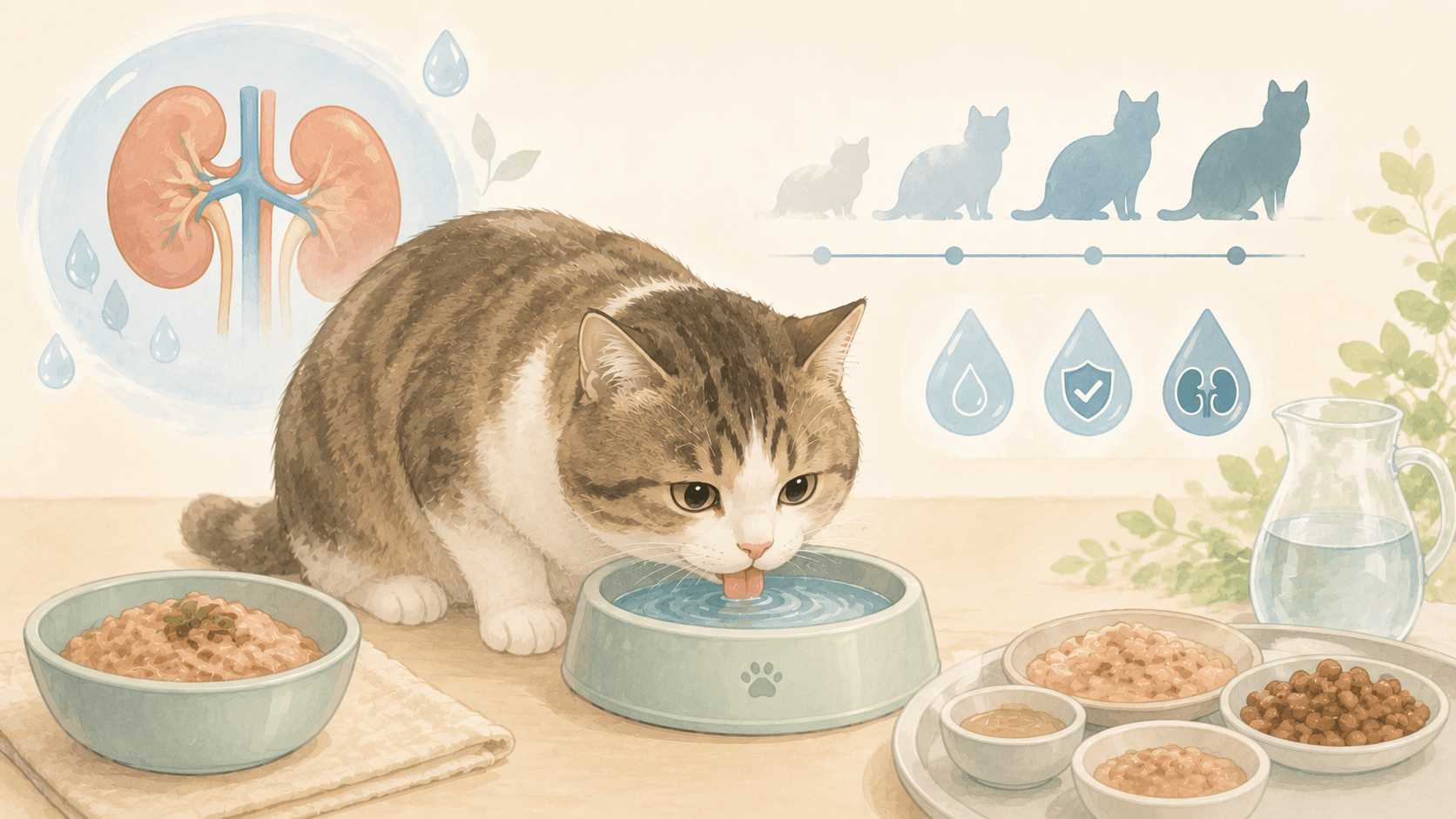
Kidneys need plenty of water to filter waste. Feeding 100% wet food is the single most effective way to maximize water intake.
⚖️ Calorie targets by body condition (BCS)
Monitor weight closely. Ideally, keep monthly weight change within 5%.
| Body condition | Daily calorie target | Management goal |
|---|---|---|
| Ideal | 90–110% of requirement | Maintain weight (within ±5%) |
| Underweight | 120–130% of requirement | Gain slowly, ~5% per month |
| Overweight | 80–90% of requirement | Lose slowly, ~5% per month (no weight loss needed up to BCS 6) |
2. IRIS staging
| Stage | Creatinine | SDMA | Signs | Key strategy |
|---|---|---|---|---|
| 1 | < 1.6 | < 18 | None | Maintain quality protein, monitor phosphorus |
| 2 | 1.6–2.8 | 18–25 | Increased thirst/urination | Begin phosphorus restriction, manage electrolytes |
| 3 | 2.9–5.0 | 26–38 | Vomiting, anemia | Aggressive phosphorus restriction, fluids, manage proteinuria |
| 4 | > 5.0 | > 38 | Uremia | Hospice care, appetite support, maintain calories |
3. Uremic toxins: the hidden key to kidney protection
As CKD progresses, uremic toxins the kidneys can no longer filter build up in the blood and damage the kidneys further. Beyond watching phosphorus alone, managing the most toxic uremic-toxin precursors is central to improving survival.
Choosing adsorbents and amino acids
- Porus One: adsorbs the raw material (indole) in the gut before toxins form. Few side effects, easy to mix into food.
- Kremezin: broadly adsorbs toxins in circulation after they form. Needs a time gap from other medications.
- Amino acid strategy: protein sources low in tryptophan (the uremic-toxin precursor), such as turkey, are advantageous.
4. Restriction and ratios: the science
🛡️ Phosphorus: the survival factor
Phosphorus is the fastest driver of kidney decline. Choose low-phosphorus diets free of inorganic phosphates.
- The risk: research shows that every 1 mg/dL rise in serum phosphorus increases mortality risk by 11.8%.
- Management: set total phosphorus intake based on your cat's serum phosphorus and whether a phosphate binder is used.
🥩 Protein: quality over quantity — and manage in grams
Managing actual intake in grams is far more precise than looking at percentages (DM%) alone.
- Requirement: recent research indicates cats need about 5.2 g of protein per kg of body weight to maintain lean body mass (bone, muscle, water).
- Strategy: restrict mildly in stages 1–2 to preserve muscle; restrict strictly in stages 3–4 to control uremic markers (indoxyl sulfate and others).
⚖️ Calcium-to-phosphorus ratio
Keep at least 1.2:1, raising toward 1.5:1 as disease advances to suppress phosphorus absorption.
5. Functional ingredients and acid–base balance
Watch for metabolic acidosis
As CKD advances, the kidneys fail to excrete acidic waste and the blood acidifies. To neutralize it, the cat's body pulls nutrients from its own bone and muscle — the main cause of rapid weight loss. This is why alkalinizing agents such as potassium citrate matter.- Simple proteins: favor highly digestible, simple ingredients such as hydrolyzed protein; avoid complex fruit/vegetable additives.
- Functional ingredients: prefer diets including B vitamins (brewer's yeast), beta-glucans, antioxidants (vitamin E, omega-3), probiotics, prebiotics, and fibers that lower uremic load.
- Sodium: unless hypertension is present, ordinary sodium levels are not a major concern.
6. Individualized strategy — and flexibility
The most important principle: "whatever it is, the cat has to eat." The most perfectly formulated diet fails if your cat refuses it — starving costs muscle and worsens prognosis fast.
7. Action checklist for cat parents
- Keep records: log daily food intake and weekly weight. You can only adjust calories if you can see the change.
- Check the numbers: at blood tests, review acid–base values (TCO2, pH) with your vet.
- Have a plan B: keep a ready list of alternative low-phosphorus/moderate-protein wet foods for the day your cat refuses the current one.
References
- IRIS Staging of CKD (2023 revision)
- Syme HM, et al. Survival of cats with naturally occurring chronic kidney disease is related to severity of proteinuria. JVIM. 2006. [PubMed] [Full PDF]
- Geddes RF, et al. The relationship between plasma phosphorus concentration and survival in felines with CKD. JVIM. 2013. (source of the 11.8% mortality figure)
- NRC. Nutrient Requirements of Dogs and Cats. 2006.