Feeding — the food bowl is half the treatment
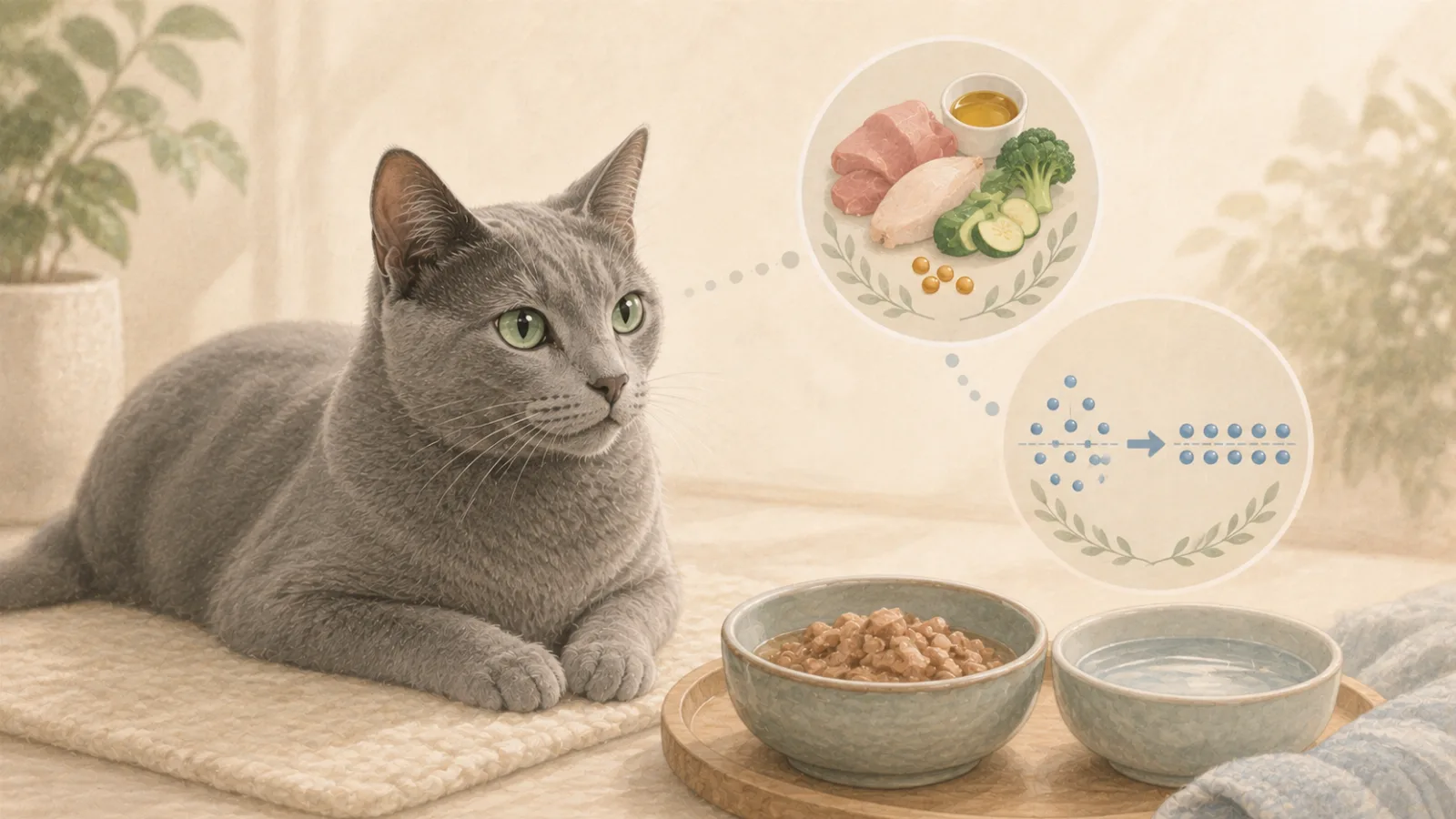
The big picture called diet one leg of the three-legged stool. This article builds that leg — and first, one number to show how much weight it carries.
In a study of newly diagnosed diabetic cats differing only in diet (Bennett 2006), remission reached 68% on the low-carb diet versus 41% on the moderate-carb diet. Same insulin, same disease — one food bowl split the odds that far. In diabetes, diet is not a side dish. It is the second drug.
1. Why low-carb — the specifications of the feline machine
Cats are obligate carnivores. The body is engineered to run on protein and fat, with only minimal carbohydrate-processing equipment (no salivary amylase, sparse hepatic sugar enzymes). A healthy cat muddles through; a diabetic body on high-carb food faces a glucose wave at every meal — a wave the tired pancreas and the injected insulin must surmount each time.
Switch to low-carb and the waves become ripples: insulin requirements fall, the glucose curve flattens, and the glucotoxic fog of the remission chapter lifts more easily. The 68% versus 41% above is that mechanism, measured.
2. The target numbers — and why wet food
- Carbohydrate: at or below 12% of calories (ME basis) — the zone where the highest remission rates were reported; many push below 10%
- Protein: above 40% of calories — guards muscle, builds satiety, and feeds GLP-1, the hormone that nurtures beta cells
- Form: wet food first — three reasons. ① Wet food is structurally low-carb (kibble needs starch to hold its shape, so most dry food runs high) ② its water bulk gives more satiety per calorie (a weight-loss ally) ③ it replaces the water lost to polyuria
One piece of practical good news — prescription diabetic diets are not the only answer. Many ordinary commercial wet foods already meet the carbohydrate bar. If the prescription diet is costly or refused, "a regular wet food that passes the carb test" is a legitimate alternative — the arithmetic for choosing one is next.
3. Carbohydrate is not on the label — how to back-calculate
Example: a wet food listing protein 10.5 · fat 6 · moisture 78 · ash 2.5 · fiber 0.5 (%) → carbs ≈ 2.5%. On a dry-matter basis, 2.5 ÷ 22 ≈ 11%. For wet food, a back-calculated ~3% or less marks a low-carb candidate. If ash is unlisted, assume ~2.5% (wet) or ~6% (dry). When in doubt, ask the manufacturer — or bring a shortlist to your vet and choose together
Run this a few times and the pattern appears — most kibble sits at 25–40% carbs and fails the bar, and even among wet foods, gravy-heavy pouches spike on starch. Pâté-style wet foods usually win.
4. Weight — the third drug, with a brake attached
- Speed limit: 1–2% of body weight per week — for a 6 kg cat, 60–120 g a week. Faster is not better; it is dangerous
- Never starve a cat — rapid deprivation triggers hepatic lipidosis (fatty liver), a separate emergency of its own. Weight loss is not "feeding less" but "feeding calculated calories, low-carb"
- Target weight and daily calories: calculated with your vet — and weigh weekly into the app to verify the pace. Note the reverse case: the thin diabetic cat is a candidate for weight gain — rebuilding pre-diagnosis muscle is also treatment
5. The craft of the switch — this article's most important warning
- Pace — mixed into the old food over 1–2 weeks; abrupt swaps invite refusal and stomach upset
- Retreat if refused — the series-wide principle: a second-best food eaten beats a perfect food starved over. Warm it, hand-feed, rotate low-carb candidates — and if intake stays below half for two days, call (the fatty-liver deadline)
- Meal timing — the base pattern is scheduled meals paired with the twice-daily injections; once stable on low-carb, your vet may open room for smaller, more frequent meals
6. Treats and kitchen rules
- Passing treats — single-ingredient freeze-dried meats, plain cooked chicken; check squeeze-treat labels (sugar and starch additives exist). Treats within 10% of daily calories
- Failing treats — gravy pouches (starch), human carbs (bread, sweet potato), "dental" biscuits
- Multi-cat homes — the diabetic's food and a housemate's kibble mixing wrecks the maths. Establish separated feeding now (microchip feeders, staggered times, separate rooms)
- The emergency exception — honey and syrup are banned in daily life but are the lifesaving tool of a hypoglycemic emergency (chapter 01). Keep them locked away in peacetime, used without hesitation in war
7. Special cases — the table when diseases overlap
- With CKD — this series' familiar crossroads. Renal diets are usually higher in carbs (starch fills the space lowered protein leaves), colliding head-on with the diabetic bar. The principle is individual design — broadly, advanced kidney disease weights phosphorus first; early CKD with uncontrolled diabetes weights carbs first — a balance your vet strikes. Never self-select; use the CKD diet article as joint discussion material
- On the oral drug (SGLT2) — low-carb's benefit is identical: less sugar coming in while the drug pours sugar out. This chapter applies unchanged
- With pancreatitis — fat content may need adjusting, narrowing the product choice within low-carb. With your vet
8. What to ask your vet
- "When we start the diet switch, how much do we pre-emptively reduce the insulin dose?"
- "Here are my candidate foods with the back-calculations — do they pass the carb bar?"
- "Please calculate the target weight and daily calories — and what weekly loss rate is safe for this cat?"
- "(With CKD) is this cat phosphorus-first or carbs-first?"
- "Is a regular low-carb wet food acceptable here instead of the prescription diet?"
9. Related
- Remission — the stage on which this table produced its 68%
- Measuring glucose at home — the seatbelt of the transition
- The big picture of treatment — this leg's place in the stool
- The Diabetes Bible — contents — chapter 06, insulin in practice, is next