The big picture of treatment — insulin or the oral drug, and the three-legged stool
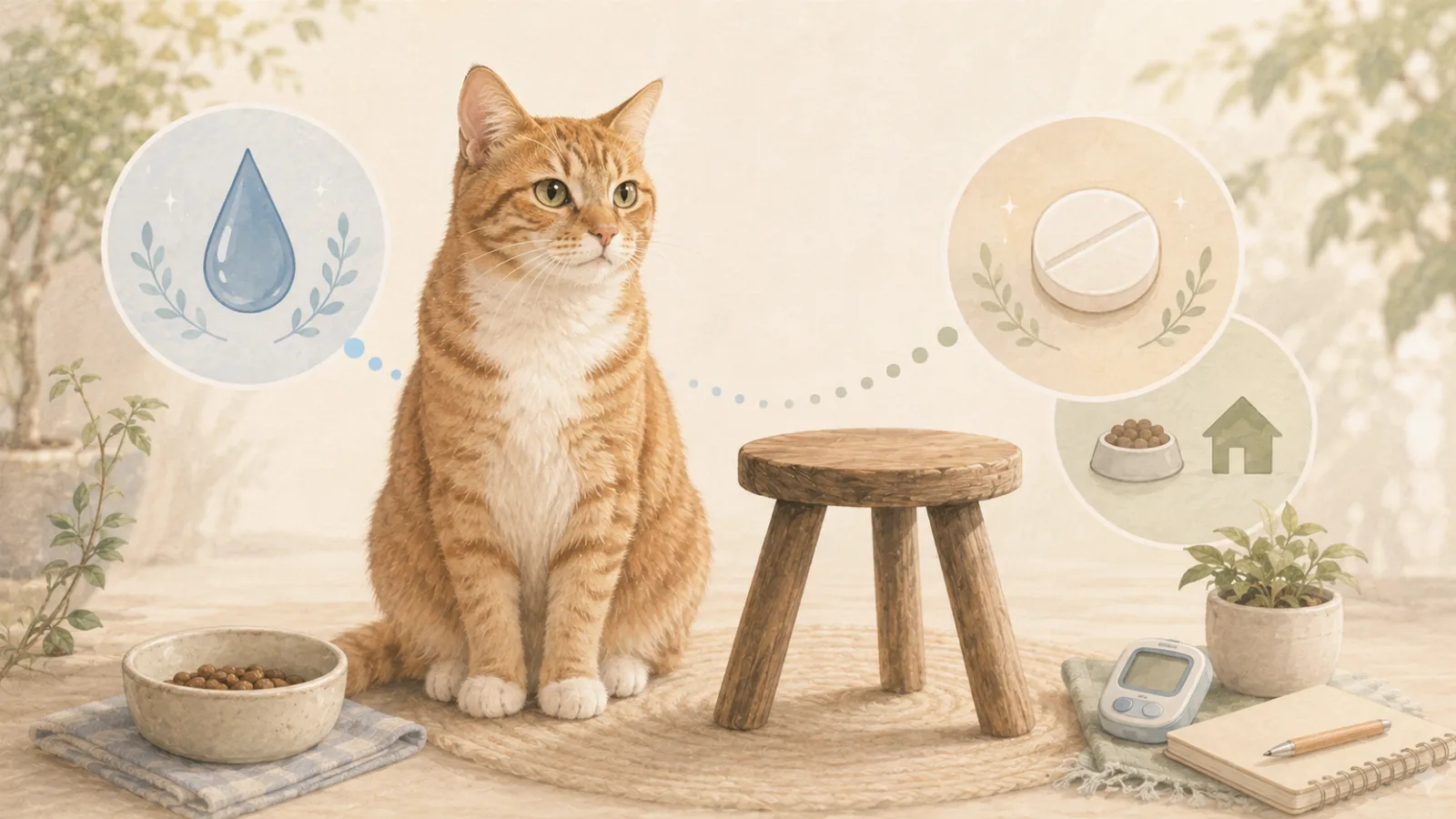
Around the first recheck, the caregiver faces a decision that did not exist a few years ago: two injections a day, or one oral dose a day? Search results are muddled, and clinics themselves differ on which road to recommend.
This article is the map for that decision. First the structure of treatment as a whole (the three-legged stool), then the two roads compared with numbers, and finally a frame for choosing your household's road. Spoiler: there is no universal right answer — but there is a right answer for your home.
1. The three-legged stool — the drug is only one leg
- ① The drug — insulin or an SGLT2 inhibitor: the engine that brings glucose down (this article)
- ② The diet — low-carb wet food plus weight management. Not a garnish but treatment — it slashes insulin requirements and was a shared condition of the remission studies (chapter 05)
- ③ Monitoring — home glucose and ketone checks: the eyes that let the drug be used safely and firmly (chapter 07)
Remove one leg and the stool tips — drug without diet means ever-rising doses; drug without monitoring means control too timid for remission. Alongside, the ladder of goals: ① erase the signs (thirst, urine, weight) → ② safety (no lows) → ③ good control (fructosamine 350–450) → ④ and, if possible, remission (chapter 04).
2. Road A — insulin: the orthodox road to remission
- Which insulin — today's standard is long-acting: glargine (Lantus), detemir, and the cat-licensed PZI (ProZinc). In newly diagnosed cats, remission rates were higher on glargine than on PZI or lente — the choice of insulin is itself part of the score
- How it starts — low and slow: a small dose, adjusted every 1–2 weeks against curves and logs. The patience is the point — hurried increases are the shortcut to hypoglycemia. Injection technique itself lives in chapter 06
- Strengths — decades of evidence · the remission data lives here (early glargine + low-carb + home monitoring) · the master key that works in every situation: ketones, comorbidity, advanced disease
- Burdens — twice daily on a 12-hour rhythm · hypoglycemia management (the spot-check habit) · the grip on the caregiver's daily life (chapter 10's subject)
3. Road B — the oral drug (SGLT2): the new door, and its conditions
Velagliflozin (Senvelgo, once-daily liquid) and bexagliflozin (Bexacat, tablet) form this class. The principle is an inversion: instead of supplying insulin, block the kidney's sugar reclamation and let the excess flow out in urine.
- The record — in the large SENSATION trial it held its own against insulin; at day 180, 81% sat within glycemic reference ranges and thirst/urination improved in ~88%. Bexagliflozin likewise reported over 80% control success
- The revolutionary part — no needles · structurally low hypoglycemia risk (it discards sugar rather than forcing it down) · workable without dense curves — a different order of caregiver burden
- The price — DKA risk — this class's single heavy shadow. Ketoacidosis occurred in about 7% in the field data — and split sharply: 18.4% in cats previously on insulin versus 5.1% in newly diagnosed cats. That split is exactly where the "insulin-naive only" rule comes from. It can arrive at normal glucose (euglycemic DKA), making early ketone monitoring a hard condition (first 2–8 weeks; chapters 02 and 08)
- Eligibility — newly diagnosed, insulin-naive, ketone-free, otherwise healthy. The thin, sick or ketotic cat belongs on insulin
- Remission? — the honest answer: unknown. Being controlled by SGLT2 and the disease retreating are different things, and this class's remission rate has not been properly evaluated (case-report level). If remission is the prime goal, today's evidence sits with insulin
- Availability — varies by country and moment; your clinic has the current answer
4. Side by side
| Insulin (glargine etc.) | Oral drug (SGLT2) | |
|---|---|---|
| Administration | Injection twice daily (12-hour rhythm) | By mouth once daily |
| Control record | The standard — excellent when well run | Non-inferior in trials — 81% in range at day 180 |
| Remission chance | The proven road (early + low-carb + home monitoring) | Unevaluated — no evidence yet |
| Hypoglycemia risk | Present — managed by spot checks | Structurally low |
| DKA risk | When control fails | Intrinsic (~5% in new cats) — early ketone monitoring mandatory |
| Who can use it | Every diabetic cat | New, insulin-naive, ketone-free, otherwise healthy |
| Monitoring focus | Glucose (spots + curves) | Ketones (early, intensively) |
| Caregiver burden | Heavy — the 12-hour rhythm pins the day | Light — travel and absence become possible again |
5. Which road for your home — the choosing frame
| Your situation | The lean | Why |
|---|---|---|
| Aiming squarely at remission, injections and checks feasible | Insulin (glargine) + low-carb | The only combination with remission evidence; right after diagnosis is the golden window (chapter 04) |
| Injections truly impossible (an extremely reactive cat / the caregiver's circumstances) | The oral drug (if eligible) | A hundred times better than no treatment — control alone restores the signs and the life |
| Ketones present / thin and unwell / prior insulin | Insulin (no choice) | Fails SGLT2 eligibility — the DKA-risk zone |
| Frequent caregiver absence (travel, shifts) | Weight toward the oral drug (if eligible) | Once-daily oral is far easier to delegate (chapter 10) |
| Senior with stacked comorbidities | Case by case | Depends on which diseases — chapter 09 and your vet's territory |
6. Whichever road — the shared leg called diet
A closing emphasis on the stool's second leg: the low-carb diet is half the treatment on both roads. On the insulin road it lowers the required dose and lifts remission odds; on the oral-drug road it lightens the sugar load the drug must handle. Only the timing and pace of the switch need care (an abrupt change mid-insulin risks lows — exactly as chapter 01 warned). Details in chapter 05.
7. What to ask your vet
- "Does my cat meet the oral drug's eligibility (new, insulin-naive, ketone-free, otherwise healthy)?"
- "(If insulin) are we starting with a glargine-class insulin — and is remission a realistic target here?"
- "(If the oral drug) what is the ketone monitoring schedule, and which signals mean stop and switch?"
- "For this cat, roughly what is the monthly cost of each road (drug + supplies + rechecks)?"
- "When, and at what pace, do we start the diet switch?"
8. Related
- The day of diagnosis — where this fork first appeared
- Reading the numbers — why the two roads watch different numbers (glucose vs ketones)
- Measuring glucose at home — the third leg in practice
- The Diabetes Bible — contents — remission, feeding and insulin-in-practice follow