Reading the numbers — the now, the last two weeks, the threshold, and the alarm light
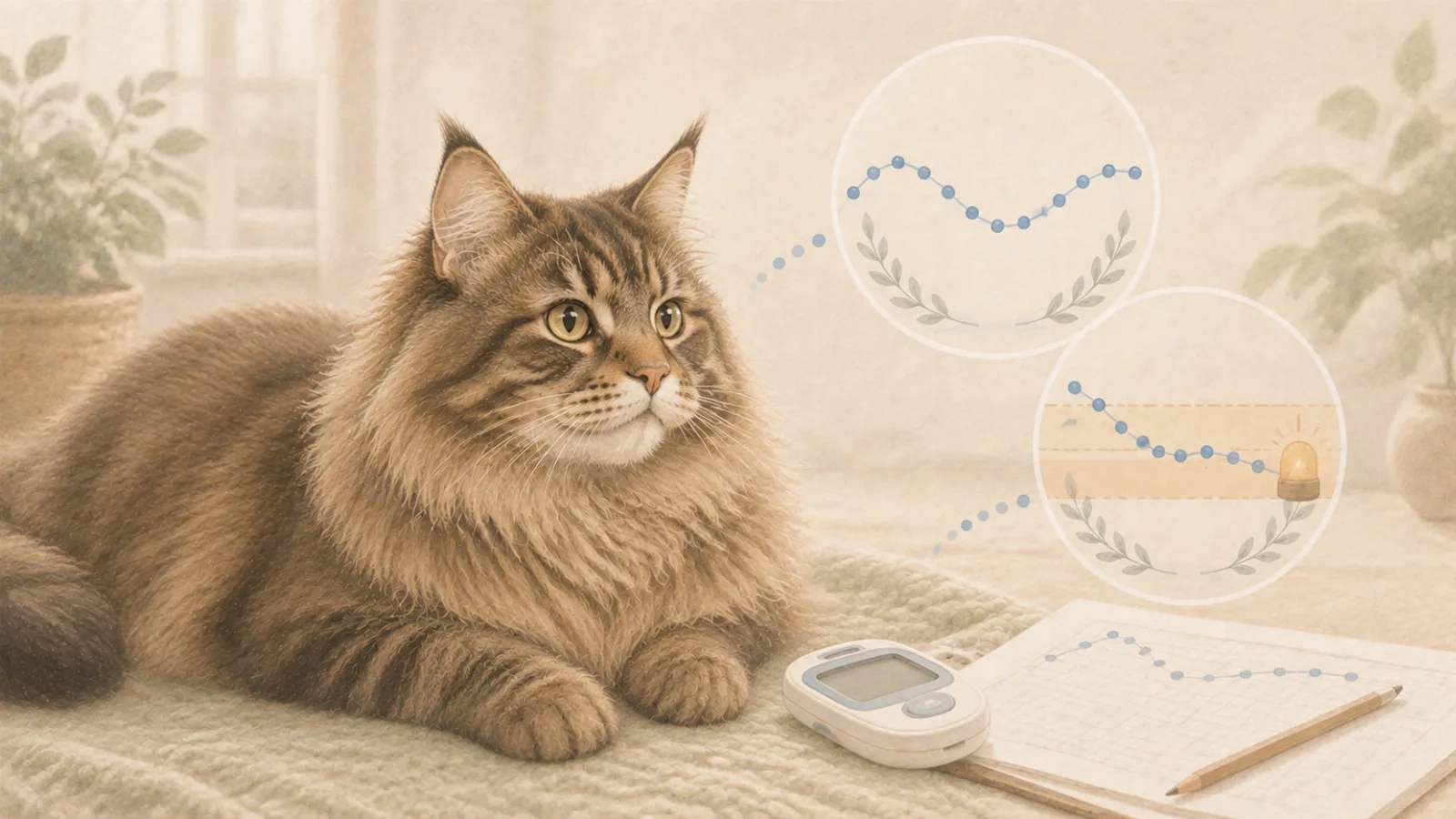
A diabetic cat's lab report carries four kinds of numbers — and the four are the same thing measured on four different clocks. Glucose is "this instant"; fructosamine is "the average of the past two weeks"; urine sugar is "did we cross the threshold"; ketones are "is this an emergency". Miss the clocks and the report reads like a contradiction ("glucose is high but fructosamine is normal?").
This article synchronises the clocks. By the end, whether "glucose 380 today" deserves alarm will be answered by the other boxes on the page.
1. The map of the four numbers
| Number | What it measures | Its clock | The question it answers |
|---|---|---|---|
| Blood glucose (BG) | Sugar in the blood, now | The instant | Is she safe right now (lows, above all) |
| Fructosamine | Sugar-coated protein | The past 1–2 weeks | Is control holding lately / was that day a fluke |
| Urine glucose | Sugar spilled into urine | The past hours to half-day | Did glucose cross the threshold (~250–290) |
| Ketones | Exhaust of emergency fat-burning | Now | Is the body in emergency mode (DKA alarm) |
2. Blood glucose — the most famous, the most volatile
- Units — mg/dL here and in the US; mmol/L abroad and in some Libre settings. mmol/L × 18 = mg/dL. A foreign forum's "BG 15" means 270 — no alarm needed
- Healthy fasting range is roughly 70–150 mg/dL; treatment targets are a wider band (home measuring, section 6)
- One clinic reading is half-void — stress alone lifts cats to 300–400, so neither diagnosis nor control verdicts rest on a single point. Glucose earns its value at home, repeated, as a flow
- The reading asymmetry — highs are judged as trends; a low (under 80) acts alone, immediately. Chapter 07 carries the details
3. Fructosamine — the two-week report card, and this disease's referee
Blood sugar slowly sticks to blood proteins; the longer glucose stays high, the more sticks. Fructosamine measures that sugar-coated protein, and because of protein lifespan it averages the past 1–2 weeks — unmoved by one stressful day. Hence its two verdicts: the diagnosis trial ("one bad day, or a bad fortnight?") and the control trial ("is the treatment working lately?").
| Fructosamine (µmol/L) | Reading |
|---|---|
| ~190 – 365 | Non-diabetic range (labs vary) |
| 350 – 450 | On treatment: good control — the band many clinics aim for |
| 450 – 550 | Suboptimal — recheck dose, diet and routine |
| Above 550 | Poor control — hunt the cause (dose, failed dosing, comorbidity) |
4. Urine glucose — the trace of a crossed threshold
Kidneys normally reclaim every bit of sugar. Above the threshold (roughly 250–290 mg/dL in cats; sources range 240–300), reclamation overflows and sugar spills into urine. A positive dipstick is thus the trace that glucose sat above the threshold in the hours before — a short past, not an instant.
- In diagnosis — signs + high glucose + glucosuria stacks one more piece of evidence for "sustained"
- Never diagnostic alone — intriguingly, traces of urine glucose occur even in some healthy cats (basal glucosuria), and stress spikes can graze the threshold. No diabetes verdict on a dipstick alone
- During treatment — home urine sticks cheaply show "are we straying over the threshold lately". Caution: never raise insulin chasing a negative strip — negative only means "below threshold" and cannot tell that apart from a dangerous low
- On the oral drug (SGLT2), everything reverses — the drug deliberately spills sugar into urine, so a positive strip means "the drug is working." In those cats, the box to watch is not glucose but ketones
5. Ketones — the report's only alarm light
When insulin runs too short, cells starve amid plenty and the body burns fat to cope. The exhaust is ketones; ketones accumulating until the blood turns acidic is ketoacidosis (DKA) — this disease's most dangerous emergency (chapter 08). The other three are management numbers; ketones alone are an emergency number.
| Test | Measures | Worth knowing |
|---|---|---|
| Urine ketone strip | Acetoacetate | Cheap, home-friendly. But it cannot see DKA's main ketone (BHB) directly and can miss the early phase — a negative strip in a sick-looking cat is not reassurance |
| Blood ketone (BHB) meter | Beta-hydroxybutyrate | More sensitive and precise. Healthy cats run 0–0.1 mmol/L; 2.4 and above strongly indicates DKA (100% sensitivity in the key study). Some combined glucose/ketone meters allow this at home |
When to check — ① a diabetic cat showing the not-eating + vomiting + flat combination (more so with high glucose) ② the first weeks on an SGLT2 drug, per the prescribing vet's schedule (these drugs can bring DKA at normal glucose) ③ whenever your clinic's "sick-day rules" say so. Positive ketones + an unwell cat = the clinic that day.
6. Which number for which scene — the cheat sheet
| Scene | The lead | Why |
|---|---|---|
| Confirming the diagnosis | Fructosamine (+ signs, urine sugar) | The referee that filters out stress hyperglycemia |
| Daily safety | Blood glucose (pre-injection spot) | The hypoglycemia mine detector |
| Is control holding (rechecks) | Fructosamine + home glucose log + weight and water intake | The two-week average agreeing with daily life |
| A sick day (not eating, vomiting) | Ketones + glucose | Never missing DKA |
| Early weeks on SGLT2 | Ketones | Watching for DKA at normal glucose |
| Testing for remission | Glucose flow (Libre, curves) + fructosamine | Does the normal band hold without insulin (chapter 4) |
7. What to ask your vet
- "What was the fructosamine, and where do we set the target band?"
- "(Senior, poor control) fructosamine looks oddly fine — should we check T4?"
- "At home, do we check ketones with urine strips or a blood meter, and in which situations?"
- "Please write down our sick-day rules (insulin, measurements and call thresholds when she won't eat or vomits)"
- "(On SGLT2) persistent urine sugar is normal for this drug, correct? How often do we check ketones?"
8. Related
- Measuring glucose at home — making the glucose number yourself
- The day of diagnosis — where these numbers first appeared
- The Diabetes Bible — contents — the crisis chapter (DKA) and remission verdicts are on the map
- The CKD Bible: what is creatinine — the sister article in reading one number deeply