What is creatinine? — reading one number properly
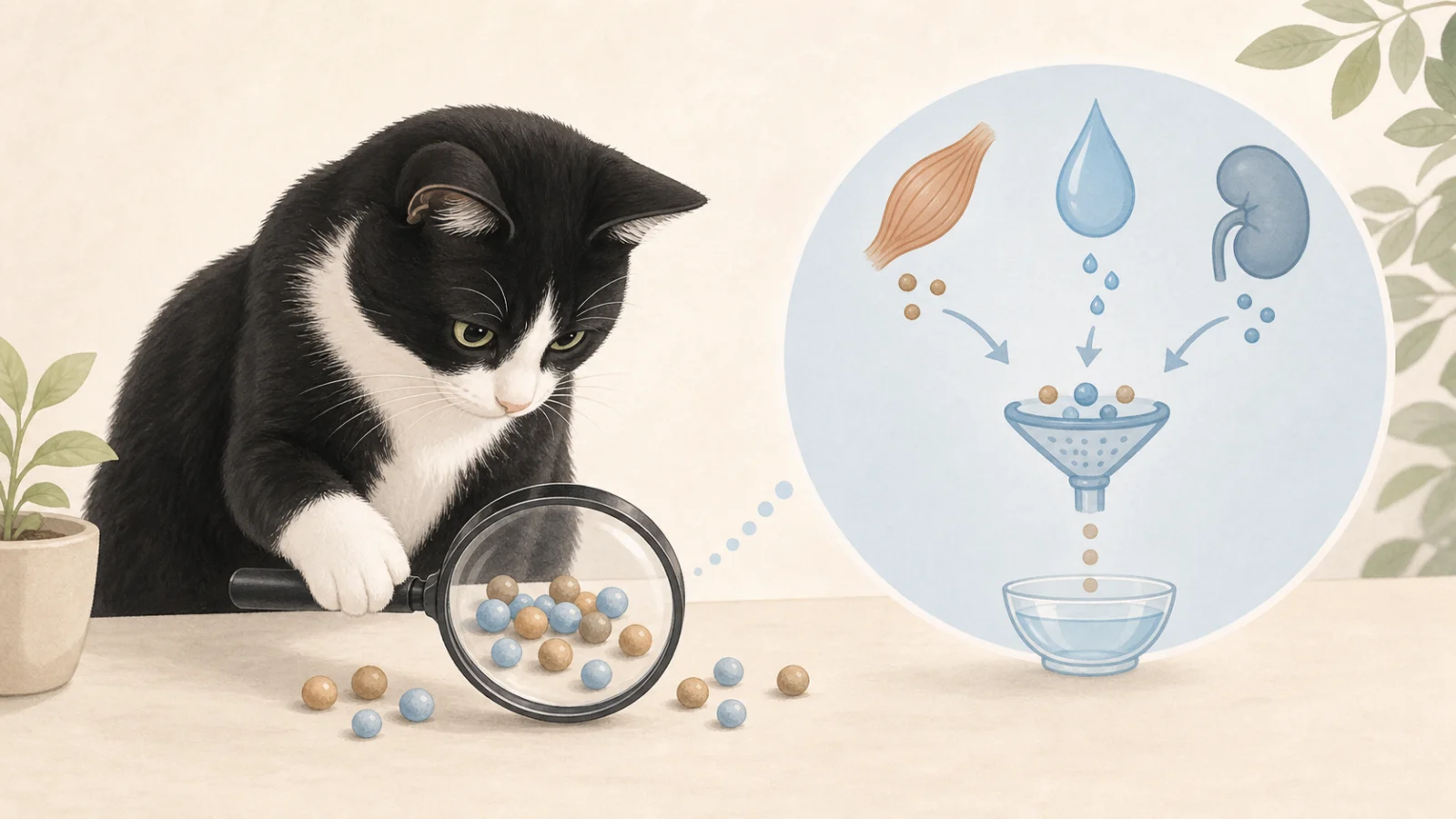
The first sentence of almost every kidney diagnosis is "creatinine is high." From then on, caregivers follow this number for years — the first thing they look for at every recheck, a ruined day when it rises by 0.1, relief when it drops by 0.2.
Yet few caregivers read it knowing exactly what it measures, why it rises so late, and what pushes it around. This article digs into creatinine alone. By the end, the same number should look different.
1. Where creatinine comes from — muscle exhaust
Muscle burns a fuel called creatine when it works. The leftover from that fuel is creatinine. Three properties matter:
- It is produced at a nearly constant rate every day — for a given muscle mass, an active day and a sleepy day produce about the same amount
- Once filtered by the kidney it is not reabsorbed — it leaves in the urine
- There is almost no other way out except the kidneys
Those three properties make creatinine a natural gauge of kidney function: if production is constant and the blood level climbs, the outflow (the kidney) has slowed. Like a sink with the tap running steadily — when the water starts rising, the drain is the problem.
2. Why it rises so late — only after about 75% of function is gone
This is creatinine's most important property and its biggest limitation. Creatinine stays inside the reference range until roughly 75% of kidney function has been lost.
The reason is the shape of the curve. Kidney function (filtration rate) and creatinine are not a straight line but a hockey stick. As function falls from 100% to 50%, creatinine drifts from about 0.8 to 1.4 — still "normal". From 50% to 25%, it jumps from 1.4 to 2.8; from 25% to 12%, from 2.8 to 5.6. Every halving of function roughly doubles creatinine.
| Remaining function (approx.) | Creatinine (conceptual) | How it looks on the report |
|---|---|---|
| 100% | 0.8 | Normal |
| 50% | 1.4 | Still normal — with half the function gone |
| 33% | ~2.0 | Early stage 2 |
| 25% | 2.8 | End of stage 2 |
| 12% | 5.6 | Stage 4 |
Two conclusions follow. First, "creatinine is normal" does not mean "the kidneys are healthy." Half can be gone and it still reads normal. Second, the same 0.5 rise means different things in different places. 1.0→1.5 is a large loss of function; 5.0→5.5 is comparatively small. Because of this curve, clinicians sometimes track progression with the reciprocal (1/creatinine), which is close to a straight line against function.
3. The muscle variable — thin old cats read low, muscular cats read high
Because creatinine comes from muscle, less muscle means less production. This creates the most dangerous illusion in feline CKD.
As CKD advances, poor appetite, acidosis and uraemia strip muscle away. Less muscle means less creatinine, so the number can hold steady or even fall while the kidneys get worse. Behind "the values are stable" there is sometimes muscle loss. So the single habit this article most wants to leave you with is reading creatinine alongside body weight and muscle. If weight is dropping while creatinine "holds", it is not holding.
| Situation | Effect on creatinine | How to correct for it |
|---|---|---|
| Old age, muscle loss | Reads lower than reality → stage underestimated | Add SDMA; log weight and muscle condition score |
| Hyperthyroidism | Muscle breakdown plus higher filtration → reads low; kidney disease "appears" after treatment | Compare creatinine and SDMA before and after thyroid treatment |
| Muscular breeds/individuals (Maine Coon, Birman, Chartreux…) | Near the upper limit even when healthy → stage may be overestimated | Judge against that cat's healthy baseline |
| Kittens, growing cats | Low | Careful applying adult ranges |
4. The hydration variable — dehydration raises creatinine
Kidneys can only filter blood that reaches them. Dehydration, low blood pressure or heart disease reduce blood flow to the kidney, filtration falls and creatinine rises even if the kidney itself is fine. This is called a prerenal rise. The day after vomiting or diarrhoea, on a hot day, or after a week of poor drinking, creatinine can read higher than the cat's true value.
The clinic's tool for sorting this out is urine specific gravity (USG). A dehydrated cat with healthy kidneys concentrates its urine (above 1.035 in cats). High creatinine with concentrated urine reads as "kidneys working, water short"; high creatinine with dilute urine (below 1.035) reads as "kidneys cannot concentrate". That is why creatinine should be measured on the same day as a urinalysis.
5. The laboratory and unit variable — the same blood reads differently
- Units — Korea and the US use mg/dL; Europe and some labs use µmol/L. Convert with mg/dL × 88.4 = µmol/L: 2.8 mg/dL = 248 µmol/L. Do not panic at a "250" in an overseas article
- Reference ranges — upper limits vary between labs and analysers, from 1.6 to 2.4. The same blood is "normal" at lab A and flagged "H" at lab B. IRIS staging uses fixed cut-offs (1.6 / 2.8 / 5.0), not the lab's range
- Analyser differences — 0.2–0.3 between an in-house analyser and a reference lab is common. For trends, stay with the same lab and analyser so real change is not confused with machine difference
- Fasting — a meal (especially meat) can nudge creatinine up. Recheck after 8–12 hours fasting, at the same time of day where possible
- Haemolysed or icteric samples — rough draws and old samples shift values. If the report says "haemolysed", weigh that value lightly
6. Stage cut-offs — IRIS 2023
| Stage | Creatinine (mg/dL) | Creatinine (µmol/L) | SDMA (µg/dL) | Meaning |
|---|---|---|---|---|
| 1 | < 1.6 | < 140 | < 18 | Creatinine normal; diagnosed from other signs (SDMA, ultrasound, proteinuria, dilute urine) |
| 2 | 1.6 – 2.8 | 140 – 250 | 18 – 25 | Mild, usually no signs — the stage where management pays off most |
| 3 | 2.9 – 5.0 | 251 – 440 | 26 – 38 | Moderate; signs begin |
| 4 | > 5.0 | > 440 | > 38 | Severe; complication management is the focus |
What if the two values point to different stages? The IRIS rule: "if creatinine suggests a lower stage but SDMA persistently suggests a higher one, consider that muscle loss is making creatinine underestimate, and follow SDMA." And staging is done on a stable patient, from at least two values two or more weeks apart — never on a number from the middle of dehydration or an acute crisis. Details in stages and targets.
7. Reading the trend — one value is a point, several are a direction
Now the practical part. One principle: change over value, and speed of change over change.
- Set a baseline — two values in a stable state (usual fluid routine, fasted, same lab). That is the cat's "zero". Earlier wellness results are even better: a 1.6 in a cat that was 1.0 when healthy is a different story from a 1.6 in a cat that was 1.5
- Read the size of a change against its range — in stage 2 (1.6–2.8), 0.2 may be analyser noise while 0.5 is meaningful; in stage 4, 0.5 may be noise. Percentages make it easy: 20% or more over the previous value counts as real change
- Watch the speed — a cat rising 0.3 per year and a cat rising 0.3 in three months are different cats. Chronic progression moves in months and years; a jump over days or weeks is an acute problem (dehydration, obstruction, infection) — acute vs chronic
- Overlay weight — flat creatinine with falling weight is not flat (section 3)
| Reading practice — a hypothetical example (same lab, fasted, usual fluid routine) | |||
|---|---|---|---|
| Time | Creatinine | Weight | How to read it |
| Diagnosis | 2.4 | 4.2 kg | Stage 2. Baseline ① |
| +1 month | 2.3 | 4.2 kg | Baseline ② — stable. This cat's "zero" ≈ 2.35 |
| +4 months | 2.5 | 4.1 kg | +6%, within noise. Read as no change |
| +7 months | 2.5 | 3.8 kg | Value unchanged but weight −7% → suspect muscle loss, check SDMA |
| +8 months | 3.9 | 3.7 kg | +56% in one month → not chronic progression but an acute event. Check dehydration, stones, infection |
8. What to ask your vet
- "How much has this creatinine risen from this cat's own baseline? (show earlier results)"
- "Did we check urine specific gravity today? Could dehydration be inflating this?"
- "Which stage does SDMA point to? If it differs from creatinine, which do we follow?"
- "My cat is losing weight — could creatinine be reading low because of muscle loss?"
- "Was this run in-house or at a reference lab? Can the next recheck use the same one?"
- "Are we confirming the stage on today's value, or rechecking in two weeks first?"
9. Related
- Reading kidney bloodwork — SDMA, BUN and phosphorus alongside creatinine
- Stages and target values — what the cut-offs decide
- Acute vs chronic — what a jump over days means
- Getting the most from your vet — recheck intervals and keeping conditions the same