The red flags on a urine report — what to check before the numbers
Urgent urinary signs
Repeated straining with little or no urine may be an emergency. Contact a vet immediately; do not wait to finish a diary or try a food or supplement. Do not squeeze the bladder at home.
A report full of flags can make every number look like a target to fix. Begin elsewhere: how was the sample obtained, and what question was the test meant to answer? Your job is not to diagnose from the printout but to separate findings from unanswered questions.
1. Put the sample history above the results
Collection and handling affect interpretation.[1] Save the collection method and time, delivery time and recent medication or fluids alongside the report. An unknown detail is a question for the clinic, not a reason to guess. Culture is preferably performed on urine obtained by cystocentesis before antibiotics.[2] Do not stop prescribed treatment or delay urgent care yourself; tell the team what has already been given.
2. Different fields answer different questions
Specific gravity describes urine concentration; pH describes acidity or alkalinity. Blood, cells and crystals provide other clues. These findings need clinical context, not isolated interpretation.[1]
- For specific gravity, ask how hydration and other findings affect the interpretation.
- For pH, ask what it means for this patient rather than choosing a food from the number.
- For blood or inflammatory cells, ask which causes remain possible.
- For culture, ask whether growth represents clinically relevant infection.
This is a conversation checklist, not a replacement for diagnostic thresholds. Tell the vet about continuing symptoms even if the report contains few flags.
3. Crystals and stones are different findings
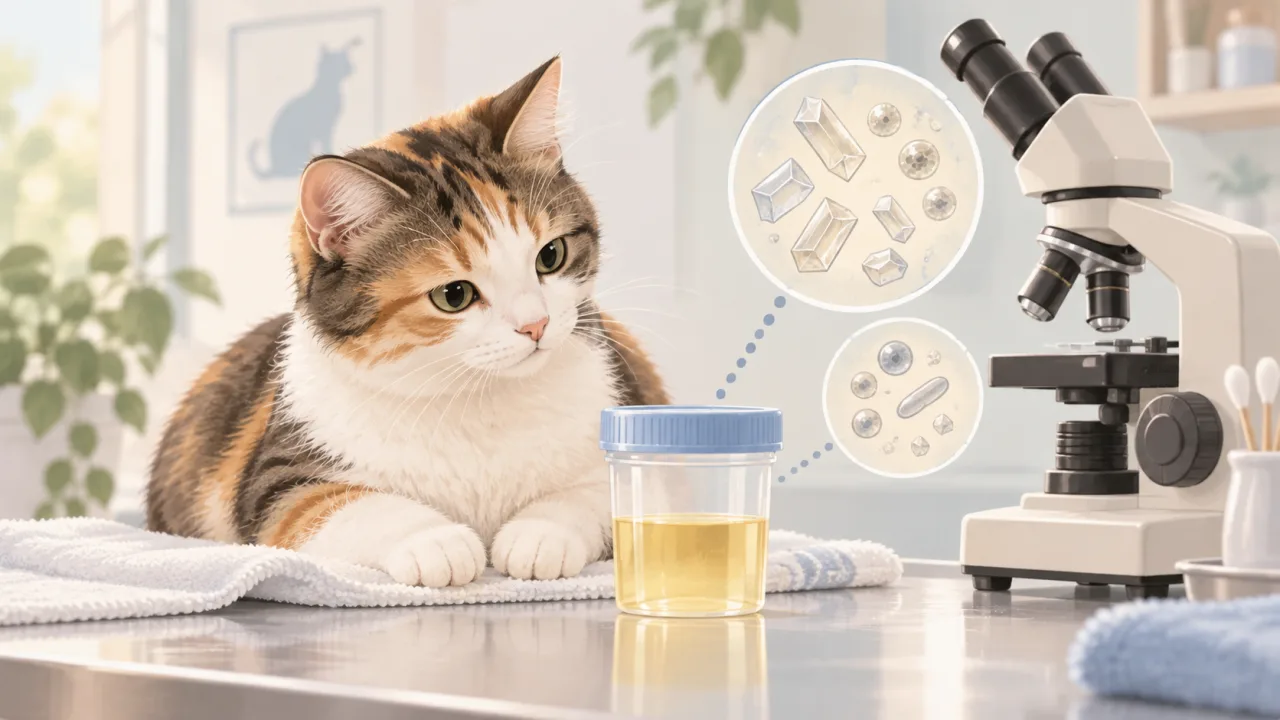
Crystals can form during storage, and stones can exist without crystals in the sample.[3] Keep microscopy findings separate from imaging findings in your notes. “Crystals observed” does not mean “a stone has grown.” Record the imaging description separately: location, size, number and the clinician’s interpretation.
4. Ask what imaging would change
Imaging can help assess recurrent or severe urinary signs and investigate stones or structural disease.[2] A second kind of test is not necessarily a repeat of the first. Ask which treatment decision the proposed examination could change. If cost is a constraint, ask the team to distinguish immediate priorities from later reassessment.
5. Leave with three sentences
CatLab suggests a short summary: what was found, what remains uncertain, and what happens next. An illustrative entry might be “Crystals reported; stone composition not confirmed; imaging follow-up to be agreed.” This is not a real patient result.
Keep units and the original report. Never enter a missing test as zero or normal. When comparing visits, compare the circumstances as well as the numbers. A clear record helps another clinician understand what is established without inheriting an accidental assumption.
References and editorial note
- Merck Veterinary Manual — Urinalysis
- 2025 iCatCare consensus guidelines on feline lower urinary tract diseases
- Minnesota Urolith Center — Being crystal clear about crystalluria
Evidence checked: 12 September 2026. CatLab educational synthesis, not individual diagnosis or a claim of veterinary manuscript review. Agree tests and treatment with your veterinarian.