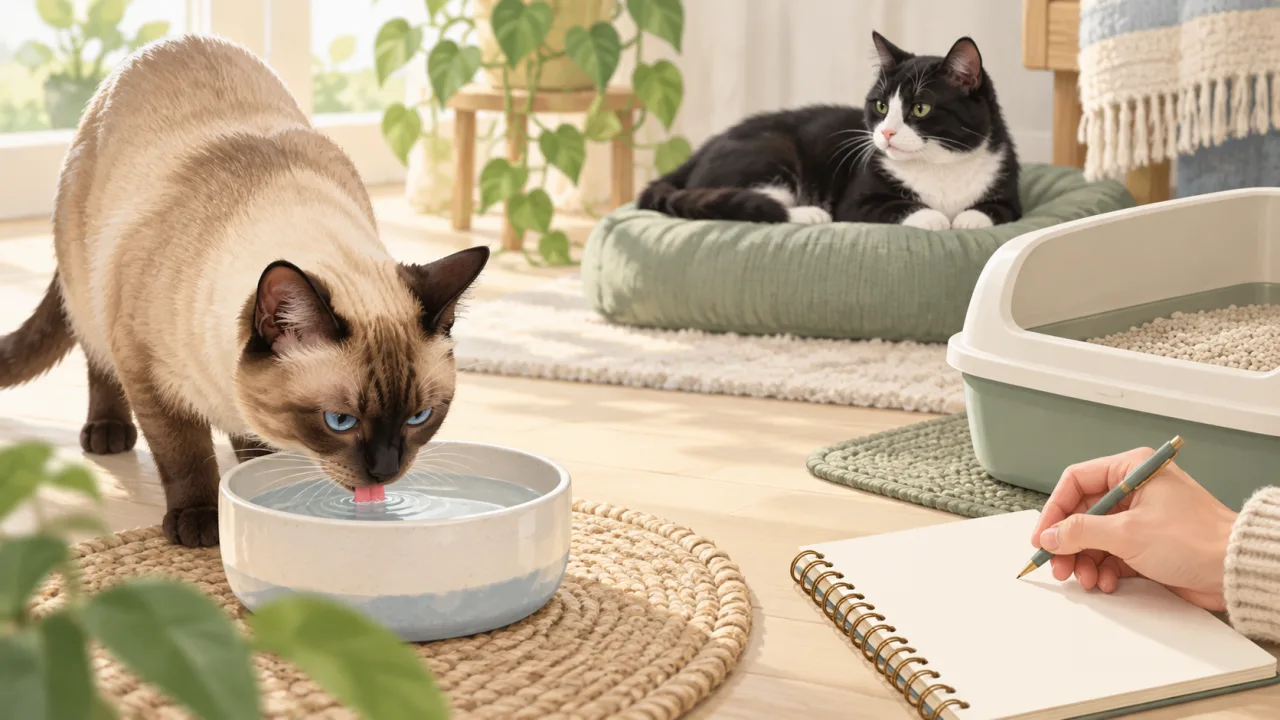
The water bowl is empty — but who drank it?
Urgent urinary signs
Repeated straining with little or no urine may be an emergency. Contact a vet immediately; do not wait to finish a diary or try a food or supplement. Do not squeeze the bladder at home.
An empty bowl feels reassuring until you ask who drank from it. Good records should show what was observed and what remains uncertain. Precision on a screen is not the same as certainty in the measurement.
1. Food contributes water too
Water comes from food as well as drinking, so a cat eating wet food may drink less from a bowl.[1] As an arithmetic example, 80g actually eaten at 75% moisture contains about 60g of water. This is not a feeding or drinking target. If the label gives a maximum moisture figure, the calculation is only an estimate.
2. Bowl loss is a household measurement
Spills, evaporation, shared access and water left inside a fountain complicate measurement. Label a shared total as shared; do not assign it to one cat. Avoid restricting water or removing familiar resources to obtain a cleaner number. “Unknown” is a valid record. Changing the household radically may change the very routine you meant to observe.
3. Separate visits from output
Repeated straining with little or no urine needs urgent veterinary assessment.[2] An automatic box counts events, not necessarily successful urination. When output is uncertain during repeated straining, contact the clinic rather than extending the observation period.
Do not convert clump size into millilitres using an invented formula. Litter and cleaning conditions differ. Record a change relative to the usual appearance, with photographs if already available. A photograph supports a description; it does not diagnose the cause.
4. Start with four fields
- Food actually eaten, added water and leftovers.
- Drinking measured directly or estimated for the household.
- Urination attempts, confirmed output and unusual signs.
- Observation limits such as absence, new litter or shared access.
This is a CatLab note-taking framework, not a validated diagnostic score. Complete records are less important than clearly identifying observations and the time a change began.
5. Make access comfortable
Fresh accessible water, a preferred bowl or fountain, and suitable wet food or added food water may help, with individual preferences taken into account.[1] Report poor appetite, low energy or concern about dehydration. Do not set a fluid-treatment dose from an online drinking target. The aim is a useful baseline for conversation, not passing a daily total.
References and editorial note
- Cornell Feline Health Center — Hydration
- Cornell Feline Health Center — Feline Lower Urinary Tract Disease
Evidence checked: 12 September 2026. CatLab educational synthesis, not individual diagnosis or a claim of veterinary manuscript review. Agree tests and treatment with your veterinarian.