Not fighting is not the same as feeling safe — the route to the litter box
Urgent urinary signs
Repeated straining with little or no urine may be an emergency. Contact a vet immediately; do not wait to finish a diary or try a food or supplement. Do not squeeze the bladder at home.
“They never fight” sounds reassuring. But perhaps one cat only approaches water after the other leaves. Rather than counting objects, ask whether each cat can reach what it needs when it needs it.
1. Tension can be quiet
Intercat tension may be subtle and go unrecognized.[1] Record actual scenes rather than deciding immediately that cats dislike one another. Who stops moving when another appears? Who avoids a formerly used space? Do not manufacture confrontations to test a theory. Describe naturally occurring events, including time, location and each cat’s response.
2. Draw the routes
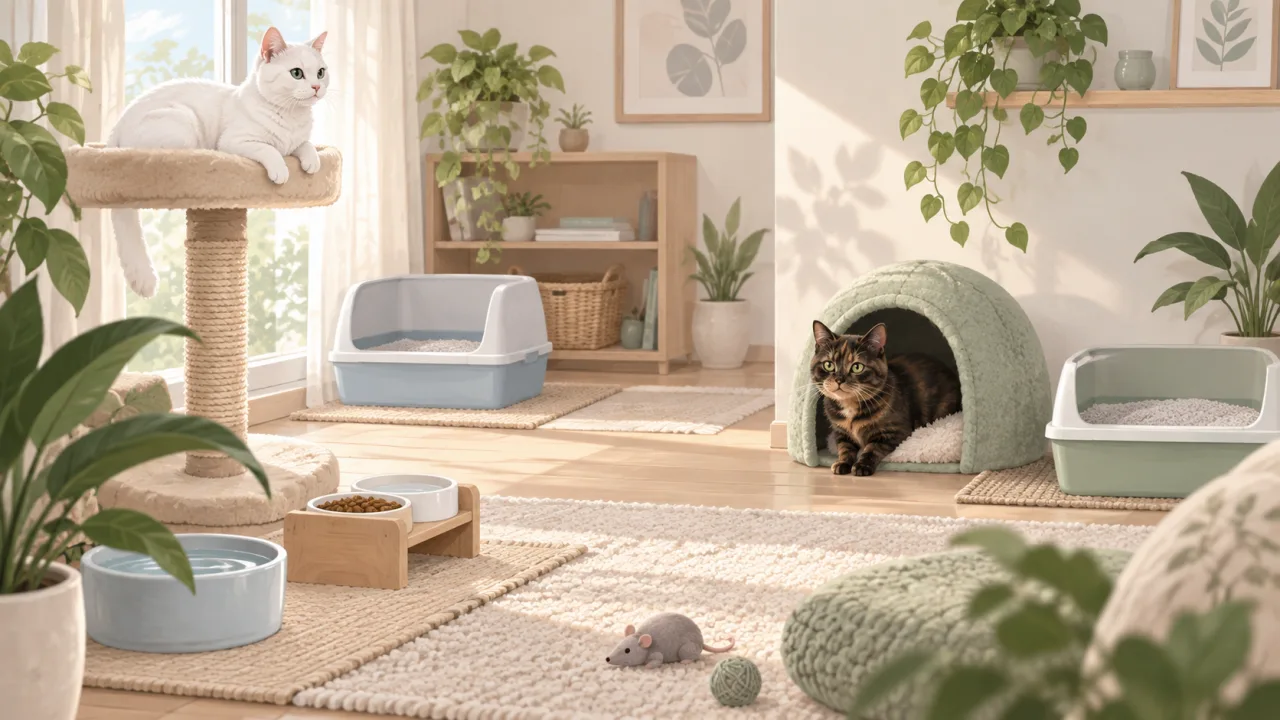
Safe resting places and separated resources are core environmental needs.[2] CatLab suggests sketching food, water, litter and resting places on a floor plan. Trace the route from each cat’s usual space. Look for bottlenecks or dead ends. This sketch is our planning exercise, not a validated behavioural diagnostic tool. It makes access easier to discuss than a list of purchases.
3. Count usable choices
Litter-box assessment includes location, size, substrate preference and cleanliness, alongside investigation of medical causes.[3] Do not treat urination outside the box as disobedience or punish it. Ask whether a closing door, household noise or a difficult entrance changes access. Observe use rather than assuming a new box solved the issue.
4. Make one observable improvement
Do not postpone urgent care or safety changes. For routine improvements, record what changed and what behaviour you hope to observe. A separate water location might be assessed by whether a previously waiting cat approaches comfortably. This is an example, not a universal layout prescription. Keep familiar safe options available where possible.
If food, litter and furniture all change together, explaining improvement becomes harder. Using a new object does not prove prevention of cystitis. Record treatment changes on the same timeline.
5. Safe coexistence is a worthwhile goal
Cats do not have to sleep together to have a workable home. Ask whether each can rest, eat and eliminate safely, and whether caregivers can sustain the arrangement. Persistent conflict or difficult introductions warrant professional help.[1]
This is not an exercise in blaming yourself. Nor is stress a reason to dismiss new blood or pain. The aim is a manageable home plan that sits alongside veterinary assessment.
References and editorial note
- 2024 AAFP Intercat Tension Guidelines
- AAFP and ISFM Feline Environmental Needs Guidelines (2013)
- AAFP and ISFM Guidelines for Diagnosing and Solving House-Soiling Behavior in Cats
Evidence checked: 12 September 2026. CatLab educational synthesis, not individual diagnosis or a claim of veterinary manuscript review. Agree tests and treatment with your veterinarian.