Does Kremezin actually lower creatinine?
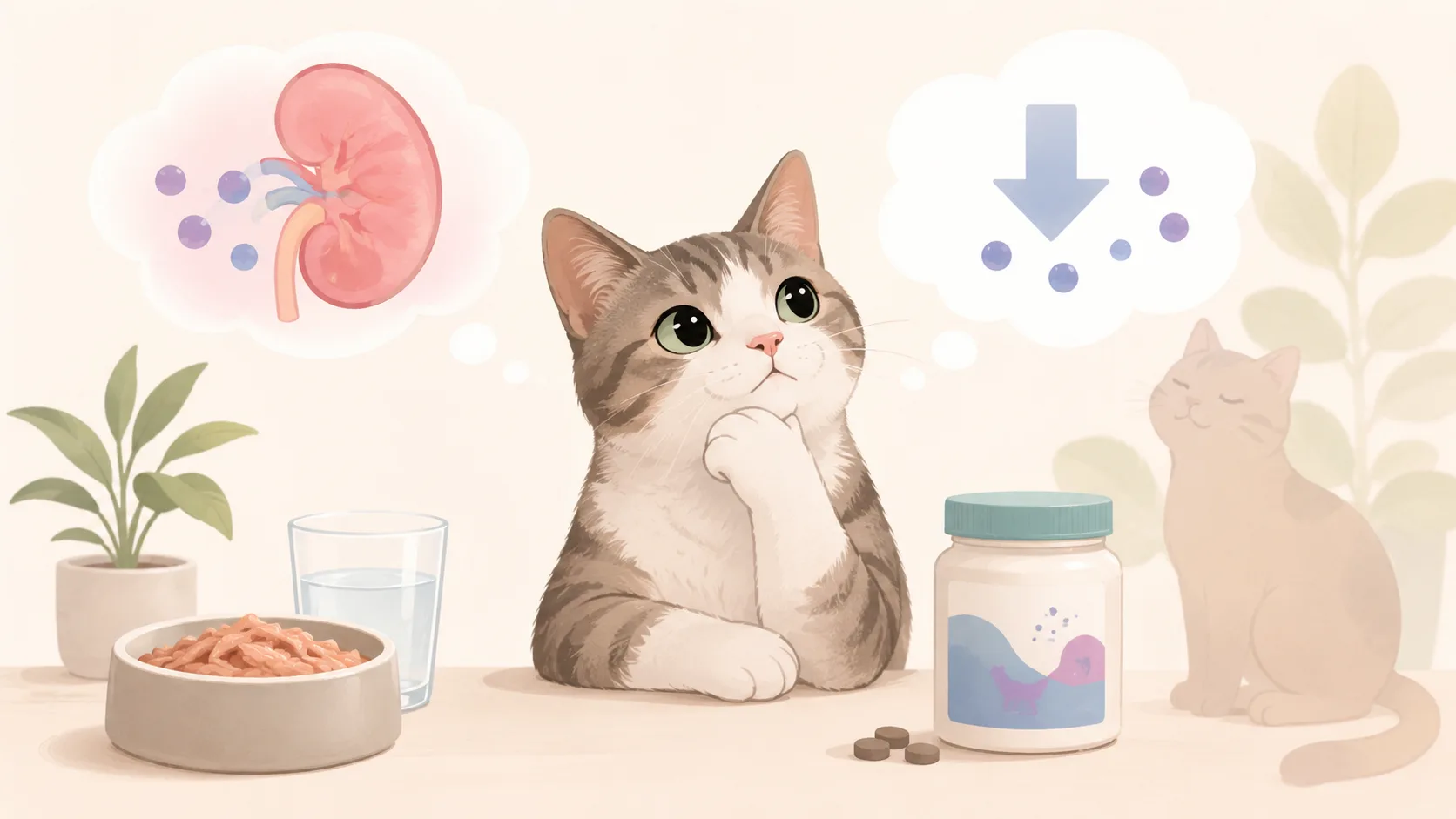
In short, Kremezin (and Renamezin, and AST-120 generally) is an oral adsorbent: it binds precursors of uremic toxins — above all indoxyl sulfate (IS) — inside the gut, so less of them is absorbed into the bloodstream.
Yet a great many owners believe it "lowers creatinine." Where did that come from?
First: what creatinine actually is
Creatinine is a waste product generated naturally as muscle uses energy. Its level in blood is an important indicator of how well the kidneys are filtering.
But creatinine itself has very low toxicity. It is not the thing damaging the body.
So why does the belief persist?
1. Coincidence, amplified by online reviews
Creatinine moves for many reasons besides kidney structure:
- Dehydration
- Renal blood flow
- Muscle mass
- Inflammation
- Nutritional status
Start the adsorbent while a dehydrated cat is also drinking more and generally recovering, and creatinine falls. The owner concludes, naturally enough: "I gave Kremezin and the creatinine dropped." Those accounts accumulate into a shared belief.
2. Conflating BUN and creatinine
The common assumption is "BUN is high and creatinine is high, so both are toxins." It's not quite that.
- Creatinine is close to a pure marker
- BUN is a marker too, but at high concentrations it does contribute to nausea, poor appetite and gastric irritation
Both being high is bad, but they harm in different ways. Collapsing "adsorbent" into "removes BUN and creatinine" is where the confusion starts.
3. IS and creatinine move together
Indoxyl sulfate is a genuinely toxic uremic solute that drives CKD progression. As IS rises:
- Inflammation increases
- Oxidative stress increases
- Fibrosis advances
That drags filtration (GFR) down further — and creatinine rises with it.
IS rises → kidney damage progresses → GFR falls → creatinine rises
This is correlation along a shared path, not a direct causal lever. Which makes it easy to feel that the adsorbent lowered creatinine directly.
4. Over the long run it can look like "creatinine protection"
Here is the important nuance. The adsorbent does not remove creatinine. But by reducing IS and similar toxins, it may slow inflammation and damage inside the kidney.
It is not a drug that takes creatinine from 5.0 to 4.0 today. Over months to years, though, what you may see is:
5. The influence of Japanese marketing material
Kremezin has been used in Japan for a long time, and the phrase "CRE improvement" is widespread in Japanese blogs, pharmacy material and owner reviews. In most cases that language is blended together with long-term slowing of progression and with functional recovery from other causes.
They are adsorbents that bind precursors of protein-bound uremic toxins such as IS and pCS in the gut, reducing how much enters the body.
So after starting one, creatinine may hold steady, drift down slightly, or drift up slightly. None of those three is automatically a failure.
Then why does creatinine fall sometimes?
A familiar story: a cat who normally runs around 2.x suddenly gets sick, and the clinic reads 6.0. After hospitalisation, fluids and medication, it comes back down to 3.0.
So creatinine can fall. True. But the key point is this:
1. The drop after hospitalisation
When a CKD cat's creatinine spikes suddenly, it is usually an acute injury layered on top of chronic disease. Common triggers:
- Dehydration
- Electrolyte imbalance
- Inflammation
- Pain
- Not eating
- Reduced perfusion
These functional problems drop GFR sharply, so creatinine jumps. Fluids, anti-emetics, pain control and electrolyte correction restore function, GFR rises, and creatinine comes back down.
That is functional recovery, not structural recovery.
Once the functionally recoverable portion is exhausted, additional fluid buys nothing and instead risks pulmonary edema, volume overload and cardiac strain.
2. The drop after initial diagnosis
Creatinine often falls in the weeks after diagnosis too — because the owner changed several things at once:
- Started a renal diet
- Increased water intake
- Corrected dehydration
- Controlled phosphorus
- Managed blood pressure
- Managed proteinuria
The kidney did not regenerate. The stack of aggravating factors was cleared, and function improved.
CKD is fundamentally progressive. So the question that matters is not "is creatinine rising?" but "how slowly is it rising?"