Is feline kidney disease inherited? — one in five is born carrying the risk
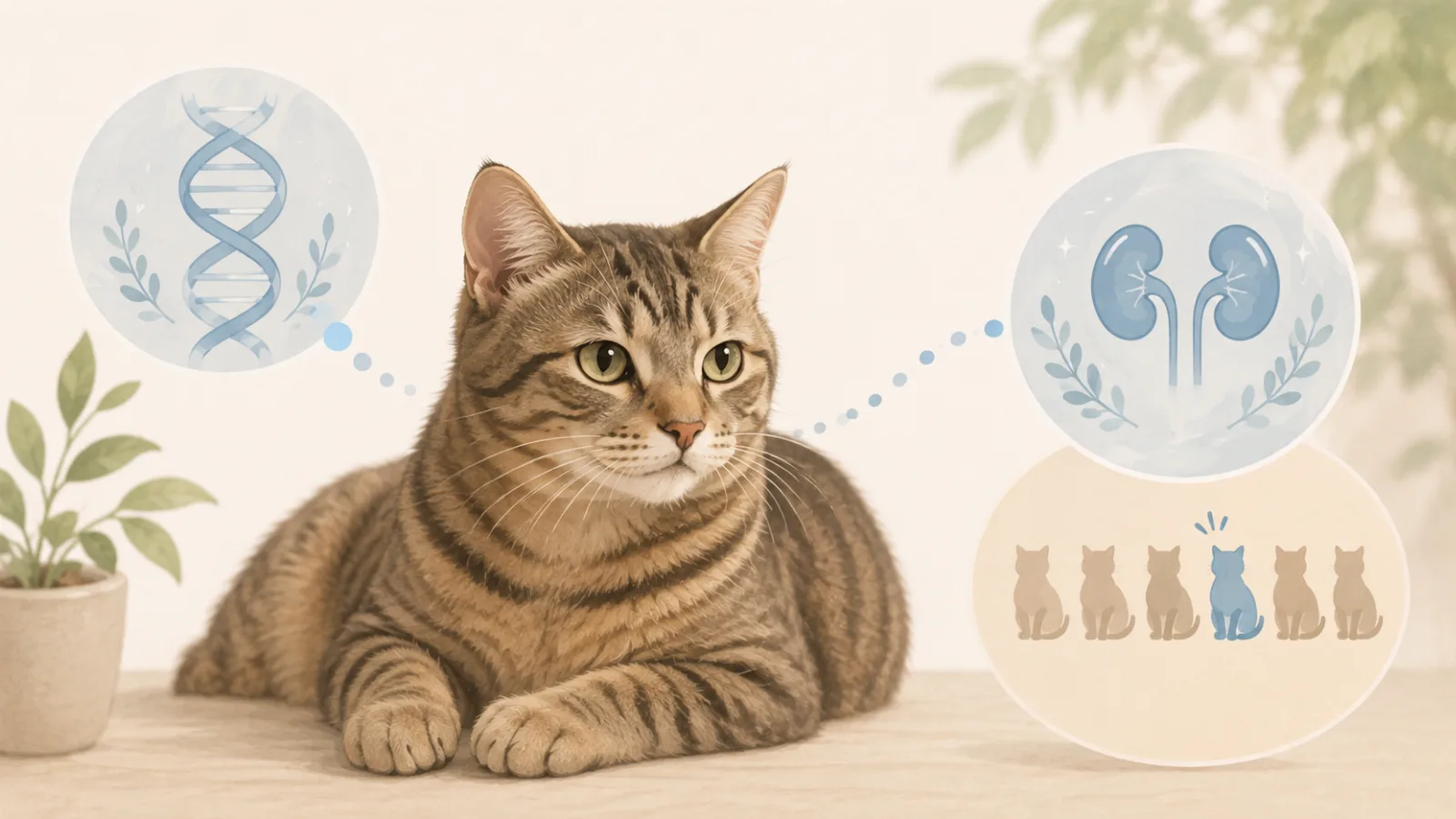
After a kidney diagnosis, the hunt for a culprit begins in every caregiver's head: was it the food, too little water, that course of antibiotics? In the last few years, the answer to this question has been shifting dramatically.
The short version — the genetics of feline kidney disease has three layers. Clear inherited diseases of specific breeds are one layer; a weakness built into the cat as a species is another; and the newest layer, mapped in 2026, is the individual variation summed up as "one in five is born carrying the risk." This article descends through all three.
1. Layer one — the breed diseases (the layer with a test sheet)
| Disease | Breeds | What is known |
|---|---|---|
| Polycystic kidney disease (PKD) | Persians and their lines (Himalayan, Exotic, Chinchilla), some Scottish Folds and Ragdolls | Fluid-filled cysts grow and crowd out normal tissue. Historically carried by ~38% of Persians worldwide — the flagship feline genetic disease. Autosomal dominant: one affected parent passes it to half the kittens. The causal variant (PKD1) is known and a commercial test exists; breeder screening has been shrinking the prevalence |
| Renal amyloidosis | Abyssinian/Somali, Siamese lines | A familial disease in which abnormal protein deposits in the kidney — sometimes appearing as kidney failure at 1–5 years of age |
| Congenital malformations | Any breed | Born with one kidney or incompletely formed kidneys — a separate article is planned |
Practical point — when adopting a Persian-line cat, requesting the parents' PKD1 results (or a clean ultrasound) is a legitimate, standard ask. For a Persian-line cat already at home, one genetic test or ultrasound settles it, and since cysts appear young, checking early pays. If PKD is confirmed, management walks the same road as this bible's CKD care — just potentially starting at a younger age.
2. Layer two — the species' weakness (the AIM story)
Here begins the most fascinating thread of the past decade of kidney research. The question was: why are cats, of all animals, so prone to kidney failure?
The answer proposed by Professor Toru Miyazaki's group in Japan is a blood protein called AIM — the body's cleanup foreman. When kidneys are injured, AIM is supposed to tag the dead-cell debris with a "clean this up!" flag. But feline AIM carries a species-wide defect: normally AIM waits bound to a large protein (IgM) and is released in emergencies — yet in cats that binding is extraordinarily strong (about 1,000-fold that of mice), so it never lets go. The foreman stays shackled for life; debris accumulates untagged; inflammation and fibrosis build.
That hypothesis produced the AIM-replacement drug (rAIM, branded FeliAIM) — injecting working AIM in place of the shackled native one. In a trial across 26 Japanese clinics, one-year survival of IRIS stage 3b cats rose from 20% to the 80% range, and in April 2026 the drug was formally filed with Japan's agriculture ministry — now under review. The drug's story continues in chapter 12, New treatments.
3. Layer three — 2026's new picture: one in five
This year added a twist: not only is every cat's AIM shackled — cats also differ from each other in the AIM gene itself.
A study published in JFMS in April 2026 genotyped the AIM gene (CD5L) in 1,000 cats. In some cats, one section of the gene (exon 3) is duplicated wholesale, producing an AIM protein one domain larger than normal — a restructured foreman whose competence is in doubt. The result:
| Genotype | Share | Meaning |
|---|---|---|
| Normal (no duplication) | 34% | Only three in ten carry genetically "normal" AIM |
| Carrier (one copy duplicated) | 46.7% | Nearly half carry one variant allele |
| High-risk (both copies duplicated) | 19.3% | One in five is born with only the variant form |
Does it connect to actual disease? It does. A 2025 study (JVIM) found that CKD cats homozygous for the variant had significantly higher odds of IRIS stage worsening. This variant is not genetic trivia — it is a candidate factor in the speed of progression.
4. So whose fault is it — what belongs where the guilt sits
- The food, the water bowl, that day's choices did not make this disease — a breed disease, a species weakness, an individual variant: all three layers are conditions set at birth. None of them were the caregiver's to choose
- Nor does "genetic" mean "fate" — some high-risk cats progress slowly, and normal-genotype cats still develop CKD by other roads (age, infection, stones). The genotype is a starting line, not a finish line
- What the caregiver holds is everything after the genes — early detection, phosphorus, water, blood pressure, blocking acute triggers. As "Is it incurable?" showed, those levers double survival time — regardless of genotype
5. Can you get tested — the honest present
| Test | Availability | Worth it? |
|---|---|---|
| PKD1 (polycystic) | Fully commercial — cheek swab, university and commercial labs | Clear value for Persian-line breeding and pre-adoption checks; for pets, ultrasound can substitute |
| AIM exon 3 variant | Early commercialisation at a few overseas providers | For now, closer to "good to know" — the result does not change management yet, but if the AIM drug is approved, that calculus may change (high-risk genotype = a logical priority candidate) |
| Amyloidosis etc. | No established single-gene test | For the affected breeds, regular kidney values from a young age are the practical answer |
6. If there are blood relatives — siblings, parents, kittens
- Relatives of a PKD-confirmed cat — dominant inheritance makes checking parents, siblings and offspring (test or ultrasound) genuinely worthwhile
- Relatives of an ordinary CKD cat — as the AIM story shows, genetic background can be shared; for littermates, regular creatinine/SDMA checks from middle age, kept a little more faithfully, is proportionate — not paranoid
- Telling the breeder — a pedigreed cat diagnosed young deserves the same principle as in the HCM genetics article: information for the next generation, not accusation
7. What to ask your vet
- "(Persian line) shall we check for PKD with the PKD1 test or an ultrasound?"
- "(Diagnosed young) this seems early for age — any signs pointing to a genetic or congenital cause?"
- "(A littermate at home) should the sibling start regular kidney values?"
- "Any news on the AIM drug (FeliAIM) reaching us — and would this cat be a candidate once approved?"
8. Related
- New treatments — the AIM drug's main story
- Is kidney disease incurable? — the levers the caregiver holds after the genes
- Acute vs chronic — the non-genetic roads
- Is HCM inherited? — the cardiac sister article: same question, same principles