Is HCM inherited? — Maine Coons, Ragdolls and genetic testing
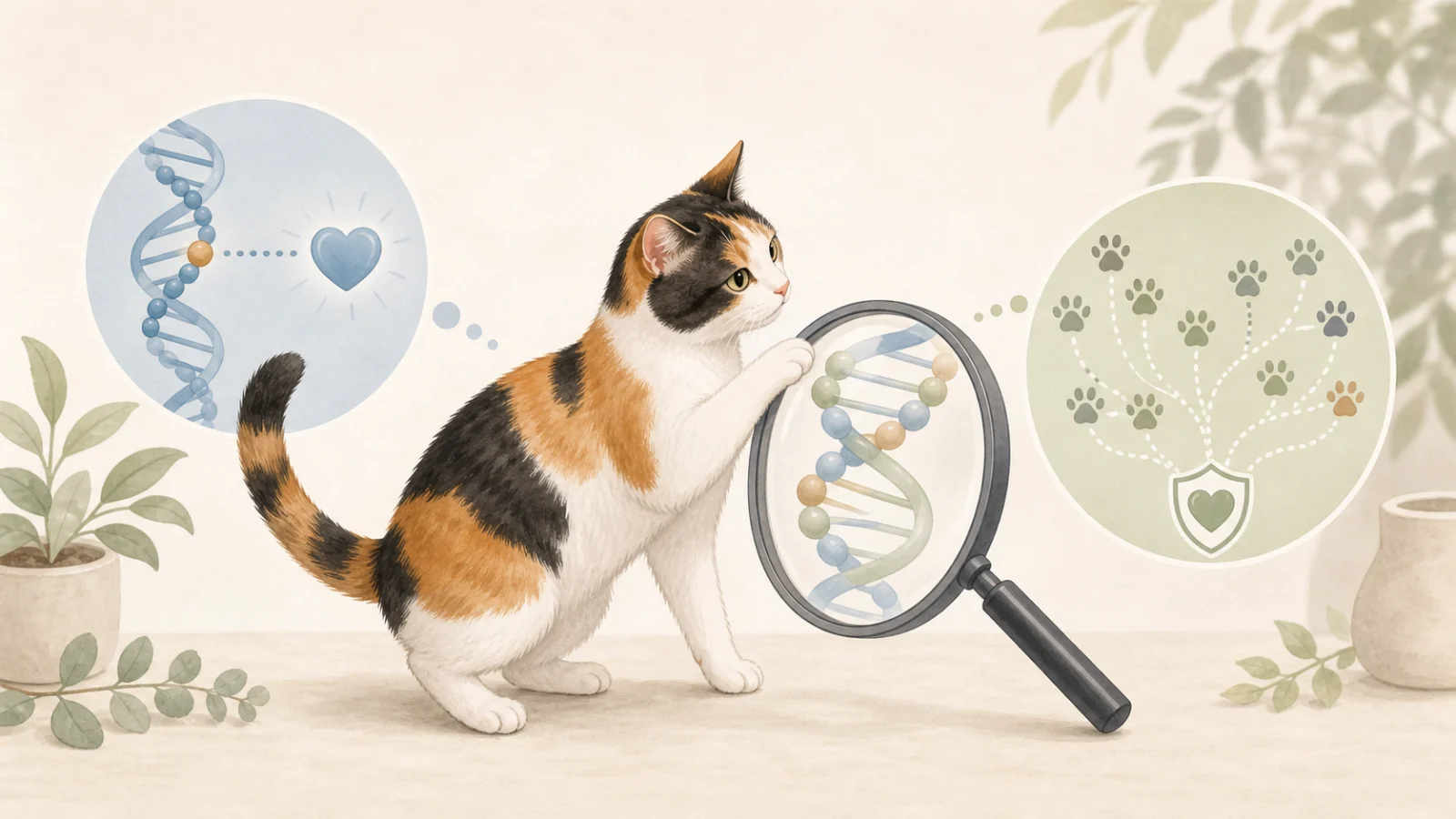
This question arrives from two directions. Maine Coon and Ragdoll caregivers ask, "our breed is high-risk — should we do the genetic test?" And domestic shorthair caregivers ask, after the diagnosis: "why our cat… is it the parents? Are the siblings at risk?"
The skeleton of the answer: HCM is strongly influenced by genetics. But "a disease explained by a single gene" is true only in a few breeds; in most cats it is a familial disease whose culprit gene has not been found. Grasp that distinction, and what a genetic test can and cannot do becomes precise.
1. Is it inherited — the accurate phrase is "a familial disease"
HCM is the classic inherited heart disease in humans, and in cats it clusters in families. The causes are variants in the genes that build the heart muscle's contractile machinery — typos in the blueprint. Muscle built from mistyped protein thickens abnormally over the years.
But across cats as a whole, a specific culprit has been pinned down only in a handful of breeds and variants. The majority — including most domestic shorthairs — are presumed polygenic, a blend of several genes with age, blood pressure and other factors. The accurate position: "strongly genetic, but not yet a disease confirmed by a single test sheet."
2. The identified variants — a breed-by-breed report card
| Breed | Variant | What is known |
|---|---|---|
| Maine Coon | MYBPC3 A31P (found 2005) | Widespread — in a large European survey, 38% carried one copy and 3.5% two. Carrying it raises HCM risk about tenfold. Two copies (homozygous) carry a clear risk of severe disease and sudden death before age 4; one copy often never develops disease (incomplete penetrance) |
| Ragdoll | MYBPC3 R820W (found 2007) | Two copies: high risk of severe disease at 1–2 years of age. One copy: usually a normal lifespan — the textbook example of copy number deciding fate |
| Sphynx | ALMS1 variant | An association is reported, but the variant is so common in the breed (allele frequency above 50%) that current opinion holds it is not yet fit to guide breeding decisions |
| Others (Bengal etc.) | Candidate variants under study | Not yet at the level of an established commercial test |
One striking fact — the same MYBPC3 gene is a leading cause of human HCM. Cats and people stumble on the same page of the same blueprint, which is why feline research feeds human therapy development and back again — the current you saw in the rapamycin article.
3. Reading a test result — what the three boxes mean
| Result | What it means | What it does NOT mean |
|---|---|---|
| N/N | That variant is absent | Not "won't get HCM" — many cats develop it from causes no test covers. In a predisposed breed, echo screening continues |
| N/HCM | Elevated risk — a candidate for scheduled echo surveillance | Not "a patient" — many never develop disease (incomplete penetrance), and there is no basis for preemptive medication |
| HCM/HCM | High risk — dense echo surveillance from a young age (e.g. once or twice yearly) | Not a verdict — but the density of watching must change |
4. The predisposed breeds — what to do, test or no test
Test or no test, the breeds where this familial disease clusters are known: Maine Coon, Ragdoll, Sphynx, British Shorthair, Persian, Bengal, Norwegian Forest, Birman and others. For them, the practice is simpler than any test:
- Never skip the yearly auscultation — the baseline net (the murmur article's procedure)
- Consider a screening echo — especially with a family history of HCM or sudden death, or in breeding cats. One baseline echo in adulthood becomes the origin for every later comparison
- Before adopting — asking the breeder for the parents' genetic test results (Maine Coon/Ragdoll) and echo history is a legitimate and standard request. Conscientious breeders keep these documents ready
5. Breeding principles — and what it means to tell the breeder
- Homozygous (HCM/HCM): out of the breeding pool — undisputed
- Heterozygous (N/HCM): phased out gradually — removing all carriers at once (38% of Maine Coons!) would slash the gene pool and invite other inherited disease. The standard advice: mate carriers only to negatives and select negative offspring, shrinking the variant over generations
- Genetic test AND echo — because untestable causes exist, international guidance pairs breeding-cat DNA tests with echo screening
6. For the domestic shorthair family — the question "whose fault?"
- Not the caregiver's — food, lifestyle and stress do not create this disease. It is a blueprint matter, and the blueprint was fixed at birth
- There is no gene to test — applying the Maine Coon or Ragdoll test to a domestic shorthair is meaningless (those variants belong to those breeds). The genetic background of DSH HCM is still research territory
- If there are littermates, parents or kittens — it is a familial disease, so blood relatives of a diagnosed cat deserve diligent auscultation, and one screening echo when feasible. That is not overreaction; it is proportionate
- Neutered pets — with no breeding plans, the genetics of this disease matters practically only as far as "check the family"
7. Testing in practice — if you go ahead
- Sample — usually a cheek swab or a small blood sample; nearly zero burden on the cat
- Where — university laboratories (UC Davis VGL and others), commercial panels, some domestic providers; going through your clinic bundles collection and interpretation
- Cost — modest for a single-variant test, cheaper than an echo — but remember it is separate information, not a substitute
- When it earns its fee — ① breeding decisions in Maine Coons/Ragdolls ② checking parents' papers before adopting those breeds ③ setting surveillance density in a predisposed breed. Conversely, for a pet already diagnosed by echo, the result rarely changes management
8. What to ask your vet
- "(Maine Coon/Ragdoll) is the genetic test worth doing for this cat — and how would the result change what we do?"
- "(Positive) how often should we echo from here?"
- "(Predisposed breed, no signs) should we get one baseline echo on record?"
- "(DSH, after diagnosis) should the sibling cat at home be checked too?"
- "(Before adoption) exactly which documents should I request from the breeder?"
9. Related
- The day of diagnosis — inherited or not, the road after diagnosis is the same
- When they hear a murmur — the predisposed breed's baseline net
- Reading the echo report — always the final judge
- Rapamycin — where the genetics is taking treatment next