Rapamycin — the first drug aimed at the disease itself
One sentence has repeated through this whole bible: "no drug has been proven to slow asymptomatic HCM." As the medications article showed, atenolol, ACE inhibitors and diltiazem all failed that test, and every drug we had was a complication-blocker — against clots and water, never the disease.
That sentence is finally being shaken. Rapamycin (sirolimus) became, in a 2023 clinical trial, the first drug to halt the progression of hypertrophy — and in 2025 it became the first approved drug in the history of feline HCM (Felycin-CA1). This article covers what it is, how far the evidence reaches, and what a caregiver outside the US can do right now.
1. Why this drug is different — it aims at a different target
Existing cardiac drugs adjust the heart's work — rate, pressure, water. Rapamycin aims elsewhere: at the switch that makes cells grow.
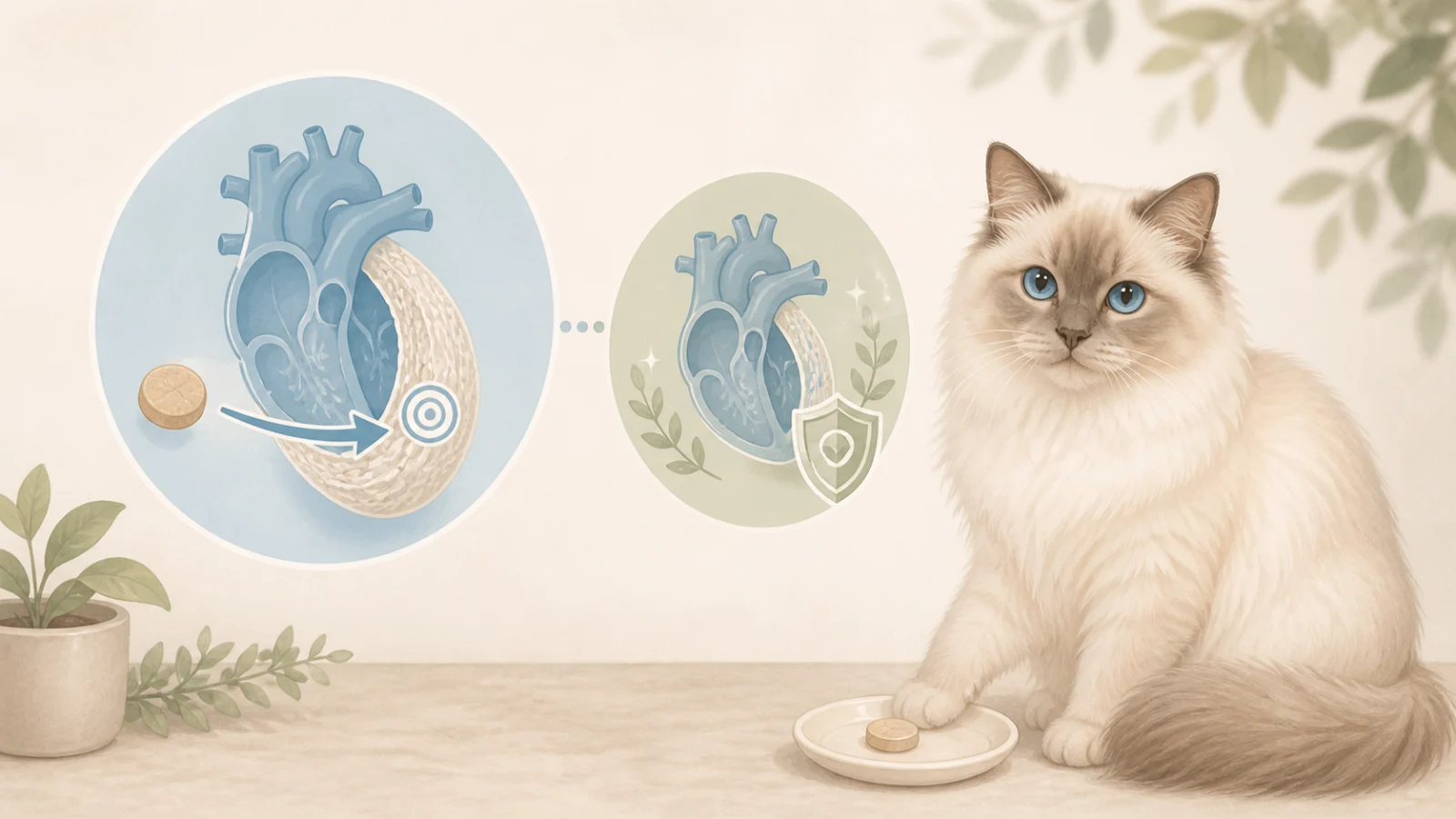
Inside cells sits a growth regulator called mTOR. It is normal machinery for building muscle — but in the HCM heart this switch runs hot and will not turn off, and the myocardium keeps thickening. Rapamycin turns that switch down — intervening not in the result (hypertrophy) but in the process that produces it. The first drug in this disease to do so.
It is an old human transplant drug — but the feline product is engineered as once weekly, delayed-release, low dose, seeking the mTOR effect without immunosuppression. That is why the scary search results about "immunosuppressants" do not apply as written.
2. RAPACAT — the first trial where progression stopped
| Item | Detail |
|---|---|
| Subjects | 43 client-owned cats with subclinical, non-obstructive HCM, aged 1–12 |
| Design | Double-blind · randomised · placebo-controlled · multicentre — the standard format of a real drug trial |
| Dosing | Once-weekly delayed-release rapamycin (low dose / high dose / placebo), 6 months |
| Result | At 6 months, maximum LV wall thickness in the low-dose group was significantly lower than placebo — the placebo hearts thickened; the treated hearts were held |
| Safety | Generally well tolerated |
Two honest restraints alongside: this is a 43-cat, 6-month result (whether lifespan, failure and clots actually improve needs longer follow-up), and it was obtained in subclinical, non-obstructive cats — there is no data yet for stage C. The drug's current position: "a candidate that holds stage B in place," not a treatment for all of HCM.
3. Felycin-CA1 — what "conditional approval" precisely means
- Indication — management of ventricular hypertrophy in cats with subclinical HCM
- Dosing — 0.3 mg/kg orally once a week
- "Conditional" — safety demonstrated, efficacy accepted at the level of "reasonable expectation," while the large confirmatory trial (PIVOTAL) runs. Its results, within a few years, will be this drug's final report card. It is the first product ever approved for feline HCM under any indication
4. Side effects and contraindications — know these in advance
| Item | Detail | Response |
|---|---|---|
| Diabetes — contraindicated | A diabetic cat on the drug developed ketoacidosis and died; the label forbids use in diabetes | Never start in a diabetic cat; stop immediately if diabetes is diagnosed during treatment |
| Liver enzymes | Asymptomatic elevations in some cats | Recheck blood 1–2 months after starting, then every 6–12 months; stop if values exceed 2× the upper limit |
| GI and demeanour | Lethargy, vomiting, diarrhoea, reduced appetite reported | Usually mild — discuss if persistent |
| Cardiac events | Arrhythmia, failure etc. reported in trials — mostly the disease progressing | The disease's own surveillance (breathing rate) continues regardless of the drug |
5. Outside the US — and what not to do
- Not yet approved or distributed in most countries (as of 2026). US vets have begun prescribing; elsewhere the introduction timeline is unset — asking "any news on availability?" at each recheck is entirely reasonable
- Do not imitate it with human sirolimus — this drug works because it is delayed-release + low dose + once weekly. Feeding a human immediate-release formulation at improvised doses is not the same drug: it is a different drug with immunosuppression and side-effect risks. The same goes for grey imports and improvised compounding
- The best use of the waiting time — the drug's target is asymptomatic stage B. Which means knowing the stage precisely (echo), watching progression (breathing rate, rechecks), preventing clots (clopidogrel at B2), and keeping the cat in stage B as long as possible is also the path to being a candidate on the day it arrives
6. The rest of the pipeline — a look ahead
- Myosin inhibitors (the mavacamten family) — drugs that directly calm the heart muscle's motor protein. Already approved for human HCM — and cats were pivotal to that development: given to HCM cats, MYK-461 abolished SAM and relieved outflow obstruction (2016). No feline product yet, but this family is the watched next card for obstructive HCM
- Genetic testing — the causal variants of Maine Coons (MYBPC3 A31P) and Ragdolls (R820W) have commercial tests, used to reduce the disease at the breeding stage. Ordinary domestic cats' HCM is not yet explained by a single gene
- Gene therapy — trials editing or compensating causal genes have begun in human HCM. Far from cats yet — but that is the direction the field faces
7. Does it apply to my cat — the frame
| Your cat | Distance to this drug |
|---|---|
| B1·B2 (asymptomatic) | Closest — RAPACAT and the approved indication are exactly this group; first in line for discussion where available |
| C (after failure or clot) | No data — standard care (diuretic, clopidogrel) takes precedence for now |
| With diabetes | Contraindicated |
| Equivocal (wall 5–6 mm) | Not yet a candidate — first establish whether it is truly HCM |
8. What to ask your vet
- "Any news on availability of rapamycin (Felycin) here?"
- "By stage, would my cat be a candidate once it arrives?"
- "If we ever start it, what would the liver and glucose monitoring schedule look like?"
- "Until then, what is the best we can do now? (stage, rechecks, prevention)"
- "(If obstructive) would you keep me posted on feline myosin-inhibitor developments too?"
9. Related
- Understanding the medications — the timetable, and the history of failures before this drug
- Between B1 and B2 — knowing precisely the stage this drug targets
- Reading the echo report — wall-thickness tracking, the drug's own outcome measure
- The HCM Bible — contents