Understanding the medications — the cardiac drugs as a timetable
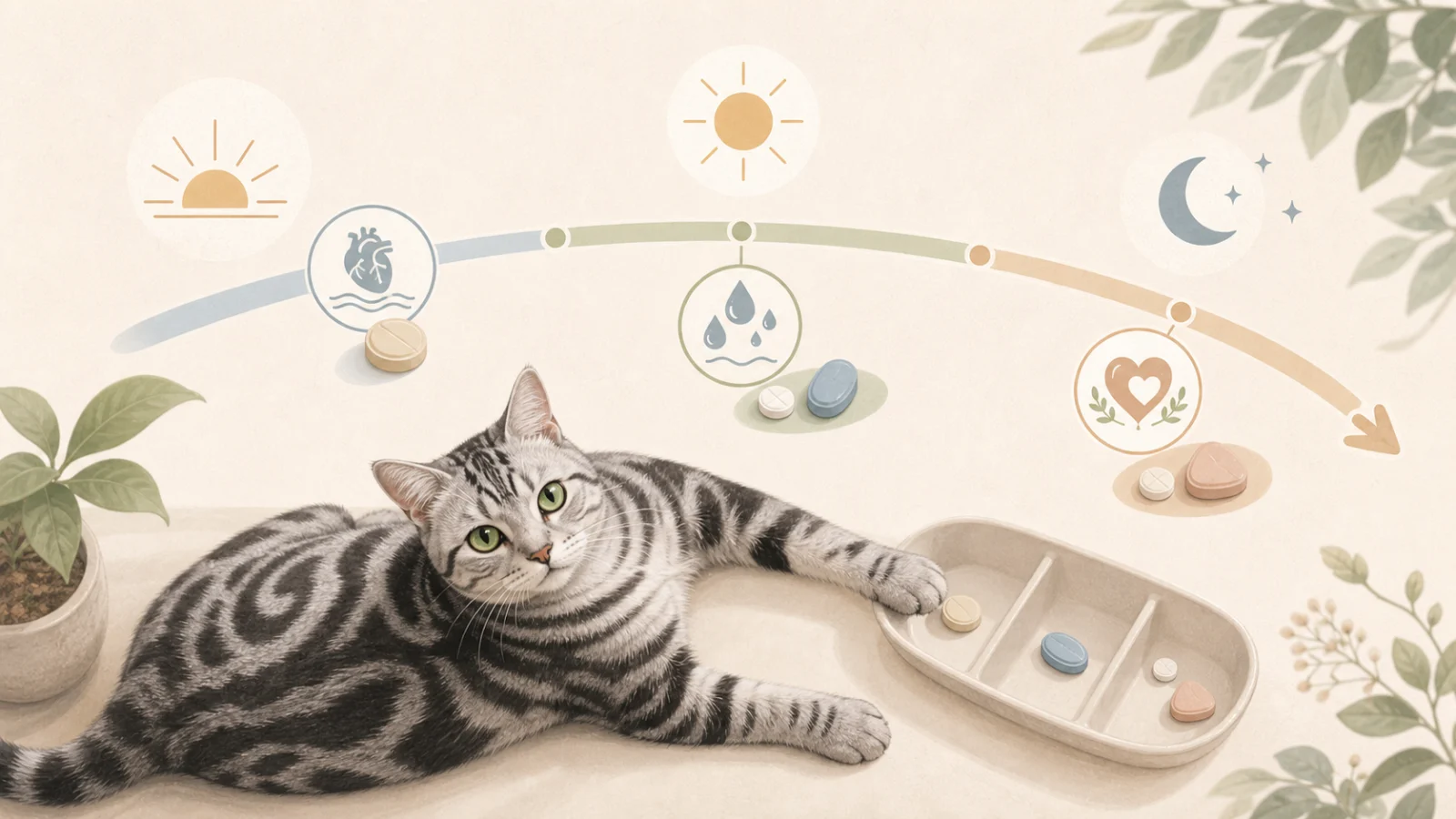
Sooner or later, the drug names start arriving: clopidogrel, furosemide, pimobendan, atenolol… The best way to understand them is not a list of ingredients but a timetable. HCM's drugs enter the stage in a fixed order, one per act of the disease — and once you know the order, both "why isn't my cat on anything?" and "why did the pills suddenly multiply?" answer themselves.
1. The whole timetable — which stage brings which drug
| Stage | Standard | Situational |
|---|---|---|
| B1 | Nothing — surveillance is the treatment | — |
| B2 | Clopidogrel (clot prevention) | Atenolol considered for severe obstruction (SAM) or tachycardia |
| C (after failure or a clot) | Furosemide + clopidogrel | Pimobendan (off-label); rivaroxaban added for high recurrence risk |
| D (refractory) | Furosemide → torasemide | Adjust the rest; palliative mindset |
Two principles jump out: drugs enter not to fix the heart but to prevent its complications (clots and water), and they multiply only when the stage moves. Which means: if the pills increased, the stage moved — time to reread the staging article.
2. Why B1 gets nothing — the history of failures sets you free
The frustration of "there's a disease, why no medicine?" is answered by history. Veterinary cardiology spent twenty years seriously testing drugs for asymptomatic HCM — and the candidates fell one by one.
| Candidate | The hope | The result |
|---|---|---|
| Atenolol (beta-blocker) | Slower heart rate, less myocardial strain | 5-year follow-up in asymptomatic cats — no survival benefit (Schober 2013) |
| Benazepril (ACE inhibitor) | Blocking RAAS to curb remodelling | Randomised placebo-controlled trial — no benefit shown (King 2019) |
| Ramipril · spironolactone | Less hypertrophy and fibrosis | No effect; spironolactone caused severe skin lesions in some cats |
| Diltiazem | Better relaxation | Failed to show survival benefit — effectively retired |
So "no drugs at B1" is not neglect — it is the conclusion of those trials (ACVIM 2020). A daily pill without benefit adds only stress and side effects. The candidate hoping to change this is rapamycin, now in clinical trials and covered in chapter 12 — the first drug aimed at the disease itself.
3. Clopidogrel — the most important half-tablet in this disease
- Evidence — in the FAT CAT trial it more than doubled the time to clot recurrence versus aspirin (443 vs 192 days); ACVIM recommends it preventively from B2, when clot risk rises
- Dose — usually 18.75 mg once daily (a quarter of the human 75 mg tablet). Cutting is a chore — ask about pharmacy splitting or recompounding into capsules
- The great obstacle is the taste — intensely bitter; touch it to the tongue once and the cat foams and never forgives. Capsule it or wrap it completely in a pill pocket or treat from the very first dose — keeping it off the tongue is the whole game
- Side effects are few — occasional vomiting or reduced appetite; visible bleeding tendencies are rare
- Do not stop — a drug that prevents an accident shows no visible effect, which makes quiet discontinuation the most common failure mode. Before surgery or dental work, discuss whether to pause it
4. Furosemide — stage C's lead, in summary only
When failure comes, the diuretic takes the lead. The rule is "the lowest dose that keeps the lungs dry", the compass is the sleeping breath rate, and the price is kidney strain — the full tightrope lives in the heart failure article, section 4. One point here: a diuretic treats a symptom, not the disease — it is never started before water exists (stage B).
5. Pimobendan — between promise and debate
- What — boosts contraction and opens vessels; standard in dogs, off-label in cats
- Evidence — a retrospective study of CHF cats reported longer survival on it (Reina-Doreste 2014), but there is still no randomised trial
- Caution — in the many HCM cats with SAM (outflow obstruction), boosting contraction can worsen the obstruction; clinics legitimately differ, and that reflects divided evidence, not divided skill
- Your role — ask: "does my cat have SAM, and given that, what is pimobendan's cost-benefit here?"
6. Atenolol — demoted from prognosis drug to symptom drug
As section 2 showed, atenolol failed the "slow the disease" test. But it was not expelled — it changed seats: for cats (often young ones) whose severe SAM narrows the outflow with loud murmurs and fast rates, it serves as symptom relief, slowing the heart and easing the obstruction. Two cautions: beta-blockers can rebound (racing heart) if stopped abruptly — taper with your vet; and it is generally not newly started in active heart failure.
7. Pilling in practice — the craft of making medicine happen
- Never dry-pill and walk away — a tablet lodged in the oesophagus can cause inflammation and strictures. Follow every pill with a lick of churu or a sip or two of water
- Bitter drugs (clopidogrel) must be shielded — capsules, pill pockets, fully buried in food. One taste and the cat starts auditing that treat forever: the first impression is everything
- Missed dose — if it is nearly time for the next one, skip and resume on schedule. Never double up. When unsure, call
- Agree the priority — for the day not everything goes in (usually diuretic → clopidogrel → the rest), a pre-agreed order replaces guilt with a rule
- Log it — dose times and refusals in the app; "he keeps spitting it out lately" is the evidence that gets a formulation changed
- Declare the med list — at any other clinic, and before any anaesthesia (clopidogrel especially)
8. What to ask your vet
- "By my cat's stage, where on the timetable does this prescription sit?"
- "Can clopidogrel be recompounded into capsules? Pilling keeps failing."
- "Given SAM status, are pimobendan and atenolol each a net gain or loss here?"
- "Which of these drugs need lab rechecks, and how often? (diuretic = kidneys, potassium…)"
- "For each drug, what do I do if a day is missed?"
- "Could a newer treatment like rapamycin ever apply to this cat?"
9. Related
- Between B1 and B2 — the moment clopidogrel enters the timetable
- Heart failure — the diuretic tightrope in full
- The clot (ATE) — clopidogrel and the rivaroxaban combination
- Feeding the heart-disease cat — where supplements end and drugs begin