Clopidogrel — the most important half-tablet
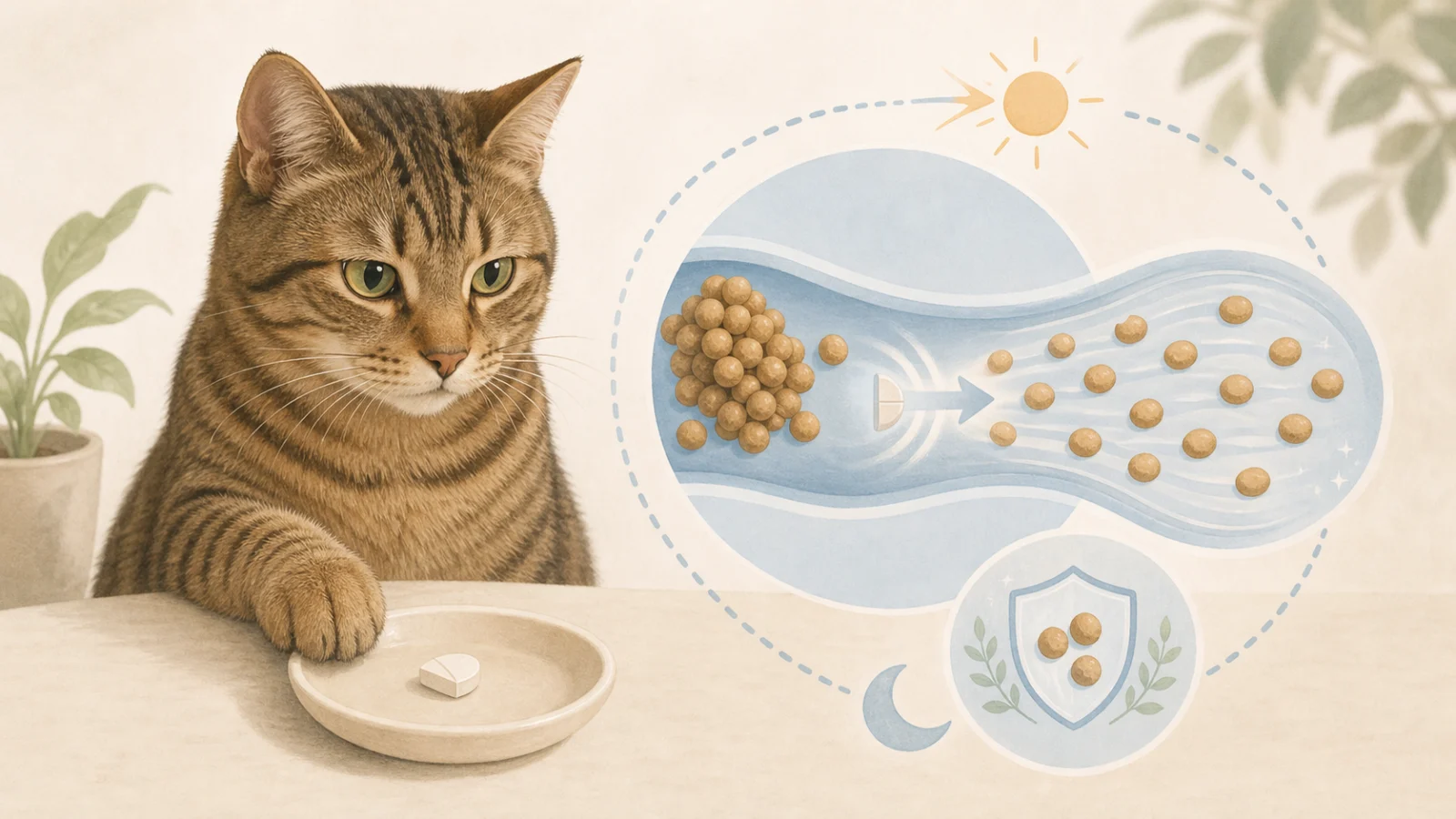
The medications article introduced this drug as "the first on stage and the longest-serving." This is the lead actor's solo interview — how it works, why it must be daily, how to actually get it into the cat, and when to suspect it is not working.
It earns a solo article for a simple reason: it is essentially the only oral drug proven in a clinical trial to prevent this disease's most feared event (the clot) — and at the same time the drug that fails most often: to the bitter taste, to its invisible benefit, to "one day won't matter."
1. Why this drug — the weight of the evidence
Seventy-five cats who survived a clot, split double-blind between clopidogrel and aspirin — the FAT CAT trial is the bedrock of feline antithrombotic care. The result: median time to recurrence or cardiac death, 443 days on clopidogrel versus 192 on aspirin. More than doubling the time pushed aspirin to the second row, and ACVIM recommends this drug preventively from B2, and as a near-necessity at C.
Hold onto one fact — this is not a blood-pressure drug or a heart drug. It does nothing to the heart itself. It is purely insurance against the moment pooled atrial blood congeals. Which is why its benefit is invisible, why it gets quietly stopped, and why this article exists.
2. How it works — breaking the platelet's button
On each platelet's surface sits a button (the P2Y12 receptor) that receives the "clump together!" signal. Clopidogrel's active form bonds to that button permanently and breaks it. A platelet with a broken button clumps poorly for the rest of its life.
Three practical rules fall out of that word "permanently":
- About a week to full effect — the time it takes for the body's whole platelet population to turn over into the broken-button generation. Day one is not full protection, so in high-risk moments the hospital may bridge the gap (injectable anticoagulants)
- About a week back to baseline after stopping — new platelets are born daily. "He's been fine, so we skipped a few days" means the shield is already thinning
- Switched on in the liver (a prodrug) — the swallowed molecule is inactive until the liver converts it, and that conversion efficiency differs between cats — the background of the "non-responder" issue below
3. When it starts — the timetable, plus one genuine debate
| Situation | Recommendation |
|---|---|
| B1 (normal atrium) | Not yet standard — clot risk itself is low |
| B2 (enlarged atrium) | Preventive start recommended (ACVIM); stronger still with smoke or low appendage velocity |
| C (after failure or clot) | Effectively essential — FAT CAT is the recurrence-prevention evidence itself |
| High recurrence risk (repeat clots, persistent smoke) | Continue clopidogrel + discuss adding rivaroxaban (the clot article, section 6) |
The debate: for a cat at the very edge of B2 — an atrium just beginning to stretch — clinics can legitimately differ on starting now. "It is a benign drug; starting early costs little" and "lifelong dosing deserves one more confirmatory finding" are both defensible. Either way, hearing the "why" is the caregiver's part.
4. Getting it in — this drug's real battlefield
The dose is usually 18.75 mg once daily — a quarter of the human 75 mg tablet, with or without food. The problem is not the dose but the taste. It is ferociously bitter; one touch on the tongue brings foaming and drooling — and worse, the cat begins auditing that treat, and that hand.
- Rule one: never on the tongue — from the first dose, inside an empty gelatin capsule (pharmacies sell them) or fully wrapped in a pill pocket or cream treat. A cut tablet with its bitter face exposed is the worst delivery
- Recompounding is the structural fix — ask the clinic or a compounding pharmacy to pre-portion quarter-dose capsules: no more daily cutting, no more taste accidents. If failures keep happening, ask
- Water or a lick of churu after — so no pill or capsule lingers in the oesophagus
- Vomited right after? — if the pill is visible in the vomit, give one more; if not visible and 30+ minutes passed, count it absorbed. When unsure, skip the day and call — never double
- Missed a day? — give when remembered unless the next dose is near, then skip. One gap does not collapse the shield (platelet turnover runs on weeks) — accumulating gaps is the real danger. Turn on the app's dosing check
5. Side effects and watching — mercifully, a gentle drug
- Generally safe — long-term tolerance in FAT CAT was good; no bloodwork is needed for this drug's sake (riding along on other scheduled panels is plenty)
- Common-ish — vomiting, reduced appetite (usually transient; persistent → discuss timing or formulation), and foaming (a taste-exposure accident — a technique problem, not a side effect)
- Rare — visible bleeding tendency. Still, know the watch-list: gum bleeding, blood in urine or black stool, unexplained bruising, wounds that will not stop. Any of these → call before the next dose
- With other drugs — high-dose omega-3 (mild clotting effect) and NSAIDs deserve a mention of the full med list; rivaroxaban combinations are by design a vet-built protocol
6. The non-responder cat — in one or two out of ten, it works less
A famous problem in human cardiology has been confirmed in cats: across studies, roughly 10–30% of cats' platelets do not respond adequately to clopidogrel. Candidate causes include liver-activation differences and a variant in a platelet receptor gene (P2RY1) — meaning genetics can decide how well the drug works, and "personalised antithrombotics" research (UC Davis and others) is under way.
- "We gave it faithfully and the clot still came" may not be a caregiver failure — non-response is a real biological background
- Platelet function testing exists as an option — some referral centres can check whether the drug is actually biting (not yet routine). Especially after a clot on therapy, "can we test for non-response — or should we add rivaroxaban?" is exactly the right question
7. When to stop — and when never to
- Before surgery or dental work — for procedures with bleeding risk, stopping about 5–7 days ahead is considered (the platelet-turnover window). But stopping itself opens the clot window, so depending on the atrium, "proceed without stopping" or "bridge with injectables" may be chosen instead — a weighing that belongs to a vet who knows this heart
- Never stop on your own — this drug's most common accident — quiet discontinuation ("he's doing fine", "it's expensive", "pilling is a war") is the leading failure path. One week erases the shield, and the event this drug was holding back arrives without warning. If it has become too hard, the answer is not stopping but a consultation about recompounding and technique
- Is it for life? — the reasons for starting (an enlarged atrium, a clot history) rarely reverse, so for most cats, yes. Stopping after clear atrial improvement is specialist territory
8. What to ask your vet
- "By this cat's atrium, what is the reasoning for starting — or not starting — now?"
- "Can we get quarter-dose capsules compounded? Pilling keeps failing"
- "(Clot on therapy) is there a test for non-response? Should we add rivaroxaban?"
- "(Before surgery) stop, continue, or bridge — which, for this heart?"
- "Set our house rules for vomited doses and missed days"
9. Related
- Understanding the medications — the full timetable this drug sits in
- The clot (ATE) — the very event this drug is holding back
- Between B1 and B2 — the atrial story that sets the start date
- NLR and PNR — the blood-side partners for watching clot risk