When they hear a heart murmur — not every sound is disease
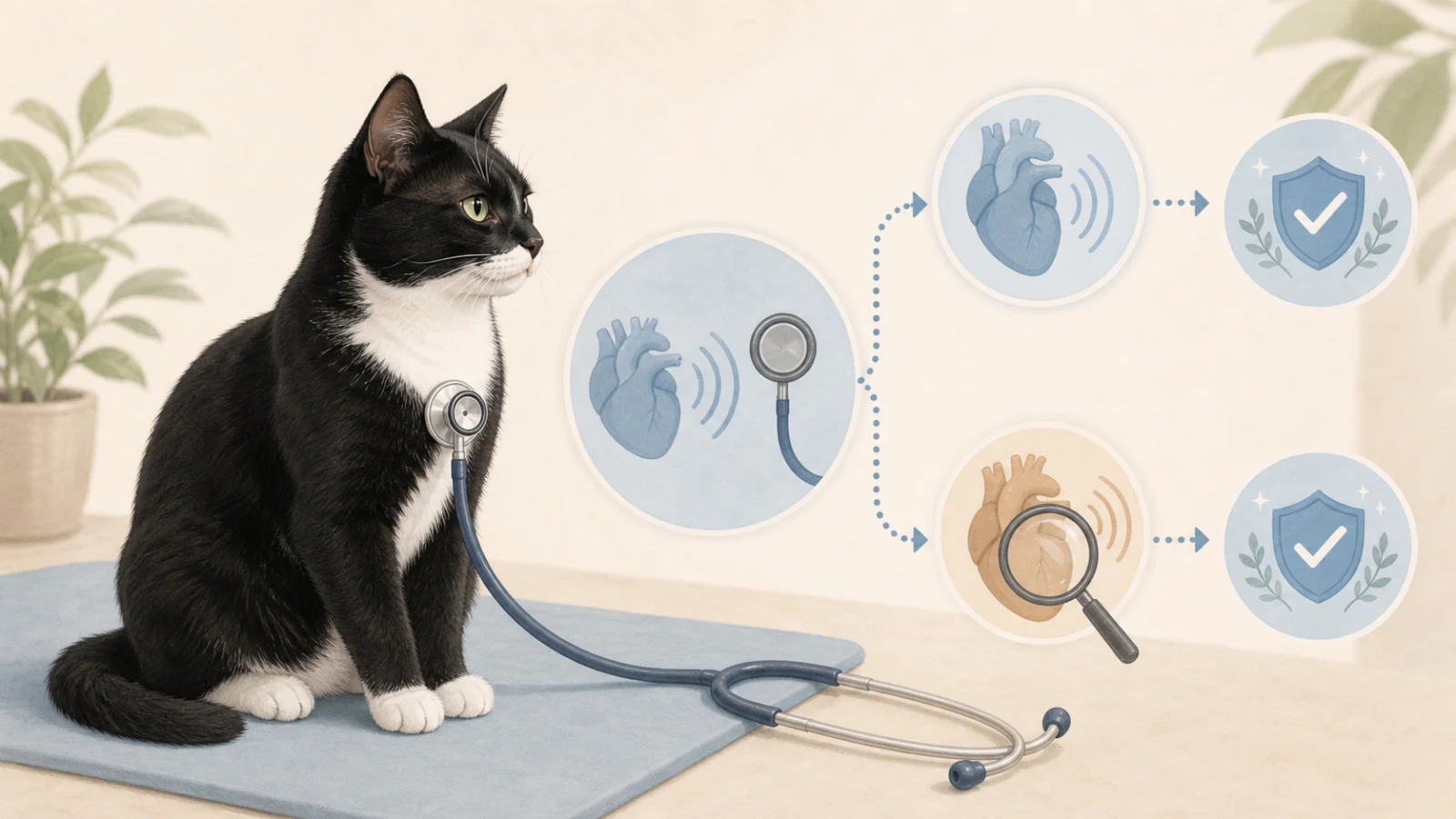
At a pre-neuter check, on vaccination day, during a dental consult — the vet with the stethoscope tilts their head and says: "I can hear a bit of a murmur."
Back home, searching "cat heart murmur" floods the screen with heart disease and sudden death, and that night you find yourself pressing an ear to your cat's chest. This article is for that night. The conclusion first: a murmur is a sound, not a diagnosis — and in cats, nearly half of murmurs occur without any disease at all. It does need checking, though. This article gives you the order in which to check.
1. What a murmur is — a sound, not a disease name
A heart normally makes a two-beat "lub-dub". A murmur is a "whoosh" slipped in between — the sound of blood swirling somewhere.
Blood swirls for many reasons: because a passage has narrowed (possibly disease), because blood is running faster and harder than usual (stress, anaemia, thyroid), or because a young heart is vigorous relative to its vessels (outgrown with age). A murmur is the starting point of the question "why is it swirling?" — not the answer. The stethoscope only establishes that there is a sound.
2. The numbers — half reassurance, half homework
From the study that auscultated and scanned 780 apparently healthy cats (CatScan):
- 40.8% of healthy-looking cats had a murmur — four in ten
- 70% of those murmurs were "functional" — occurring without heart disease
| Non-disease murmur | What is happening | Hallmark |
|---|---|---|
| The stress murmur (DRVOTO) | Clinic stress spikes the heart rate and the right ventricle's outflow narrows transiently — a common cause in healthy-looking cats (8–16% across studies) | Heard only at the clinic, varies day to day, can vanish once the cat settles |
| The kitten murmur | An "innocent" murmur of a young, vigorous heart | Usually fades by about 5 months of age; tracked by re-listening |
| Anaemia | Thinner blood swirls more easily | Checked with bloodwork (HCT) |
| Hyperthyroidism | A whipped heart beating hard and fast (age 7+) | Checked with T4 |
And the other side of the truth, stated plainly: 82% of HCM cats have a murmur — but 18% have none (REVEAL). A murmur proves nothing, and silence guarantees nothing — which is exactly why this article's conclusion is verification.
3. "It's a grade 3" — what the grade means, and what it doesn't
Murmur loudness is graded 1–6: grade 1 barely audible with concentration, grade 3 clearly heard, grades 5–6 accompanied by a vibration you can feel with a hand on the chest.
- The grade measures the sound, not the disease — quiet murmurs with serious disease exist, and loud murmurs with healthy hearts exist
- There is a statistical lean, though — HCM cats tended toward louder murmurs (grade 3+), healthy cats toward grades 1–2 (REVEAL)
- Two sounds outrank any murmur — a gallop (a three-beat, hoofbeat-like rhythm) and an arrhythmia are rarely functional; either one points straight to an echocardiogram
4. So what do you do — next steps by situation
| Situation | A reasonable next step |
|---|---|
| Kitten (under 6 months), soft murmur | No rush — re-listen at 5–6 months. If it persists, discuss an echo |
| Adult cat, incidental murmur | Both paths are legitimate: ① straight to the echo (definitive, done in one step) or ② NT-proBNP screen first (a blood test as a filter — details below) |
| Senior (7+) | Before the echo, check T4, blood pressure and anaemia — the other culprits that cause murmurs and thicken hearts (echo report article, section 3) |
| Gallop or arrhythmia present, or grade 5–6 | Skip the screen — echocardiogram directly |
| Symptoms present (fast breathing, open-mouth, collapse) | This is no longer a murmur-verification situation — it is a prompt-care situation |
About the NT-proBNP screen — a blood test for a substance released by stretched heart muscle. In cats with murmurs, it identified moderate-to-severe heart disease with 71% sensitivity and 92% specificity. How to read it: normal (under 100 pmol/L) supports "significant heart disease unlikely right now" (early disease can still slip through, so re-listening continues), and high means proceed to the echo. Cheaper than an echo, it is a rational halfway station when the full scan is not yet on the table.
5. While you wait for the answer — do and don't
- Do: establish the resting breathing-rate baseline — count the sleeping chest's rise-and-falls for 30 seconds, double it; under 30/min is normal. Whatever the diagnosis turns out to be, starting now gives you a baseline — and if it is heart disease, this number becomes the lifelong monitoring tool — the full method
- Do: get the details on paper — ask "what grade, and where?" and write it down. It becomes the baseline for the next clinic and the next listen
- Don't: all-night searching and stethoscope apps — phone microphones cannot judge this, and the pre-verification search results are mostly worst cases
- Don't: treat the cat as a patient in advance — no exercise restriction, no supplement shopping, no diet overhaul yet. The most common verification result is "fine"
6. The answers the echo can give
- "The heart is normal" — the most common answer. A functional murmur needs no management; you return to routine checkups, and future murmurs carry the light label "known functional"
- "It's the stress murmur (DRVOTO)" — a clinic-only sound. Also not disease
- "Equivocal (wall 5–6 mm)" — judgement deferred; recheck in 6–12 months. Remember: not a diagnosis (reading the echo report, section 2)
- "It's HCM" — from that day, this bible's Day of diagnosis is your next page. Being found without symptoms is the best way to be found with this disease — it says so right there
7. What to ask your vet
- "What grade was it — and was there a gallop or an arrhythmia too?"
- "Given this cat's age and state, where do we start: re-listen, NT-proBNP, or echo?"
- "(Senior) should we check thyroid, blood pressure and anaemia before the echo?"
- "(Kitten) at what age do we re-listen?"
- "She was very stressed today — could this be a stress murmur?"
8. Related
- The day of diagnosis — if the answer turns out to be HCM, start here
- Reading the echo report — the map to study before the scan
- Resting respiratory rate — the tool you can start using tonight, whatever the answer
- The HCM Bible — contents