NT-proBNP — how much a blood test can say about the heart
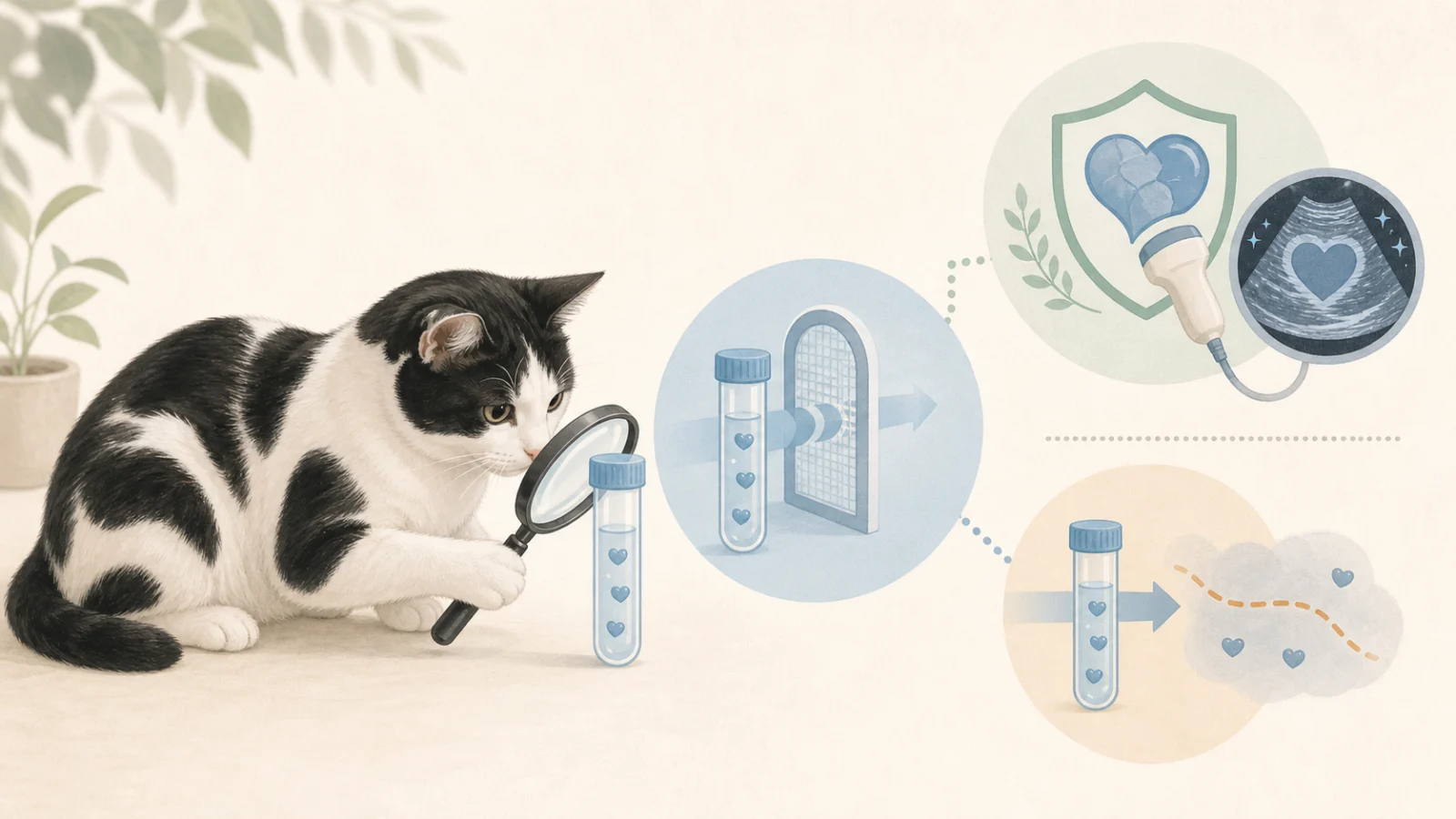
"If only a blood test could check the heart" — every caregiver has the thought. The echo is expensive, needs booking, and the cat panics at the clinic door.
The test that comes closest is NT-proBNP. It is genuinely useful and has already appeared in supporting roles across this bible. But it is a test with sharply divided strengths and weaknesses — it is worth exactly as much as you understand its boundaries. This article draws them.
1. What it measures — the fragment a stretched heart sheds
Heart muscle releases a hormone called BNP when it is stretched — the more burdened the heart (rising pressures, a swelling atrium), the more it sheds. NT-proBNP is the fragment clipped off as that hormone is made; it survives longer and more stably in blood, which is why it is the piece we measure.
Its essence in one line: this test measures not "what disease the heart has" but "how much strain the heart is under right now." It cannot name a disease — but it answers "should we look harder at the heart?" with real accuracy.
2. Two versions — the one that gives a number, and the one that gives a colour
| Quantitative (reference lab) | SNAP point-of-care (in clinic) | |
|---|---|---|
| Result | A number (pmol/L) | Normal / abnormal, nothing between |
| Turnaround | 1–3 days | 10 minutes |
| Use | Interpretable values, comparable over time | The fast fork in an emergency |
| Limit | Sensitive to sample handling (section 5) | Cannot show the grey zone |
You can tell from the report — a number means quantitative; "Normal/Abnormal" alone means SNAP. Record which one it was: the two cannot be compared with each other.
3. The two jobs it does well — with the study numbers
Job ① The murmur cat's "echo or not yet?"
This is the role from the murmur article. In cats with murmurs it identified moderate-to-severe heart disease with 71% sensitivity and 92% specificity. The high specificity is the point: a high result makes the case for the echo fairly solid. A normal result supports "significant disease unlikely now" — but 71% sensitivity means roughly three in ten diseased cats can slip through, so the re-listening continues.
Job ② Sorting the breathless cat — this test's finest hour
Facing a dyspnoeic cat, the ER's most urgent question is "heart (oedema, effusion) or airways (asthma and kin)?" — because the treatments point in opposite directions. Here NT-proBNP posts its best numbers: at a cut-off around 265 pmol/L, sensitivity 90% and specificity 88%. Especially valuable at hours and clinics where an immediate echo is not an option.
A bonus: if there is pleural effusion, the tapped fluid itself can be tested. For "is this effusion cardiac?", it performs about as well as blood (bedside test: 100% sensitivity, 86% specificity). Worth asking about whenever a tap happens.
The job it does not do — screening healthy-looking cats wholesale
"No signs, but shall we check the heart by blood?" has weak footing. In cats with no murmur and no signs, a normal result does not guarantee health (early HCM mostly reads normal), and many abnormal results are not disease. This test earns its keep only in cats with a clue. The heart item of a wellness check is auscultation — and, when needed, the echo.
4. Reading the number — 100 and 270
| Quantitative result (pmol/L) | Reading | Next step |
|---|---|---|
| Under 100 | Normal — significant cardiac strain unlikely | If there was a clue (murmur), keep the re-listening schedule |
| 100 – 270 | Grey zone — strain may be present | Echocardiogram recommended. The vaguer the number, the more the answer is imaging |
| Above 270 | Strong signal — (in a breathless cat) the heart is the likely cause | Echo — after stabilisation if it is an emergency |
One caution: these cut-offs are foggy hills, not cliffs. 98 and 105 are effectively the same state, and labs vary. Do not live and die by numbers near a boundary — read the direction (vs last time) together with the other findings.
5. When the number lies — in both directions
| Situation | Which way it fools you | Worth knowing |
|---|---|---|
| High kidney values | False rise | This fragment leaves through the kidneys. With creatinine high (roughly 2.8+), it can climb without cardiac strain — in a CKD cat, always interpret it beside the kidney values |
| Hyperthyroidism | A real rise — but indistinguishable | The whipped heart genuinely sheds more. The problem: the number cannot separate "thyroid heart" from true HCM — re-evaluate after thyroid treatment |
| Dehydration, systemic illness, hypertension | False/mixed rise | A sick body strains the heart too; read mid-illness values conservatively |
| Sample handling | False fall | The molecule degrades in the tube — up to 30% lost within a day at room temperature in one report. Prompt processing and cold transport are conditions; a suspiciously low value can be a sample problem |
| Early disease | Reads normal | Mild B1 mostly sits in the normal range — why a normal result is not proof of "no HCM" |
6. Why it cannot replace the echo — or track the disease
- It knows neither the disease nor the stage — only that the number is high. Whether it is HCM or another heart disease, B1 or B2 (= whether clopidogrel starts) — all of that belongs to the echocardiogram. NT-proBNP is the bridge to the echo, never the terminus
- It is weak as a progress tracker — even in the trial where rapamycin halted wall thickening (RAPACAT), NT-proBNP did not move. Whether treatment is working is read from the echo's three numbers and the breathing rate, not from this value
- SNAP-normal is not a guarantee — the bedside version cannot show the grey zone. SNAP normal with a clue still standing (murmur, signs) should continue to the quantitative test or the echo
7. In practice — when to request it, how to record it
- Three moments to ask for it — ① a murmur was found and the echo decision feels premature ② a breathless emergency needs the cardiac-or-respiratory fork fast ③ blood is being drawn anyway (e.g. CKD rechecks) in a cat with a cardiac clue on file
- Record — date, value (or "SNAP"), and the kidney values from the same draw. An NT-proBNP filed without its creatinine cannot be interpreted later
- Cost sense — far cheaper than the echo, but the accurate frame is not "the cheap substitute": it is the toll-gate fee for deciding whether to drive to the echo
8. What to ask your vet
- "Was this the quantitative test or the SNAP? If quantitative, may I have the number?"
- "Given this cat's kidney values, how should we read it?"
- "(Grey zone) so the next step is the echo — when?"
- "(Senior) did we check the thyroid alongside?"
- "(At a tap) can we run this test on the pleural fluid too?"
9. Related
- When they hear a murmur — the scene where this test first appears
- Reading the echo report — the terminus this test delivers you to
- Heart failure — where the dyspnea fork becomes real
- NLR and PNR — the other cardiac numbers in the same blood draw