Managing the signs — when a silent disease starts to speak
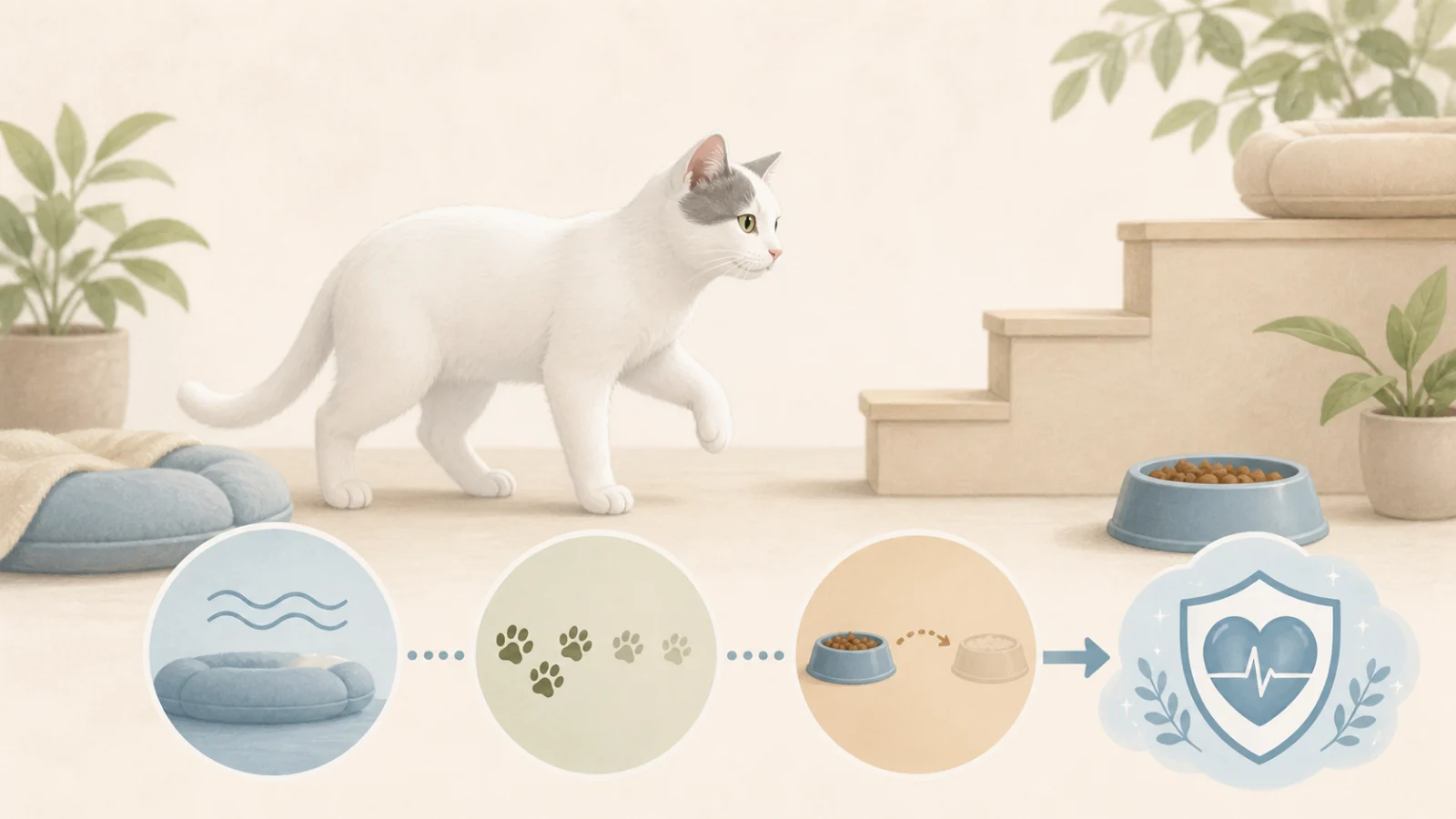
HCM is a silent disease — which means that in this disease, a "symptom" usually announces that the quiet phase is over. The good news: most symptoms send small previews first. The catch: a cat's previews look nothing like human common sense expects.
This article sorts every symptom an HCM cat may show into three tiers — "hospital now" / "clinic within days" / "log and watch" — and untangles the two most confusing pairs (fainting vs seizure, and the coughing myth).
1. The symptom triangle — one table
| Tier | Signs | Action |
|---|---|---|
| 🚨 Hospital now | Open-mouth breathing · abdominal heaving · sleeping rate above 40 / sudden hind-leg paralysis with crying / collapse and recovery (syncope) / pale or bluish tongue and gums | Call ahead, minimal-stimulation transport — even at night |
| ⚠️ Clinic within days | Sleeping rate climbing on consecutive days (entering the 30s) / clearly reduced appetite / lethargy lasting more than a day / mild intermittent limping | Bring the records (numbers, videos) and move the appointment up |
| 📋 Log and watch | Less activity and jumping / more hiding / less grooming / occasional vomiting | Log dates and frequency in the app; report at the next recheck |
2. Breathing — this disease's native language (summary only)
The breathing rate has its own article, so only the coordinates here: the earliest and most reliable symptom is a rising sleeping respiratory rate — under 30 reassuring, over 40 an emergency, in between re-measure and follow the trend. The full method, traps and action rules live in Resting respiratory rate; what follows the emergency lives in Heart failure.
3. Fainting — seconds long, but heavy
A cat playing normally suddenly drops limp — then, within a minute, gets up as if nothing happened. That is classic cardiac syncope: an arrhythmia or outflow obstruction cut blood to the brain for a few seconds.
Its great impostor is the seizure. Final judgement belongs to the clinic, but the observation points are clear:
| Leans cardiac syncope | Leans seizure | |
|---|---|---|
| Onset | Sudden — right after excitement, play, or straining in the litter box | After a prodrome (dazed, restless) |
| Appearance | Limp collapse; brief twitching can occur | Forceful paddling, jaw motion, foaming; usually longer |
| Recovery | Fast — straight back to normal | Dazed and wobbly for minutes to hours afterwards |
4. Hiding and reduced activity — feline for "something hurts"
Cats do not cry when unwell. They subtract. Less play, fewer jumps, less grooming, more time out of sight. In HCM this can mean oxygen is starting to run short — the body rationing its own activity.
- Compare to the baseline — "she was always calm" is the trap. The comparison is not other cats but this cat, a month ago: when was the last trip to the top of the cat tree, where did the evening zoomies go?
- The trend of hiding — a day or two under the sofa is within normal; days in a row, emerging only for meals, is a signal
- Pair it — from the day you notice, count the sleeping rate daily. Reduced activity plus a rising rate moves the appointment up
5. Falling appetite — a three-way fork
- Heart failure approaching — breathless cats struggle to eat. The most urgent branch → check the breathing rate first
- Drug side effect — clopidogrel and others can bother the stomach. Check whether dosing times and appetite changes line up in the log
- Another disease — senior cats stack kidney, dental and pancreatic problems. Blaming the heart for everything hides the others
Whichever branch: two days at less than half the usual intake means the clinic. Cats develop a separate liver disease (hepatic lipidosis) after only days of not eating — falling appetite is a symptom with its own deadline.
6. Leg signs — the dramatic and the subtle
The dramatic version — sudden paralysis + crying + cold paws — is the clot, and everything about it is in the ATE article. What belongs here is the subtle version: a brief limp that resolves, an occasional shake of one hind leg can be the trace of a small clot passing through. It may be orthopaedic — but in an HCM cat, do not file limping under "sprained something": compare paw-pad temperatures, and if it repeats, ask the clinic to check the pulse in that leg.
7. Two myths — coughing and vomiting
- "No cough, so the heart is fine" — dog logic. Cats rarely cough in heart failure. Conversely, a cat that does cough more likely has asthma or bronchitis (crouched, neck extended, hacking — easily confused with hairball retching). A new cough deserves its own workup, not a heart self-diagnosis
- "Is the vomiting from the heart?" — vomiting is more often a drug effect or a separate problem than a direct HCM sign. But dehydration from vomiting or diarrhoea is dangerous in a cat on diuretics — if a diuretic-taking cat starts vomiting, talk to the clinic within the day
8. The symptom diary — turning observation into data
- One line a day — sleeping rate (number), food intake (% of usual), one note. Thirty seconds
- Events on video — odd breathing, collapses, limping: film them instead of describing them. Video is the only evidence for symptoms that refuse to perform in the consult room
- Read changes in combination — each sign alone is ambiguous, but two or more in the same week (activity↓ + rate↑, appetite↓ + hiding↑) is a different signal strength. That is when the appointment moves up
9. What to ask your vet
- "Here is the video (of the collapse) — syncope or seizure? Do we need an ECG or Holter?"
- "Activity is down but the breathing rate is normal — is there reason to suspect the heart, or does another workup come first?"
- "Appetite has dropped — could it be the medication? Can we change timing or formulation?"
- "She limps occasionally — would you check that leg's pulse and paw temperature?"
- "At my cat's stage, which combination of signs should move the recheck up?"
10. Related
- Resting respiratory rate — the symptom of symptoms, measurement and all
- Heart failure — where the breathing signs point
- The clot (ATE) — the emergency edition of leg signs
- Between B1 and B2 — the surveillance system for when there are no symptoms