

Appetite stimulants — a tool to break the cycle, not to hide it
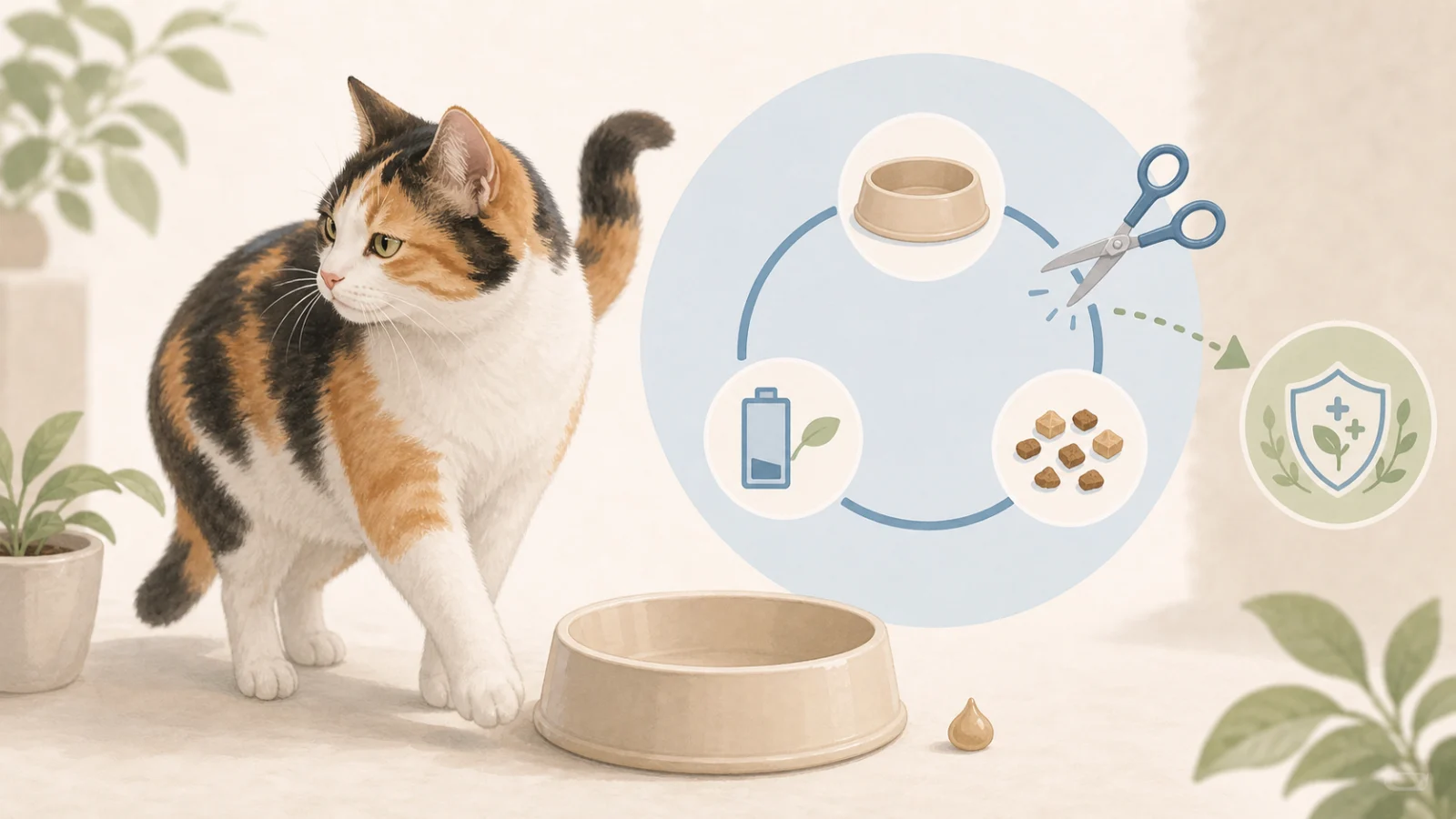
When a CKD cat stops eating, the caregiver faces a fork: "Do I ask for an appetite stimulant, or hold out until we find the cause?"
The answer is — both. There is just an order to it. This chapter lays out that order, and how to use the two drugs (mirtazapine and capromorelin) correctly.
1. Poor appetite is a symptom, not a disease
Before any talk of stimulants: there is a reason the cat is not eating. In CKD the list of suspects is quite specific.
- Uremic nausea — waste products irritating the stomach and the brain's vomiting center (uremia chapter)
- Anemia — no energy, no appetite. The causal treatment is an ESA injection (darbepoetin)
- Oral pain, dental disease — wants to eat but it hurts
- Dehydration and electrolytes — low potassium by itself causes lethargy and inappetence
- The drugs themselves — food ruined by a mixed-in binder, stomach upset from antibiotics
- Comorbidities — pancreatitis, thyroid disease (comorbidities chapter)
So when inappetence is new, the first move is not another drug — it is asking "what changed?" New medication? When was the last blood panel? Any vomiting, drooling, mouth odor?
2. When a stimulant is genuinely needed — the vicious cycle
While you hunt for the cause, the clock runs. And inappetence has one nasty property: it reinforces itself.
Let this spin for a few days and the loop survives even after the original cause is fixed.
Cats add a time bomb of their own: hepatic lipidosis — fatty liver that develops when a cat starves for days, and is uniquely dangerous in this species. A cat that is not eating does not grant you time.
This is the legitimate place for an appetite stimulant: cut the loop and buy time until the causal treatment kicks in.
3. Mirtazapine — the science of half a pill
The most widely used appetite stimulant. Originally a human antidepressant; at low doses in cats it stimulates appetite and suppresses nausea.
The key point: CKD cats have their own dosing schedule.
| Healthy adult cat | CKD / elderly cat | |
|---|---|---|
| Dose | 1.88mg (1/8 of a 15mg tablet) | 1.88mg — the same |
| Interval | Once daily | Every 48 hours |
| Why | — | Failing kidneys clear the drug slowly — it lingers (longer half-life). Daily dosing accumulates |
The evidence is a placebo-controlled crossover trial (Quimby 2013): 1.88mg every other day for three weeks in CKD cats produced increased appetite, increased activity, less vomiting, and a median +0.18kg of body weight. It doesn't just push appetite — it also damps nausea, which is exactly what CKD cats need.
A transdermal ointment (Mirataz, applied to the inner ear) exists for cats who cannot be pilled — FDA-approved for weight loss in cats at 2mg once daily for 14 days. Availability varies by country; ask your clinic.
4. Capromorelin — the new drug that imitates the hunger hormone
Sold as Elura, an oral liquid. It works completely differently from mirtazapine: it directly stimulates the receptor for ghrelin — the hormone that makes the body feel hungry.
- The first drug ever FDA-approved specifically for managing weight loss in cats with CKD (2020)
- Dose: 2mg/kg (0.1ml/kg) once daily, oral liquid
- In the 55-day placebo-controlled field study (176 cats), treated cats gained weight while controls lost — +3.3% at 2 weeks, +5.2% at 8 weeks (day 55)
- Common side effects: vomiting (32% on the drug, but also 24% on placebo), drooling (21%, drug group only), lethargy — vomiting can limit long-term use in some cats
Its relationship to mirtazapine is not "old versus new" but different jobs. Mirtazapine is closer to "buy a few days"; capromorelin is designed for long-term management of chronic weight loss. Availability differs by country — ask your clinic.
5. Side by side
| Mirtazapine | Capromorelin (Elura) | |
|---|---|---|
| Mechanism | Modulates brain appetite/nausea circuits | Stimulates the hunger-hormone (ghrelin) receptor |
| CKD regimen | 1.88mg every 48h | 2mg/kg daily |
| Form | Tablet (split) · ear ointment | Oral liquid |
| Bonus effect | Anti-nausea | — |
| Best fit | Breaking an acute anorexia loop | Long-term chronic weight-loss management |
| Watch for | Accumulation in CKD, behavior changes | Vomiting, drooling, availability |
Note that maropitant (Cerenia) and ondansetron are anti-nausea drugs, not appetite stimulants — but when nausea is the reason for not eating, controlling it alone often restarts eating. That story lives in the uremia chapter. The older drug cyproheptadine is weaker and harder to dose, and has largely been retired.
6. A real record — what half a pill did, and what it did not do
From our lab's stage-3 CKD cat (17 years old), July of this year. The late-June blood panel was good — yet mid-July, appetite collapsed.
| Period | Daily intake | What happened |
|---|---|---|
| Mid–late July | 58g (under 3/4 of normal) | Vomited 4 times, anti-nausea meds every 2–3 days. Cause found later — a 6-week gap in ESA injections had let anemia creep back |
| July 27 | — | One half-tablet of mirtazapine |
| July 28 | 80g | Recovered the very next day |
| From Aug 2 | Holding at ~75g | ESA restarted — causal treatment took the baton. No further mirtazapine needed |
What this record shows: mirtazapine cut the loop with a single dose, and the causal treatment (the ESA) took over from there. Mirtazapine did not fix the anemia — it bought time until the anemia treatment could work.
7. What a stimulant can hide — if it takes a daily dose to eat
There is one dangerous way to use these drugs: weeks of daily use without knowing the cause.
Needing the stimulant every day to eat means something is still progressing behind it — rising urea, deepening anemia, pain somewhere. Let the drug mask that signal and the diagnosis comes late.
- Keep logging intake after starting — the difference between dosed and undosed days is data
- Dependent for more than 2 weeks → recheck (blood panel, renewed search for the cause)
- Not eating despite the stimulant → don't wait, go in. That is not an appetite problem — it is a different problem
8. Every study so far, in one table
The feline studies on appetite stimulants. Two things to check as you read:
- Subjects — whether a study looked only at CKD cats or at cats losing weight from various diseases
- Funding — studies with manufacturer-employed authors are flagged in the last column
8-1. Mirtazapine
| Study | Subjects · design | Result | What to note |
|---|---|---|---|
| Quimby 2011 | 6 CKD cats + 6 age-matched healthy cats, a single 1.88 mg dose with blood levels over 48 hours | Half-life 15.2 vs 12.1 hours; total exposure (AUC) higher in CKD. Accumulation factor 1.15 with 48-hour dosing | Basis for section 3's "every other day (48 hours) in CKD". 12 cats |
| Quimby & Lunn 2013 | 11 cats with stable CKD, placebo-controlled masked crossover, 1.88 mg orally every other day for 3 weeks | Appetite (P=0.02) and activity (P=0.02) up, vomiting down (P=0.047). Median weight +0.18 kg (placebo −0.07 kg) | Source of section 3's placebo-controlled trial. 11 cats |
| Quimby 2020 | 9 and 10 cats with CKD stage 2–3, placebo crossover, compounded transdermal gel 3.75 mg or 1.88 mg every other day for 3 weeks | Weight gain at both doses (median +0.22 and +0.26 kg), appetite up | Basis for section 3's "compounded ointment". Worked even though the gels varied in strength |
| Poole 2019 | Cats with various diseases and ≥5% weight loss, randomized, double-blind, placebo, Mirataz 2 mg on the ear once daily for 14 days, 83 vs 94 cats | Body weight +3.9% vs +0.4% (P<0.0001). Application-site redness 10.4% (placebo 17.4%) | Source of section 3's Mirataz dosing. Manufacturer (Kindred) employee authors. Not a CKD-only study |
| Ferguson 2016 | 84 cats exposed to mirtazapine, reported to an animal poison control center, retrospective | Common signs: vocalization 56%, agitation 31%, vomiting 26%, tremors 14%, fast heart rate 11%. Most toxic exposures were a whole 15 mg tablet (40 cats) or 3.75 mg (25 cats); only 1 cat at 1.88 mg. Onset 15 minutes to 3 hours, resolved in 12–48 hours | Basis for section 3's "overdose signs". 70% were accidental — exact 1.88 mg compounding is safer |
8-2. Capromorelin (Elura)
| Study | Subjects · design | Result | What to note |
|---|---|---|---|
| Wofford 2025 | 176 CKD cats with more than 5% weight loss, randomized, masked, placebo (2:1), once daily for 55 days | Body weight +3.3% at day 15 (placebo 0%) and +5.2% vs −1.7% at day 55 (difference about 0.25 kg). Vomiting 32% vs 24% on placebo (not significantly different); drooling 21% (drug group only) | Source of section 4's numbers. Manufacturer (Elanco) employee and stockholder authors |
In short, mirtazapine 1.88 mg every other day in CKD cats rests on a small placebo-controlled trial (11 cats) and a pharmacokinetic study (12 cats), while capromorelin has the largest evidence base — a 176-cat placebo-controlled trial — though it was run by the manufacturer. For both drugs, what has been shown is "weight and appetite went up".
- A head-to-head comparison of mirtazapine and capromorelin — none. Section 5's "different jobs" comes from study design (3 weeks vs 55 days) and the approved indications
- Whether appetite stimulants help CKD cats live longer — no study has looked at survival
- Section 5's "cyproheptadine is weak" — we found no feline comparison (clinical experience)
- Section 7's "recheck if dependent for more than 2 weeks" — a practical rule, not a research-derived threshold
Study names link to the PubMed abstract. Evidence checked: 2026-11-18.
9. What to ask your vet
- "Before we start a stimulant — what do you suspect as the cause of the inappetence?"
- "If it's mirtazapine — she has CKD, so are we dosing every 48 hours?"
- "She's impossible to pill — is the ear ointment form available?"
- "Her weight keeps drifting down — is a long-term option like capromorelin (Elura) available here?"
- "How long do we use this, and when do we reassess?"
10. Related
- When your cat suddenly stops eating — the first rung of the cause ladder
- Uremia — nausea and vomiting at home — the most common culprit
- When another disease comes too — pancreatitis and thyroid shaking the appetite
- Getting the most from your vet — timing the recheck