

Wet Cat Food FAQ — 12 answers: cans per day, storage after opening, gravy vs pâté
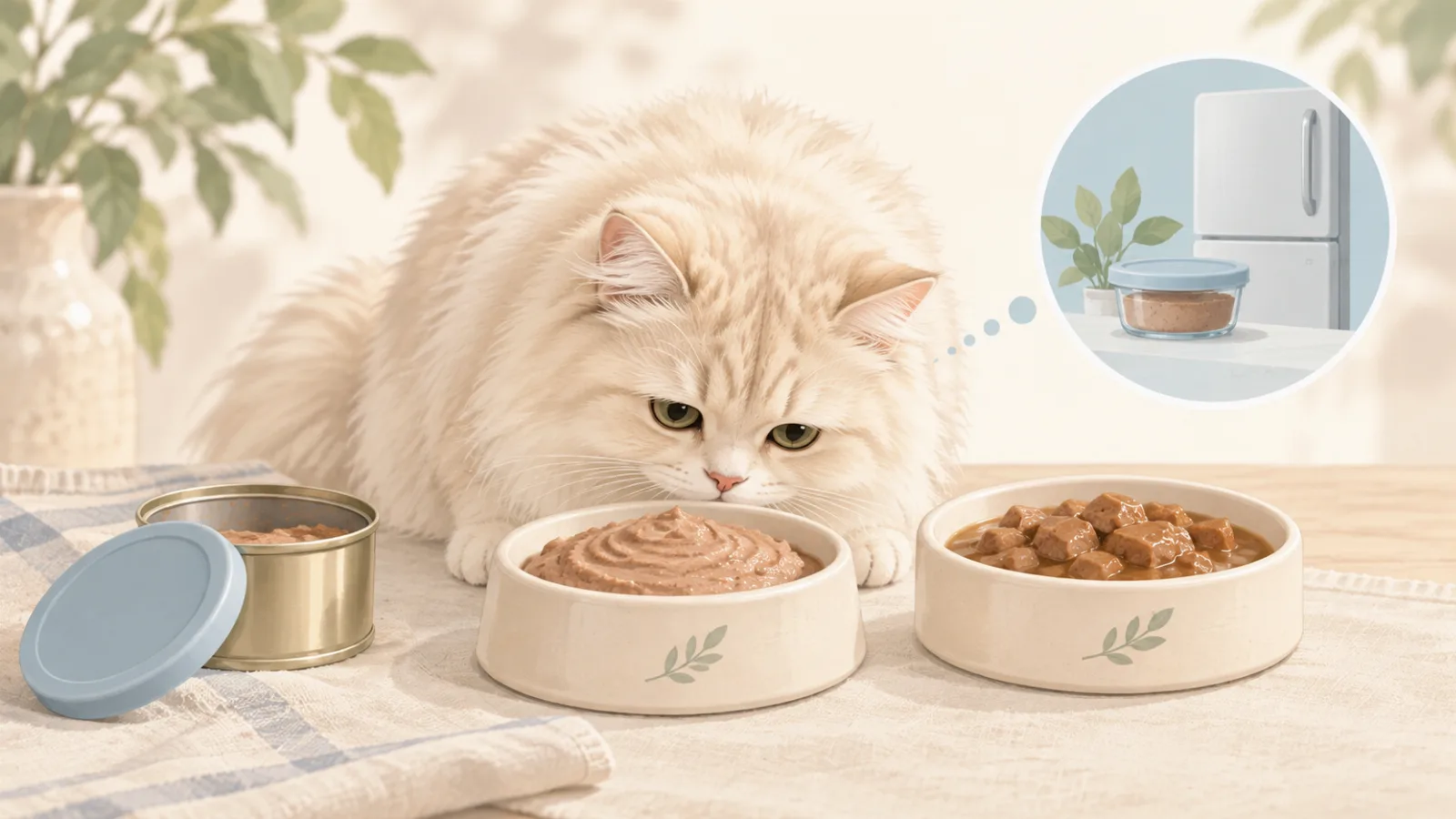
Feeding wet food (cans and pouches) raises the same questions again and again: how many cans a day, how long after opening, gravy or pâté. Here are 12 answers, using numbers from the CatLab product database (October 2026, 395 regular wet foods).
1. Can my cat eat only wet food?
Yes, if the label says complete (main) food. Cans labelled treat or complementary cannot be the whole diet, however tasty. See how to tell complete cans from treat cans.
2. How much wet food per day?
Divide daily calories by the food's calories. A neutered 4 kg adult needs about 240 kcal a day (resting energy 70 × weight0.75 ≈ 198 kcal × 1.2). The median regular wet food in our database is 90 kcal per 100 g, so that is about 270 g a day — roughly three 85 g cans. Products range from 66 to 125 kcal per 100 g, so always calculate from the label. The app's Smart Care works out a daily calorie target from body weight.
3. How long can an opened can be kept?
Cover it or move it to an airtight container, refrigerate and use within 2 days (48 hours). Wet food left in the bowl at room temperature should go after 1-2 hours, sooner on hot days — the moisture makes it spoil quickly. Unopened cans keep at room temperature until the expiry date; throw away dented or bulging cans.
4. Can I serve wet food straight from the fridge?
You can, but cold food smells less and many cats refuse it. Warming it to about body temperature (38°C) brings out the aroma. In a microwave, heat in 5-10 second bursts and stir, checking with a finger for hot spots.
5. Why is wet food often recommended over dry?
The biggest difference is water: the median regular wet food in our database is 80% moisture, dry food averages 9.6%. Cats are poor drinkers, so moisture from food helps against urinary stones, cystitis and kidney strain. Wet food is also bulkier for the same calories and usually lower in carbohydrate.
6. Gravy or pâté — which is better?
By the numbers, pâté usually wins. In our database, gravy and jelly wet foods have a median of 13.2% of calories from carbohydrate, pâté and mousse 6.5% — about double, because of the starches and thickeners in the sauce. For cats that lick the gravy and leave the rest, pâté is even better. See the low-carb list.
7. Can I mix wet and dry food?
Yes. Split the daily calories between them; the bigger the wet share, the better for moisture and carbohydrate. For example, 240 kcal could be two cans of wet (about 150 kcal) plus about 23 g of kibble (about 90 kcal). Add both calorie amounts together so the total does not creep up.
8. Does wet food cause dental problems?
The idea that kibble cleans teeth has weak support. Most regular kibble shatters before it can scrape plaque, and the benefit is shown mainly for dental diets specifically accepted for plaque or tartar reduction. The basis of dental care is brushing, not the food type.
9. Why do wet food protein numbers look so low?
Labels show values as fed, water included. 10% protein in an 80% moisture food is 50% once the water is removed. To compare with kibble fairly, convert to dry matter or, as CatLab does, to per 1000 kcal. All numbers on our product pages and lists are per 1000 kcal.
10. How do I switch to wet food?
Switch gradually over 7-10 days, mixing more each day; sudden changes cause refusal or loose stools. Kibble-only cats may find wet food strange — a few favourite kibbles on top or gentle warming helps. If your cat eats almost nothing for more than two days, go back to the old food; fasting cats can develop fatty liver.
11. How much phosphorus is typical in wet food?
The 395 regular wet foods in our database average about 2,921 mg per 1000 kcal; more meat means more phosphorus. That is not a worry for healthy adults, but older cats are better at 2,500 mg or less and cats with kidney disease at 1,000-1,500 mg or less — see senior cat food and the renal diet list.
12. How do I pick a good wet food?
Check three things first — ① are the first two ingredients meat (not by-products or grains) ② is protein at least 100 g per 1000 kcal ③ is carbohydrate 12% of calories or less. Products that pass are listed in Best Wet Cat Food, and every card in the food explorer shows a two-line good point / caution summary.
13. Every study so far, in one table
Most numbers in this FAQ (calories, moisture, carbohydrate, phosphorus) are tallies from the CatLab product database, not studies. Below, the "why wet food helps" and "does dry food clean teeth" answers are checked against feline studies. Two things to check as you read:
- What was compared — mostly wet vs dry forms of the same food, or the same food with only the water changed
- Size — many studies involve a few dozen cats; randomised trials are rare
| Study | Subjects · design | Result | What to note |
|---|---|---|---|
| Kosmal 2026 (scoping review) | 32 papers on feline water intake (1975–2025) | Healthy cats took in 23–51 ml/kg of total water a day. Cats on dry food alone took in less and had more concentrated urine (unless given nutrient-enriched water) | Basis for Q5's "the biggest difference is water" |
| Markwell 1999 | 54 cats with idiopathic cystitis, canned vs dry form of the same acidifying diet, 12 months | No recurrence in 16 of 18 on canned vs 17 of 28 on dry — recurrence about 11% vs 39% | Basis for Q5's "better for cystitis". Same diet in two forms; not randomly assigned |
| Wei 2011 | 10 adult cats, the same canned food as is vs freeze-dried (water removed), 3 weeks each, crossover | Daily energy intake was about 25% lower on the water-containing food, and weight fell; in short preference tests cats ate more of it | Basis for Q5's "more filling for the same calories". Entire (unneutered) males |
| Clarke 1998 | 20 pet cats (canned and dry food) vs 29 feral cats (prey) | Calculus scores were significantly higher in pet cats, but periodontal disease prevalence did not differ | Basis for Q8's "food type alone doesn't protect teeth". Not a direct dry-vs-wet comparison |
In short, the research-backed advantage of wet food is water — intake, cystitis recurrence, fullness. We found no feline study supporting "dry food cleans teeth", and feral cats eating prey had as much periodontal disease as pet cats.
- Opened cans: 2 days chilled, 1–2 hours at room temperature (Q3) — food-safety practice; we found no study measuring this for cat food
- Warming improves eating (Q4) — we did not find a feline study figure
- A dental study directly comparing dry and wet food (Q8) — not found this time
- 7–10 day transition; fatty-liver risk after two days without food (Q10) — practice values, not checked against a figure
Study names link to the PubMed abstract. Evidence checked: 2026-11-19.