

Grain-free diets and heart disease (DCM), US FDA investigation (2018–): what is confirmed and what is not
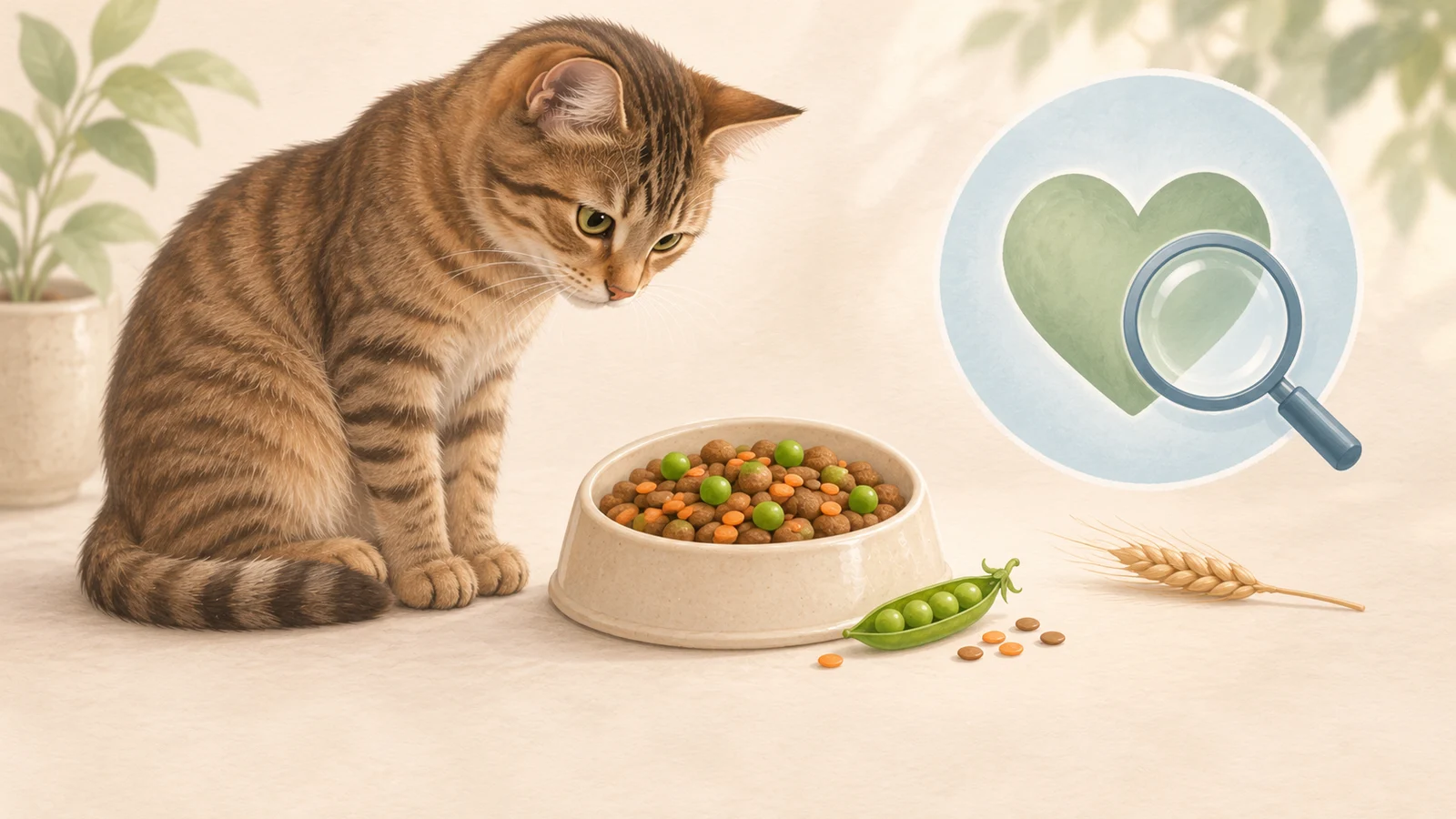
In July 2018 the US Food and Drug Administration (FDA) announced it was investigating reports of dilated cardiomyopathy (DCM) in dogs eating grain-free diets. DCM is a disease in which the heart muscle thins and stretches and loses pumping strength. It is a different disease from hypertrophic cardiomyopathy (HCM, a thickening of the muscle), which is the common heart disease in cats.
This article covers that one event. Since then the advice "grain-free is bad for the heart, switch to a grain-inclusive food" has spread widely. Re-reading the research, though, what came under suspicion was not the missing grain but the pulses (peas, lentils and similar) that took its place. So besides what is and is not confirmed, we used the numbers in the Cat Lab product database to show what cat owners should actually check.
- On 23 December 2022 the FDA said it would not release further public updates until there is meaningful new scientific information. No cause was established, and the FDA announcements included no recall or sales ban.
- From 2014 to 1 November 2022 the FDA received 1,382 reports of DCM in dogs. The FDA itself states that report numbers alone cannot establish a causal relationship.
- Cat reports numbered 9 (14 cats) up to April 2019. No separate cat count has been published since.
- What was suspected: more than 90% of the reported dog foods were grain-free, and 93% contained peas or lentils (FDA 2019). The suspicion centres on pulses, not grain.
- Cause: still unknown. Taurine deficiency explains only part of it; many DCM patients eating pulse-rich diets had normal taurine.
- Cats: a study comparing 52 healthy cats on high- vs low-pulse diets found no difference in heart size, function or taurine (Karp 2023). The evidence is not there to say "grain-free = heart disease" in cats.
- Does switching to a grain diet fix it? No. Across 480 cat dry foods in our database, the median share of protein from animal sources was 53% in grain-inclusive foods, lower than in grain-free foods (76%).
- What to do now: instead of grain vs no grain, read the first five ingredients. If there is a plant protein concentrate such as pea protein or corn gluten, or two or more pulses, check the animal-protein share and prefer products at 70% or more.
| Who | Decides |
|---|---|
| At home | Checking the first five ingredients and the animal-protein share, not putting the whole diet on one pulse-heavy food, counting sleeping breathing rate |
| Together | Whether to change the food and whether to measure blood taurine after a diagnosis of reduced heart contraction |
| The clinic | Diagnosing DCM or HCM (echocardiography), heart medication, whether and how much taurine to give |
1. What happened
| Date | What | Source |
|---|---|---|
| July 2018 | The FDA announces it is investigating DCM reports in dogs eating diets, many labelled "grain-free", with peas, lentils, other pulses or potatoes as main ingredients (first 10 on the list) | FDA |
| December 2018 | Veterinary cardiologists and nutritionists publish "Diet-associated dilated cardiomyopathy in dogs: what do we know?" in JAVMA | Freeman 2018 |
| 27 June 2019 | Third update: 524 reports from 2014 to April 2019 — dogs 515 (560 animals, 119 deaths), cats 9 (14 animals, 5 deaths). Brands named in ten or more reports are published | FDA |
| 23 December 2022 | Cumulative dog reports published: 1,382 (to 1 Nov 2022). Public updates paused until new science emerges | FDA Q&A |
| 2022–2026 | Four cat studies and a large long-term dog cohort (Dog Aging Project) published | Table in section 8 |
The FDA itself noted that most reports arrived after its July 2018 announcement, and that Golden Retrievers were over-reported because of breed-community activity. Report counts therefore do not show the true rate of disease.
2. What is confirmed and what is not
| Confirmed | Not confirmed |
|---|---|
| More than 90% of reported foods grain-free, 93% containing peas or lentils (FDA 2019) | That grain-free diets or pulses cause DCM — the FDA says reports alone cannot establish it |
| Of 71 dogs with DCM on nontraditional diets, those whose diet was changed had a median survival of 337 days vs 215 days without a change (Freid 2021) | The causative substance and mechanism — taurine, fibre, or a specific pulse compound |
| In 46 healthy dogs, ejection fraction was lower on nontraditional diets (48.7% vs 56.7%, Owens 2023) | How common it is — a reporting system has no denominator |
| Peas were the ingredient that best separated implicated diets (Smith 2021). Four weeks of a pea diet produced mild heart changes in dogs; lentil and rice diets did not (Quilliam 2023) | The same experiment in cats |
| 14 of 37 cats with DCM (38%) ate high-pulse diets, and those whose diet was changed lived longer (P = 0.025, Karp 2022) | Whether high-pulse diets raise DCM risk in cats — no difference in healthy cats (Karp 2023) |
3. Why "switch to a grain diet" sounds odd
The way researchers grouped diets gives the answer. "Grain-free" came first, then "nontraditional", and eventually "high-pulse". The absence of grain was only a sign that pulses had probably filled the gap.
- Changing the grouping changed the result. When 188 healthy dogs were split both by "grain-free or not" and by "peas, lentils or potatoes in the first 10 ingredients", ventricular premature complexes differed only under the pulse grouping (10% vs 2%, Adin 2021).
- Grain-free diets differed among themselves. When dogs ate rice (grain), lentil and wrinkled-pea diets for four weeks each, changes appeared only on the pea diet. The lentil diet was also grain-free and showed none (Quilliam 2023).
- Grain-inclusive foods contain pulses too. In our database, 41 of 255 grain-inclusive dry foods (16%) have a pulse in the first five ingredients.
So adding grain is not itself a fix. Closer to the research is "avoid diets crowded with pulses."
4. The animal-protein hypothesis — checked against our database
Cat Lab's hypothesis: grain-free diets replace grain with pulses and fill part of the protein percentage with pulse protein, so less of the protein comes from meat. Pulse protein is low in methionine and cysteine, the sulfur amino acids that taurine is made from (Banton 2021), and contains none of the taurine that meat supplies.
We tested it on 480 cat dry foods in the Cat Lab database (products with an ingredient list and an animal-protein estimate, excluding freeze-dried and air-dried; 22 Nov 2026). Grain and pulse status came from the ingredient list, not the product name. Here the animal-protein share is not the meat percentage on the label; it is our estimate, from the ingredients, of how much of the protein comes from animal sources such as meat, fish and egg.
| Group | Products | Median animal share | Under 45% | 70% or more |
|---|---|---|---|---|
| All grain-free | 225 | 75.5% | 9% | 65% |
| All grain-inclusive | 255 | 52.8% | 37% | 25% |
| Grain-free + pulse in first 5 | 159 | 71.3% | 13% | 55% |
| Grain-free + no pulse in first 10 | 28 | 89.5% | 0% | 89% |
| Grain is ingredient #1 or #2 | 191 | 50.5% | 42% | 23% |
| Plant protein concentrate in first 5 pea protein, corn or wheat gluten, soy protein, potato or rice protein, etc. | 158 | 45.2% | 49% | 8% |
| No plant protein concentrate | 322 | 75.5% | 12% | 62% |
- Half the hypothesis held. Pulses lower the animal share: within grain-free foods, 89.5% without pulses vs 71.3% with a pulse in the first five.
- But grain-inclusive foods were lower still (52.8%). They also fill protein with plant concentrates such as corn and wheat gluten. The biggest gap came not from grain but from plant protein concentrates (45.2% vs 75.5%).
- Grain first does not mean poor protein. Of 191 foods with grain as ingredient #1 or #2, 44 (23%) had an animal share of 70% or more — rice used for carbohydrate, protein from meat.
- This alone cannot explain DCM. If the animal share were the cause, grain-inclusive foods, with lower shares, should have drawn more reports. Reports clustered on pulse-rich foods instead. The research therefore points to something about pulses themselves as well: fibre carrying taurine out with bile acids (Pezzali 2020), lower sulfur amino acid digestibility (Quilliam 2023), or pea-specific compounds (Smith 2021).
5. What about cats?
Feline DCM has had one "food" event before. In 1987, 21 cats with DCM eating commercial foods recovered normal heart function on taurine (Pion 1987). In a treatment series of 37 cats, 59% improved markedly and one-year survival rose to 58% from a historical 13% (Pion 1992). Taurine levels in cat food were raised afterwards, feline DCM became rare, and most feline heart disease today is HCM.
| Study | Subjects | Findings |
|---|---|---|
| Karp 2022 | Survey of 52 cardiologists + records of 37 cats with DCM | 15% reported more feline DCM in the past two years. 14 cats (38%) ate high-pulse and 20 (54%) low-pulse diets. Taurine was low in 2 of 13 tested. High-pulse cats whose diet was changed lived longer (P = 0.025) |
| Karp 2023 | 52 healthy cats (21 high-pulse, 31 low-pulse) | No difference in heart size, function, biomarkers or taurine. In the high-pulse group only, longer time on the diet correlated with thinner left ventricular walls |
| DuPerry 2024 | One 11-year-old cat | High-pulse diet, normal taurine. Survived 374 days after diagnosis with diet change and heart medication |
| Bilger 2026 | Heart tissue from 7 cats with DCM (4 high-pulse, 3 low-pulse) | Mitochondria in more advanced stages of degeneration in the high-pulse group |
In short, the feline evidence is small samples and case reports. "Pulse diets are risky for healthy cats" is not established. On the other hand, "if a cat diagnosed with DCM is eating a high-pulse diet, change it" costs little and has one small study behind it.
Cats make almost no taurine of their own and must get it from food, so commercial cat foods add taurine. That many cats with DCM had normal taurine also means the problem cannot be reduced to taurine. This event does not directly concern cats diagnosed with HCM; their diet is covered in feeding the cat with heart disease.
6. Where opinions differ
Why they differ.
- Limits of report data: no denominator, reports surged after the announcement, and some breeds were over-reported (noted by the FDA itself).
- Funding: the Tufts researchers behind many diet-associated DCM papers disclose funding or fees from large pet food companies (Purina, Royal Canin, Hill's, Mars). Conversely, Quilliam 2023, which found changes on a pea diet, was funded by Canadian pulse grower groups, and Donadelli 2020, which found a grain-free diet did not lower taurine, included a researcher from that food's manufacturer. Both sides have interests.
- Large observational data: the owner-reported Dog Aging Project found no association between grain-free feeding and new cardiac diagnoses (odds ratio 1.05, 95% CI 0.91–1.21, O'Brien 2026). Diagnoses were owner-reported, many owners misclassified their food, and DCM was not analysed separately.
Where Cat Lab stands. In dogs, different teams using different designs (case series, recovery after diet change, healthy-dog comparisons, food chemistry, four-week feeding trials) point in the same direction. Because a pulse-industry-funded trial also found changes on a pea diet, we do not consider the link between pulse-rich diets and some DCM negligible. In cats the evidence is thin. So our rule is not "avoid grain-free" but "do not keep the whole diet on one food crowded with pulses or plant protein concentrates, and check the animal-protein share."
How to check your own cat: count the sleeping breathing rate (resting respiratory rate), have the heart listened to at routine visits, and keep a photo of the first five ingredients of the current food.
7. What to check at home — choosing food
- Read the first five ingredients of the main food.
- Flag it as "pulse/plant-protein heavy" if any of these apply: two or more of peas, lentils, chickpeas or faba beans / pulse fractions such as pea protein or pea starch / plant protein concentrates such as corn gluten, wheat gluten or soy protein.
- For flagged foods, check the share of protein from animal sources on the product page. 70% or more: fine as is. 45–70%: split the diet with a food of a different kind. Under 45%: consider another product.
- If the main dry food is flagged, mix it with a food from a different manufacturer and main ingredient (or wet food) so it is under half of daily calories. See spreading the diet.
- Sleeping breathing rate persistently above 30 per minute, open-mouth breathing, or sudden hind-leg weakness: go to a clinic straight away, before thinking about food.
- Echocardiography shows "reduced contraction" or "DCM": bring photos of the food bag, check together whether it is pulse-rich, and discuss measuring blood taurine and changing the food (Karp 2022).
- HCM diagnosis: separate from this event. See feeding the cat with heart disease.
8. All the studies in one table
Where this article's numbers come from, in one place. Look at three things.
- Design: reports and case series show association only; feeding trials are closer to cause but short.
- Subjects: most studies are in dogs. Cat studies are collected in 8-4.
- Funding: studies funded by large pet food companies and by the pulse industry are mixed; noted in the last column.
8-1. Dogs — patients and survival
| Study | Subjects and design | Findings | Notes |
|---|---|---|---|
| Kaplan 2018 | 24 Golden Retrievers with taurine-deficient DCM + 52 healthy, multicentre prospective | 23 of 24 ate grain-free or legume-rich diets. 23 improved on echocardiography after diet change plus taurine | This breed already had more taurine-deficient DCM |
| Adin 2019 | 48 dogs with DCM, retrospective | Larger left ventricles in the grain-free group. No taurine deficiency in grain-free dogs. 7 improved after diet change | First sign of diet-associated DCM with normal taurine |
| Freid 2021 | 71 dogs with DCM, retrospective | Nontraditional diet + diet change: median survival 337 days; no change: 215 days (P = .002) | Authors disclose funding from large pet food companies |
| Walker 2022 | 67 dogs with DCM and heart failure, retrospective | Previously grain-free dogs that changed diet: 344 vs 253 days for grain-inclusive (P = 0.074; P = 0.033 for dogs surviving over a week). Longer grain-free feeding, worse outcome | Suggests a form of DCM that improves on diet change |
8-2. Dogs — healthy-dog comparisons and large cohorts
| Study | Subjects and design | Findings | Notes |
|---|---|---|---|
| Adin 2021 | 188 healthy dogs (4 breeds), cross-sectional | No differences in echocardiography, NT-proBNP or whole-blood taurine. Higher troponin I on grain-free (0.076 vs 0.048). VPCs differed only by pulse grouping (10% vs 2%) | "Pulses in the top ingredients" separated better than "grain-free" |
| Owens 2023 | 46 healthy dogs (23 nontraditional, 23 traditional), cross-sectional | Ejection fraction 48.7% vs 56.7% (2D), 45.4% vs 57.6% (3D) | Differences before symptoms. Small sample |
| O'Brien 2026 | Dog Aging Project, owner-reported, several years | Grain-free and new cardiac diagnoses: odds ratio 1.05 (0.91–1.21), no association | Owner-reported diagnoses, frequent grain-free misclassification, not DCM-specific |
8-3. Looking for the cause — food chemistry and feeding trials
| Study | Subjects and design | Findings | Notes |
|---|---|---|---|
| Smith 2021 | 9 diets from brands most reported to the FDA with pulse-heavy recipes vs 9 others, metabolomics | 30 compounds separated the groups with 100% accuracy. Separating ingredients: peas, lentils, chicken/turkey, rice — peas strongest | First study to narrow candidate compounds. Authors funded by large pet food companies |
| Quilliam 2023 | Healthy dogs, rice, lentil and wrinkled-pea diets, 28 days each | Pea diet: lower stroke volume and cardiac output, higher NT-proBNP (subclinical). Taurine unchanged; sulfur amino acid digestibility lower | Changes found despite pulse-industry funding |
| Donadelli 2020 | 8 Labradors, one commercial grain-free diet, 26 weeks | Plasma and whole-blood taurine rose. Faecal bile acid excretion increased | Co-author from the food's manufacturer. One product |
| Pezzali 2020 | 12 Beagles, grain vs grain-free (potato, pea, tapioca), 28 days, randomised | No difference in taurine status. Share of primary bile acids in faeces 25.5% vs 12.1% on grain-free | Evidence that fibre and oligosaccharides change the bile acid pool |
| Banton 2021 | 8 Beagles, grain-free diet with added methionine, taurine and others | Background: pulses are low in methionine and cysteine, the taurine precursors. Added methionine raised homocysteine | Nutritional basis for the section 4 hypothesis |
| Mansilla 2019 | Review | Pulses have been used for over two decades; digestibility, fibre and nutrient interactions must be considered | Caution before concluding causation |
8-4. Cats
| Study | Subjects and design | Findings | Notes |
|---|---|---|---|
| Pion 1987 | 21 cats with DCM on commercial foods + 11 on a purified diet for 4 years | Low taurine with myocardial failure; taurine normalised left ventricular function | Start of the feline "food standard" event |
| Pion 1992 | 37 cats with DCM treated with taurine | 59% improved markedly; one-year survival 58% vs 13% historically | Taurine standards in food raised afterwards |
| Karp 2022 | Survey of 52 cardiologists + 37 cats with DCM | High-pulse diets 38%, low taurine 2/13, longer survival after diet change in the high-pulse group (P = 0.025) | Small retrospective sample |
| Karp 2023 | 52 healthy cats (21 vs 31), cross-sectional | No difference in cardiac measures or taurine. Negative correlation between time on high-pulse diet and LV wall thickness | Different overweight rates (67% vs 39%) |
| DuPerry 2024 | One cat | DCM with normal taurine, 374 days with diet change and medication | Single case |
| Bilger 2026 | Heart tissue from 7 cats with DCM, electron microscopy | More advanced mitochondrial degeneration in the high-pulse group | 7 cats, mechanism clue only |
In summary, in dogs different designs point the same way: pulse-rich diets are associated with some DCM, which improves after a diet change. One large observational study found no association. In cats there are only case reports and small samples, so it is too early to conclude.
What research has not answered yet
- Which component of pulses is the problem (fibre, a specific compound, processing?)
- Whether pulse-rich diets raise DCM risk in cats — there is no prospective study in healthy cats
- A threshold such as "above X% pulses is risky" — labels do not state pulse content, so nobody has produced a number
- The animal-protein hypothesis in section 4 — our analysis shows differences between foods only; no study links it to heart outcomes
9. Update log
- 2026-11-22 First version. Re-checked the FDA investigation page (2022-12-23) and Q&A (updated 2024-08-19) and 20 PubMed records (14 dog, 6 cat). Database analysis based on 480 cat dry foods (with ingredient lists and animal-protein estimates, excluding freeze-dried and air-dried).
📌 On the label, read the first five ingredients rather than the words "grain-free" — what came under suspicion was not the missing grain but the pulses that replaced it.