
Can't brush your cat's teeth? What the research says about home oral care, with products scored
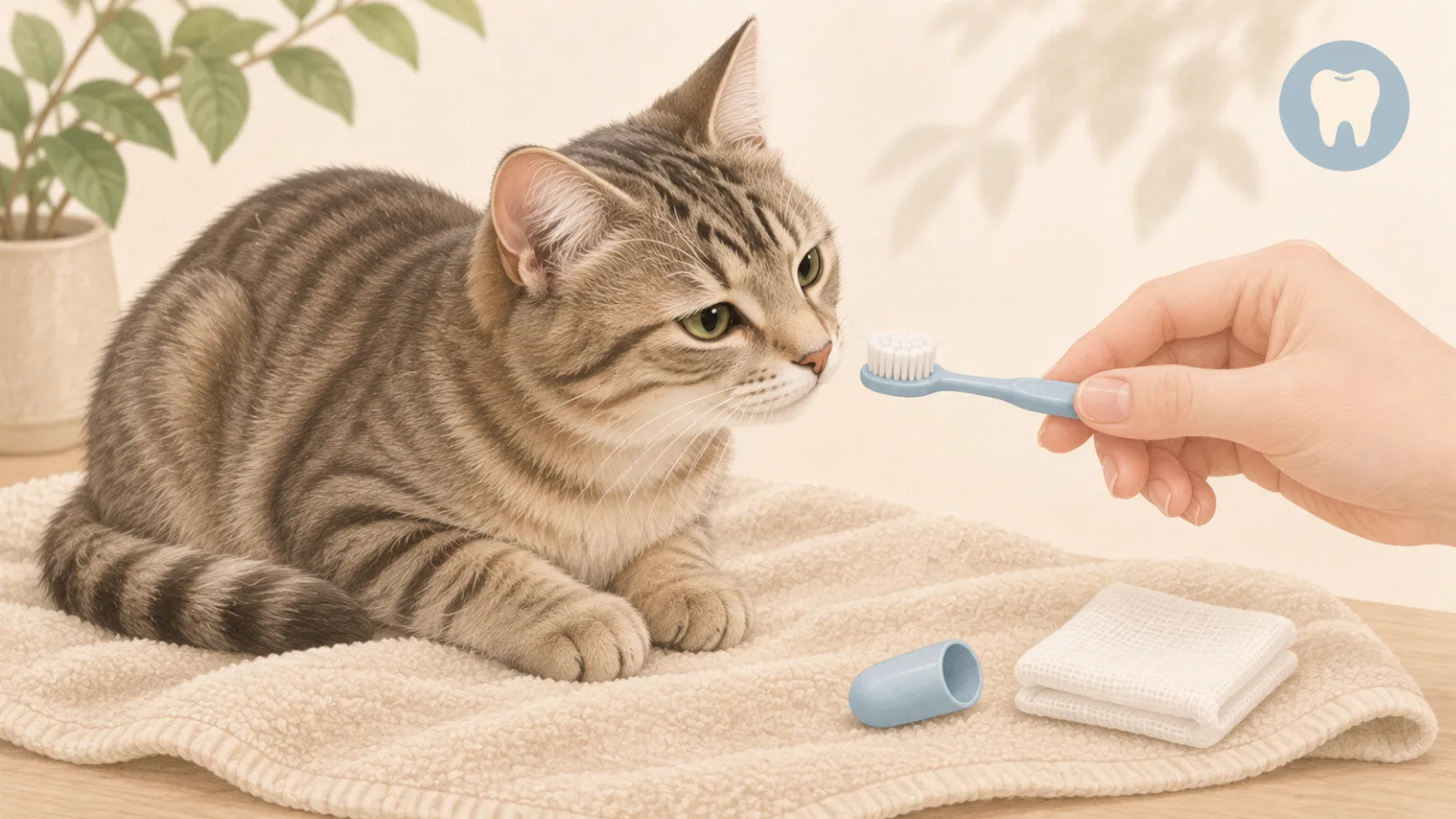
Lift your cat's lip and you will often see yellow tartar at the base of the canines and a red line along the gum edge. It is common. In UK primary-care records of 18,249 cats, periodontal disease was diagnosed in 15.2% within one year and was the most common disorder (O'Neill 2023). In a UK cohort where vets examined the mouth, gingivitis rose from 24.5% in cats under one year to 56.3% at 5–6 years (Williams 2024).
Everyone knows cats "should have their teeth brushed". The problems are that most cats will not let you, and it is hard to tell whether the toothpastes, water additives, powders and dental treats sold instead actually work. This article gathers every cat study on home oral care, compares them by method with numbers, and scores the products sold in Korea on four things: evidence, safety, ease of daily use, and fit with the rest of the diet.
- If your cat accepts brushing: any cat toothpaste is fine; what matters is doing it every day. In a survey of 6,371 cats, brushing and dental treats helped only when done daily; occasional care was grouped with no care (Buckley 2011).
- If your cat does not (most cats): pick one "passive" method with evidence behind it. First choice is a product with the VOHC seal (Veterinary Oral Health Council; requires an average reduction of at least 20% over two trials). In Korea that means seaweed powder (PlaqueOff), dental treats (Greenies, DentaLife) or dental diets (Hill's t/d, Royal Canin Dental).
- Tartar that is already there cannot be removed at home. Every product was shown only to slow new build-up, and most trials started from a mouth that had just been scaled.
- Tooth resorption (FORL) and stomatitis cannot be prevented by brushing or products. They are different diseases. Drooling or chewing on one side calls for dental X-rays, not a new product.
- Avoid: human toothpaste, products with tea tree or other essential oils, and gels or sprays containing alcohol.
| You can decide at home | Decide together with your vet | Your vet decides |
|---|---|---|
| Trying brushing and choosing tools; choosing a cat toothpaste, powder or treat; building a daily habit; photographing the gums | Switching to a dental diet (for cats on another therapeutic diet); seaweed products in cats with thyroid disease; the home-care plan after a scale and polish | Scaling and extractions under anaesthesia; diagnosing tooth resorption and stomatitis (dental X-rays); antibiotics and anti-inflammatories |
1. First, tell apart what home care can and cannot prevent
There are three main mouth diseases in cats. Home care (brushing and products) only works for the first.
| Disease | Cause | How common | Preventable at home? |
|---|---|---|---|
| Periodontal disease (plaque → tartar → gingivitis → bone loss) | Bacterial film (plaque) building up on the teeth | Diagnosed in 15.2% in primary care (O'Neill 2023). In 109 colony cats examined with X-rays, only 4.0% had no gum inflammation at all (Girard 2009) | Yes. Reducing plaque is the core of prevention |
| Tooth resorption (FORL, TR) | The body dissolves its own teeth; cause mostly unknown | 29–61% depending on the study (Ingham 2001, Lommer 2000) | No. "No known prevention" (Gorrel 2015; 2025 feline practice guidelines) |
| Stomatitis (feline chronic gingivostomatitis, FCGS) | An over-reaction of the immune system in the mouth; calicivirus and others are involved | 10.9% pooled across 17 studies (Sánchez-Vallejo 2025) | No. Treated by the vet (usually extractions) |
2. What to do now: choose the path that fits your cat
2-1. Cats that accept brushing
- How often: daily, or at least every other day. No cat study has shown a benefit from once or twice a week (Buckley 2011: "provided they were practised daily").
- Toothpaste: any cat toothpaste. No cat study has measured the effect of enzymes (glucose oxidase and others) in toothpaste. Assume most of the benefit comes from the brush touching the teeth.
- Where: outer surfaces only, focusing on the canines and the big upper back teeth. The tongue cleans the inner surfaces to some extent.
- How long: 15 seconds a side, 30 seconds in total. Short and daily beats long sessions that make your cat hate it.
- Reality: of 407 Swedish owners, 28% brushed at all; 15 (3.7%) brushed daily and 14 every other day (Oskarsson 2021). If you brush daily, you are in the top 4%.
2-2. Cats that do not
Use one passive method (powder, treat, diet or water) every day. No study shows that stacking several adds up. Choose from the ranking in section 5 based on your cat's situation.
| Your cat | Look at first | Avoid |
|---|---|---|
| Healthy adult, no diet restrictions | Seaweed powder (VOHC) or a VOHC dental treat daily | Relying only on "oral care" treats with no evidence |
| On a kidney, heart or urinary therapeutic diet | Seaweed powder sprinkled on food; treats within 10% of daily calories | Switching wholesale to a dental diet (it cannot replace the current diet) |
| Hyperthyroid cat | VOHC dental treats, dental diet | Seaweed (iodine) products; the maker does not recommend them |
| Losing weight | Seaweed powder (almost no calories) | Lots of dental treats |
| Lives with a dog | If using a water additive, one without xylitol | Xylitol water additives (dangerous if the dog drinks) |
3. All the research in one place
We searched PubMed for every study on home oral care in cats and checked the numbers against the abstracts. How to read the tables:
- Control and randomisation: whether there was a comparable control group and whether cats were randomly assigned.
- Population: almost every trial measured build-up over 4 weeks to 1 year after scaling. None followed cats until teeth were lost.
- Sponsor: marked when authors worked for the maker or tested the maker's product. Most feline oral studies fall into this group.
3-1. Brushing
| Study | Population and design | Result | Notes |
|---|---|---|---|
| Buckley 2011 | 6,371 cats and 17,184 dogs in 700+ Polish clinics; oral exam plus owner survey (observational) | Daily brushing or daily dental treats gave significantly better oral scores than occasional or no care, "provided they were practised daily". Dry-only diets helped | Observational, so not proof of cause. Waltham (Mars) authors |
| Vrieling 2005 | 88 cats with gingivitis and tartar, randomised to 4 groups after scaling, 6 months (small dental kibble / plain kibble + brushing / large dental kibble / plain kibble only) | Only the large dental kibble group had significantly less gingivitis and tartar. The abstract reports no benefit for the brushing group | Brushing was left to owners, as in real life. Hill's co-author |
| Oskarsson 2021 | Survey of 407 Swedish owners | 28% brushed. 15 daily, 14 every other day | Shows that adherence, not efficacy, is the main problem |
No randomised trial of brushing exists in cats yet. The case for brushing comes from the observational data above and from dog and human research. In the only randomised trial that left brushing to owners (Vrieling 2005), the brushing group did not beat the dental kibble, most likely because daily brushing was hard to keep up for six months.
3-2. Dry food and dental diets
| Study | Population and design | Result | Notes |
|---|---|---|---|
| Scherl 2019 | (1) 45 cats, 3 months; (2) 24 cats, 1 year. Food with 1.2% lactic acid vs the same food, randomised | (1) At 2 months plaque −19.4%, calculus −35.3% (significant in one of the two test groups; the other showed −2.1% plaque, no difference). (2) Plaque and calculus −30.9% each at 6 months; plaque −30.4%, calculus −25.4% at 12 months | Hill's employees (sponsor) |
| Oba 2025 | 20 cats after scaling, randomised to dry or wet, 28 weeks, blinded assessor | Dry group had less calculus coverage and thickness and lower gingivitis scores. Plaque coverage did not differ | University study, no commercial relationships declared. Small |
| Williams 2024 | Bristol Cats cohort, 317 cats aged 3–4 | Wet-only or mixed diets: odds of gingivitis 2.7× those of dry-only (95% CI 1.4–5.1) | Observational |
| Vrieling 2005 | See 3-1 | Only the large dental kibble worked | Kibble size and structure matter |
A randomised trial and a large cohort agree that dry food is better for teeth than wet. Dental diets cut a further 20–35%, but every trial was run by the food company. For Royal Canin and Purina dental diets we found no PubMed paper, only the VOHC seal.
3-3. Dental treats
| Study | Population and design | Result | Notes |
|---|---|---|---|
| Gorrel 1998 | 15 client-owned cats; dry food + one dental chew vs dry food only (crossover) | Adding the chew daily gave significantly less plaque and calculus (no % in abstract) | Small |
| Ingham 2002 | Dry food vs dry food + dental chew, crossover, 4 weeks each | Less plaque and calculus and milder gingivitis (no % in abstract) | Waltham (Mars) authors |
For products such as Greenies and DentaLife the evidence is a VOHC tartar seal rather than a paper. Treats worked when given daily; a few times a week has never been tested.
3-4. Water additives and gels
| Study | Population and design | Result | Notes |
|---|---|---|---|
| Clarke 2006 | Xylitol water additive, crossover, 56 days each | Less plaque and calculus (no % in abstract) | Appears to be the HealthyMouth line, not sold in Korea |
| Gawor, WSAVA 2025 presentation (DailyVet report, Korean) | Virbac Vet Aquadent FR3SH, 40 cats (20 vs 20), 30 days, VOHC-style | Plaque −18%, calculus −15% (not significant), gingival bleeding index −49% | Conference presentation, no full paper. Virbac product |
| Clarke 2001 | Zinc ascorbate gel, 18 cats vs 18 on saline, randomised, 42 days | Plaque, gingivitis and anaerobic bacteria fell significantly. Calculus and bad breath did not differ | Concludes it works best right after professional cleaning |
| Bellows 2012 | Barrier gel, 31 cats, randomised, blinded assessor, 56 days, applied weekly by clinic staff | Only plaque was lower than control. Calculus, gingivitis and bleeding did not differ | Not applied by owners at home |
We found no cat study measuring plaque or gums for enzymatic toothpaste (glucose oxidase, lactoperoxidase), chlorhexidine, delmopinol or CPC (cetylpyridinium chloride). These ingredients have dog and human data only.
3-5. Seaweed (Ascophyllum nodosum) and probiotics
| Study | Population and design | Result | Notes |
|---|---|---|---|
| Gawor & Jank 2023 (review) | Dog and cat studies | Ascophyllum nodosum reduced calculus and plaque in dogs and cats, with several VOHC-standard trials; powder was the most effective form | We could not find the individual cat trials as PubMed papers. The cat evidence is the VOHC seal (2020, plaque and tartar) |
| Gawor 2018 | 60 dogs, double-blind randomised, 90 days | Plaque, calculus and malodour compounds all better than placebo | Dog study |
| Zhang 2024 | 12 healthy cats, mixed probiotic, 42 days | Oral bacterial make-up changed. Plaque, calculus and gums were not measured | Company-employed authors. This is about all the cat evidence for oral probiotics so far |
4. What the VOHC seal means, and its limits
The VOHC (Veterinary Oral Health Council) was set up by American veterinary dentists. It reviews trial results behind plaque or tartar claims and grants a seal (VOHC trial requirements).
- Requirements: two trials, each at least 15% better than the control group and averaging at least 20%, statistically significant, lasting at least 28 days.
- Plaque and tartar seals are separate. Less plaque (bacterial film) directly helps gingivitis; a tartar seal means less hardened deposit.
- Limits: the company designs and pays for the trials. The VOHC reviews the plan and the results but does not run trials. So it is not independent testing, but it is the only way to check that a cat oral product passed a threshold set in advance.
- In November 2026 there were 18 cat products with the seal. Of these, PlaqueOff, Feline Greenies, Purina DentaLife, Hill's t/d and Royal Canin Dental are sold in Korea. HealthyMouth water additive, gel and toothpaste and Whiskas Dentabites have seals but we could not find them on sale in Korea.
5. Products sold in Korea, scored
5-1. How we scored (100 points)
| Item | Points | Criteria |
|---|---|---|
| Cat evidence | 60 | VOHC plaque + tartar seal 60 · one seal 50 · randomised cat trial 35 · small trial or conference report, observational evidence for brushing itself, or the same ingredient as a sealed product with undisclosed amount 25 · dog or lab data only 10 · none 0 |
| Safety | 20 | Nothing of concern 20 · something to check (iodine, undisclosed fragrance) 15 · antiseptics (peroxide, CPC) 10 · alcohol or essential oils 0 (excluded) |
| Ease of daily use | 10 | Food, water, powder or treat 10 · applied gel 7 · needs brushing 4 |
| Fit with the diet | 10 | Added to current food 10 · treat (adds calories and phosphorus) 8 · replaces the whole diet 3 |
Ingredients come from the maker's official information (home-country site first) and may differ from Korean import labels. As of November 2026.
5-2. Ranking
| Rank | Product | Type | Score (evidence · safety · ease · fit) | Evidence and cautions |
|---|---|---|---|---|
| 1 | ProDen PlaqueOff Cat | Seaweed powder sprinkled on food | 95 60·15·10·10 | VOHC plaque + tartar (2020). Single ingredient, Ascophyllum nodosum, one scoop (330 mg, about 0.2 kcal) a day. Not for cats with thyroid disease (iodine) |
| 2 | Hill's Prescription Diet t/d | Dental therapeutic diet (dry) | 93 60·20·10·3 | VOHC plaque + tartar (2001). Large kibble that wipes the teeth. Cannot replace another therapeutic diet (kidney, urinary, etc.) |
| 3 | Feline Greenies Dental Treats | Dental treat | 88 50·20·10·8 | VOHC tartar (2005). Under 2 kcal each. Must be given daily (as in trials) |
| 3 | Purina DentaLife Cat | Dental treat | 88 50·20·10·8 | VOHC tartar (2016). Must be given daily |
| 5 | Royal Canin Dental (veterinary diet) | Dental therapeutic diet (dry) | 83 50·20·10·3 | VOHC plaque (2014). The seal is for the veterinary Dental diet; the retail "Oral Care" line is not on the list. Cannot replace another therapeutic diet |
| 6 | Virbac Vet Aquadent FR3SH (cat) | Water additive | 60 25·15·10·10 | 40-cat, 30-day conference report: plaque −18%, gingival bleeding −49%. Contains erythritol (no cat data). Check you are buying the cat version |
| 6 | Oraclepet sprinkle-on tooth powder | Powder sprinkled on food | 60 25·15·10·10 | Same seaweed as no. 1 plus four oral probiotic strains, but amounts and strains are not disclosed. No trial of this product. Iodine caution |
| 8 | Cat toothpastes: Virbac C.E.T. (enzymes) · Enzadent (enzymes + zinc) · Penovis OralVet (propolis, probiotic) | Toothpaste for brushing | 59 25·20·4·10 | No cat study compares toothpastes. The score reflects the evidence for brushing itself. If you can brush daily, whichever flavour your cat likes is enough |
| 11 | Catpure Soft Dental Gum (shared base of the liver, eye, immunity and gut versions) | Dental treat (soft chew) | 58 25·15·10·8 | The same seaweed as no. 1 (Ascophyllum nodosum), the oral probiotic Ora CMU (Weissella cibaria CMU, with human and beagle trials) and a tartar-binding phosphate (sodium hexametaphosphate). Several sensible ingredients, but no amounts disclosed and no cat trial of this product. Iodine caution. Being soft, it is unlikely to clean teeth by chewing |
| 12 | Dongkook Canident | Toothpaste for brushing | 54 25·15·4·10 | Enzymes (dextranase, bromelain, lysozyme) plus seaweed extracts. Labelled for "companion animals", not cats specifically. Fragrance blend not disclosed |
| 12 | Nyangpum Meongpum Chika toothpaste | Toothpaste for brushing | 54 25·15·4·10 | Mostly plant and ferment ingredients: green tea, propolis, skullcap, licorice, cordyceps and seaweed extracts, lactobacillus ferment, chitosan. No enzymes or zinc. None has a cat plaque study, so the score reflects brushing itself. Flavour not disclosed |
| 14 | Jungle Monster cat dental water | Water additive | 50 10·20·10·10 | Zinc gluconate, sodium pyrophosphate (tartar-binding phosphate), bromelain (enzyme), green tea extract. Zinc has a cat trial only as an applied gel, not in drinking water. No essential oils, alcohol or xylitol. Silver vine and catnip extracts are for taste |
| 15 | Petshield dental biscuits for cats | Dental treat | 48 10·20·10·8 | Contains tartar-binding phosphate salts (sodium metaphosphate, sodium acid pyrophosphate). No cat trial. Adds phosphorus, so avoid in kidney disease |
| 15 | Nutters Garden Denti-Bite | Dental treat (crunchy biscuit) | 48 10·20·10·8 | Rice, brown rice and pollock biscuit with the oral probiotic Weissella cibaria and propolis. Weissella cibaria (strain CMU) lowered breath and calculus measures in human randomised trials and a beagle study (2019), but there is no cat trial and the product does not name its strain. No tartar-binding phosphates |
| 17 | Oratene Antiseptic Oral Gel | Applied enzyme gel | 47 10·20·7·10 | Six enzymes. No cat trial. Labelled for preventing mouth infections (5–7 days) rather than daily care |
| 18 | Dr.Paring Cat Dental Care toothpaste | Paste rubbed on the gums (cat only) | 42 10·15·7·10 | Lysozyme (enzyme), fucoidan, chitosan, spirulina, probiotic ferments. Rubbed between gums and teeth without a brush, so the evidence for brushing does not apply. No cat trial of the ingredients. Erythritol; flavour blend not disclosed |
| 19 | The Barun dental water (cat) | Water additive | 40 10·10·10·10 | Ingredients: citric acid, chlorine dioxide, purified water, sorbitol, natural mint flavour. The key ingredient, chlorine dioxide (an antiseptic), has no cat trial. The label does not say whether the mint flavour is a peppermint oil |
| 20 | INABA Churu oral care | Treat | 38 0·20·10·8 | No data on dental effect. Fine as a treat, but it does not replace oral care |
| 20 | Cattem spirulina dental treats | Treat (dry biscuit) | 38 0·20·10·8 | An ordinary corn, fish meal and corn gluten treat with spirulina, green tea and cranberry powders. No tooth-specific ingredients (zinc, phosphates, seaweed, oral probiotics), and the ones it has lack cat plaque studies |
5-3. Products outside the ranking
- VOHC seal but not found in Korea: HealthyMouth water additive, gel, spray and toothpaste (plaque); Whiskas Dentabites (tartar). Zinc ascorbate gel (MaxiGuard type) has a randomised cat trial but we also could not find it on sale in Korea.
- Toothbrushes: silicone finger brushes and baby toothbrushes both work. No cat study compares brush types; use what your cat accepts.
- Why many score low: green tea, propolis, spirulina, chitosan, fucoidan and gut probiotics, common in Korean products, have no cat study showing less plaque. When choosing, look for zinc, phosphates (sodium ...phosphate), Ascophyllum nodosum, or a named oral probiotic strain in the ingredient list.
6. Ingredients to avoid in cats
| Ingredient | Evidence | Verdict |
|---|---|---|
| Tea tree and other essential oils (including eucalyptus and peppermint oil) | Ten years of US poison-centre records: 106 cats exposed to 100% tea tree oil had drooling, lethargy, tremors and wobbliness, worse in young and small cats (Khan 2014). Cats break these compounds down poorly in the liver. | Avoid. Small "extracts" in toothpaste are not the same as pure oil, but there is no reason to put them in something swallowed daily. |
| Human toothpaste (fluoride, SLS foaming agent) | No cat studies. Cats cannot spit and swallow it all. | Do not use. |
| Alcohol (ethanol) | Found in some imported gels and sprays. Irritates the mouth and is swallowed. | Avoid. |
| Xylitol | In dogs even small amounts cause low blood sugar and liver failure. Six cats given a single dog-toxic dose (up to 1,000 mg/kg) showed no blood changes (Jerzsele 2018). | Not a major worry in cat-only homes, but the evidence is six cats, one dose. In homes with dogs, do not use xylitol water additives (dogs share water bowls). |
| Seaweed (iodine) | Ascophyllum nodosum is rich in iodine. The maker does not recommend it for cats with thyroid disease. | Do not use in hyperthyroid cats or cats on an iodine-restricted diet (y/d). |
7. Where opinions differ
7-1. "Should I feed dry food for the teeth?"
Why opinions differ: for teeth alone, the evidence consistently favours dry food (Oba 2025, Williams 2024). But for cats with kidney disease, bladder stones or constipation, getting more water in through wet food matters far more.
Our position: do not cut wet food for the teeth. Teeth can be reset with a scale and polish; kidneys and bladders are much harder to fix. For cats on wet food, add one of the passive methods in this article (seaweed powder or a dental treat).
How to check in your cat: photograph the gums and tartar at each check-up every 6–12 months. If the tartar stage stays the same, keep doing what you are doing.
7-2. "Brushing is best, so why are toothpastes ranked low?"
Why opinions differ: human and dog research and veterinary dental guidelines treat brushing as the best method. But no randomised brushing trial exists in cats, and only about 4% of owners brush daily.
Our position: brushing itself is a good method. Toothpastes rank low because their ingredients have no cat evidence and brushing is hard to keep up. If your cat accepts daily brushing, brushing is the first choice regardless of how the toothpastes rank.
8. What research has not answered yet
- Whether daily brushing prevents tooth loss and bone loss in cats (every trial measured only plaque and tartar scores).
- Whether dental diets, treats and powders keep working over years (the longest trial was 1 year).
- Whether they work in a mouth already thick with tartar (no scaling). There is dog data only.
- Whether enzymatic toothpaste, chlorhexidine, CPC, green tea, propolis or probiotics reduce plaque in cats.
- Independent re-testing of VOHC-sealed products.
- The effect of years of daily seaweed powder on iodine intake.
- Any way to prevent tooth resorption (none so far).
9. What to bring to the vet
Your job at home is to keep records. Check the following and keep photos to show at check-ups; your vet can use them directly to stage the disease and plan the timing of a scale and polish.
- Red line at the gum edge: a red band where the gum meets the canines and big upper back teeth. Photograph monthly from the same angle.
- Tartar coverage: how much of the tooth surface it covers (under 1/3, 1/3–2/3, over 2/3).
- How your cat eats: chewing on one side, dropping kibble, shaking the head while eating, pulling away when the mouth is touched.
- Saliva and breath: blood in the saliva, or breath that suddenly gets much worse.
- Current care: what and how often (for example, PlaqueOff one scoop daily for 6 months).
10. Read next
- 12 common questions about wet cat food: oral care for cats on wet food
- One food for life?: how to rotate if a dental diet is the main food
- Chronic kidney disease: diet by stage: adding oral care for cats on a therapeutic diet
📌 Brushing, powders or treats: everything that worked in studies was done every day. The best method is the one your cat will accept daily.