Tosil Tosil Restaurant raw food and avian influenza H5N1 in cats (Korea, 2023): what is confirmed and what is not
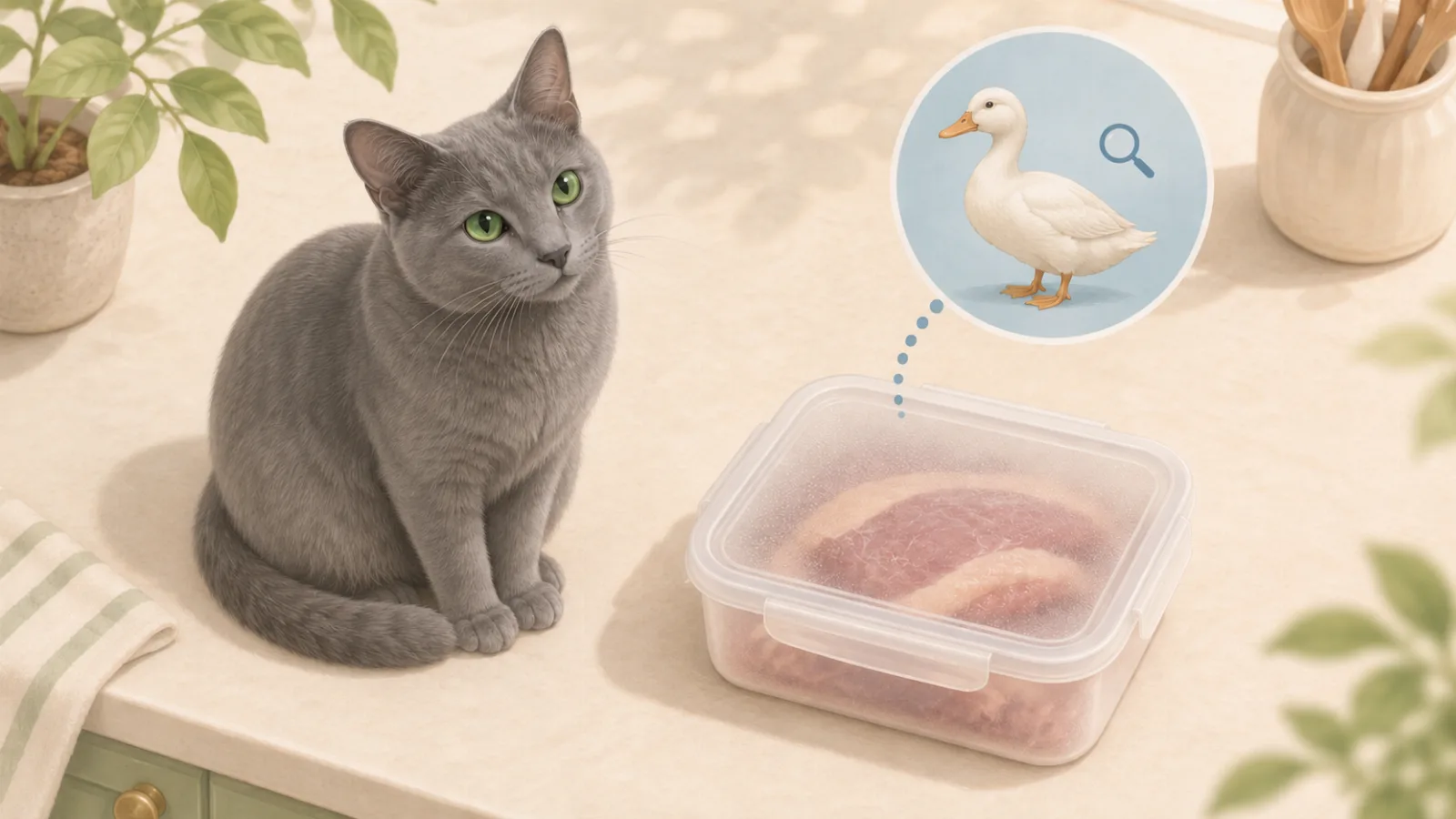
In July 2023, cats at two animal shelters in Yongsan-gu and Gwanak-gu, Seoul, were infected with highly pathogenic avian influenza (H5N1). The Ministry of Agriculture, Food and Rural Affairs (MAFRA) traced the same virus to a raw duck cat food, "Balanced Duck" (brand: Tosil Tosil Restaurant), fed at the Gwanak shelter. Together with "Balanced Chicken" made in the same period, about 13,200 units (1,980 kg) were recalled and destroyed.
This article covers that one event. Using government releases and the papers published afterwards, we separate what is confirmed from what is not, explain with numbers why this happens in raw food, and list what to check at home.
- This event is closed. The recall was completed, and with no further cases the movement restrictions were lifted on 21 August 2023.
- We could not find a final trace result on where the duck meat was contaminated.
- We did not check the brand's current manufacturing process or whether it is still sold. This is a record of the 2023 event.
- What: Tosil Tosil Restaurant "Balanced Duck" and "Balanced Chicken" made by the manufacturer Nature's Row (Gimpo, Gyeonggi) between 25 May and 1 August 2023. MAFRA stated that sterilization steps were not properly carried out in that period.
- Confirmed: HPAI H5N1 was confirmed on 3 August in Balanced Duck made on 5 July. Nine cats were confirmed (Yongsan 5, Gwanak 4), and at the Yongsan shelter 38 of 40 cats died (most without testing).
- Why the food is blamed: virus genes from the Gwanak cats and the food were more than 99.9% identical. For the Yongsan shelter, the same brand was presumed from a receipt and the owner's account, with no direct evidence.
- Buyers' cats: the cats of 286 buyers were monitored for two weeks and showed no problems. We found no reports of human infection in public sources.
- What to do now: if you feed raw or freeze-dried food made from chicken or duck, choose only products whose maker can tell you what sterilization step (for example electron-beam irradiation) they use. If a cat has fever, stops eating, struggles to breathe or is unsteady, go to a clinic straight away and report it to the national animal disease hotline (in Korea 1588-4060, 1588-9060).
| Who | Decides |
|---|---|
| At home | Whether to feed raw; if so, choosing products with a confirmed sterilization step; photographing the pack and lot; hand-washing and hygiene |
| Together | Testing and isolation when there is fever, respiratory or neurological signs; whether to keep feeding raw |
| Clinic and authorities | Diagnosis, receiving reports, epidemiological investigation, recall orders |
1. What happened
| Date | What | Source |
|---|---|---|
| Late June 2023 on | Cats at the Yongsan shelter began dying with respiratory and neurological signs (eventually 38 of 40) | Kang 2024 |
| 25 July | Two Yongsan shelter cats confirmed with H5N1; three more on 28 July | MAFRA 22 Aug |
| 31 July | Two Gwanak shelter cats confirmed (two more on 3 August) | MAFRA 22 Aug |
| 1–2 August | H5 antigen detected in the Gwanak shelter's food (Balanced Duck made 5 July). Gyeonggi Province ordered production and sales to stop, and a recall and destruction | MAFRA 2 Aug |
| 3 August | Final confirmation of HPAI H5N1 in that food | MAFRA 4 Aug |
| 9 August | 286 buyers contacted (268 purchases, 18 free trials); excluding 47 who had already fed it, all stock held by 239 buyers recovered. Inspections of 14 chicken/duck raw-food makers began | MAFRA 9 Aug |
| 21 August | Restrictions lifted with no further cases. 110 samples of products and raw meat from 13 other makers all clear; one more maker found not following sterilization steps | MAFRA 22 Aug |
2. What is confirmed and what is not
| Confirmed | Not confirmed |
|---|---|
| HPAI H5N1 confirmed in Balanced Duck made on 5 July (government) | Whether virus was found in Balanced Chicken itself — no test result was published; it was recalled for the same process failure |
| H5 detected in 4 unopened food containers; the same virus isolated from batches made 26 May, 15 June, 6 July and 27 July, all from one duck-meat lot (Kang 2024) | Where the duck meat was contaminated (the government only said tracing was under way) |
| Gwanak shelter: cat and food virus genes over 99.9% identical, so the food was the direct source (Kang 2024) | The Yongsan shelter's source — the food had been discarded and there were no feeding records, so no direct evidence (presumed from a receipt and statement) |
| Nine cats confirmed; 38 of 40 cats died at the Yongsan shelter | 33 of the 38 Yongsan deaths were disposed of untested, so whether all were this virus is unknown |
| Two-week monitoring of 286 buyers' cats found no problems | Whether any household cats were infected without signs |
| 13 other makers, 110 samples clear; one more maker caught skipping sterilization | That maker's name and products (not public) |
3. Why this happens in raw food
Avian influenza virus is killed by cooking, so the risk concentrates in raw food that is never heated. Raw-food makers use a non-heat step such as electron-beam irradiation instead; in this case, the government said that step was skipped for about two months.
- How much virus was in the food: the recalled food carried 102.5–103.5 EID50 (infectious units) per gram (Kang 2024). The cat viruses carried mammal-adaptation mutations (PB2 E627K and D701N).
- How much treatment is needed: in a quarantine-agency experiment irradiating virus-spiked duck meat, 2.34 kGy reduced the virus tenfold, and fully inactivating very heavily loaded meat (107.6 per gram) was estimated to need about 17.6 kGy (Jeong 2026). What matters is not just that a step exists but that it is applied at a sufficient dose.
- Was it only this brand? Right after the event, 110 samples from 13 other makers were clean. However, a 2025 study isolated live avian influenza virus (low-pathogenic H9N2) from 2 of 62 raw foods made in Korea (Kim 2025). Deaths in cats fed raw poultry food have also been reported in the United States (Jeong 2026, introduction).
4. What to do at home now
- If you feed raw or freeze-dried: for poultry ingredients such as chicken, duck or turkey, ask the maker which sterilization step they use and to what standard, and avoid products whose maker cannot answer. Food that is thoroughly heated during manufacture (dry food, cans) kills the virus in processing, so the risk by this route is far lower.
- Photograph the lot: raw-food recalls are defined by manufacturing date (here, 25 May–1 August). Keep a photo of the manufacturing date and lot.
- Signs: the shelter cats showed fever, loss of appetite, laboured breathing or dry cough and neurological signs such as unsteadiness. If a raw-fed cat shows these together, go to a clinic straight away and report it to the animal disease authorities.
- Human hygiene: wash your hands after handling raw meat food, and keep cats away from wild-bird carcasses (MAFRA advice).
- Bring to the clinic: the product name, manufacturing date and lot photo of the raw food, when you started feeding it, and any signs in other cats in the home.
5. Response by the company and the authorities
Gyeonggi Province ordered production, sales and supply to stop and the products to be recalled and destroyed on 2 August, and the government and local authorities contacted buyers directly and recovered their stock within a week. The government then announced plans to strengthen avian influenza testing at slaughter and to set up safety management for raw pet food. We could not find a separate notice from the manufacturer or the brand; if one is confirmed, we will add it here.
6. How to read this event
The government and the published paper reached the same conclusion: contaminated raw material entered during a period when one maker skipped its sterilization step. It is a rare case in which the cause and scope were identified fairly clearly. At the same time, it shows the risk built into raw food as a format. Where the duck meat was contaminated was not established (in the paper, 214 samples from 9 duck supply-chain sites were negative), and without heat the sterilization step is the last line of defence.
So the takeaway is less "avoid this brand" than "feed poultry-based raw food only when the sterilization step can be confirmed." To make sure one product's failure cannot expose your cat completely, see how to spread your cat's diet.
7. Update log
- 2026-11-14 First published. Re-checked four MAFRA releases (2, 4, 9 and 22 August 2023) and the abstracts or full text of Kang 2024, Kim 2025 and Jeong 2026.
📌 Buying raw food? One question — "Which sterilization step do you use, and to what standard?" A maker that answers straight away is the baseline.