AIXIA MiawMiaw Yawaraka Kotsubu recall (Japan, 2021, propylene glycol): what is confirmed and what is not
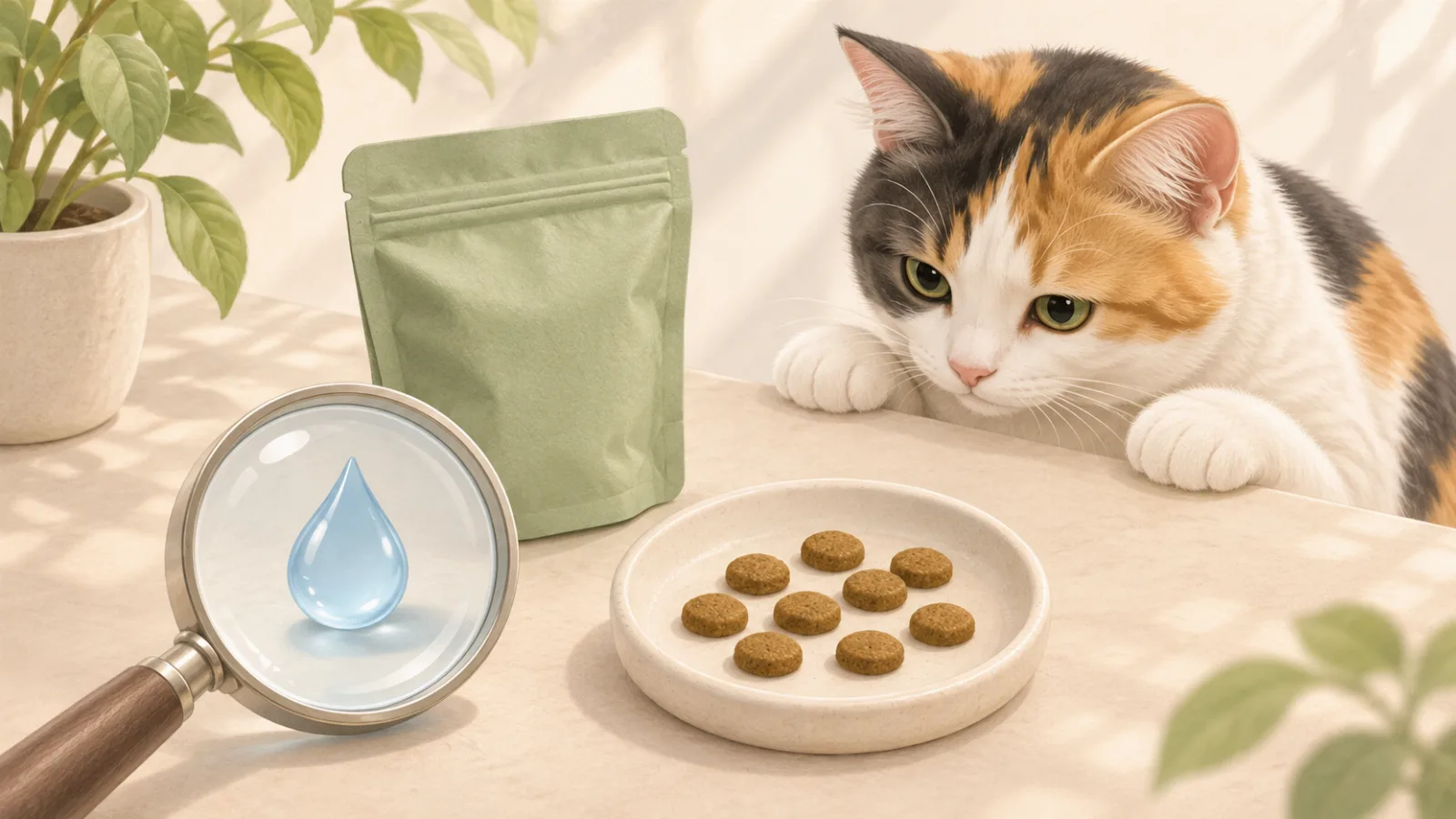
On 16 June 2021, Japan's AIXIA voluntarily recalled some MiawMiaw Yawaraka Kotsubu (soft small kibble) cat food and the Fish Jerky Tuna made in the same factory. The company's own testing had detected propylene glycol (PG), an additive that Japan's Pet Food Safety Act does not allow in cat food.
This article covers that one event. We separate what the company notice confirms from what it does not, explain with numbers why PG, used in dog food, is banned for cats, and list what to check at home. It is not a verdict on AIXIA products as a whole.
- This is a past recall of 2021 Japanese domestic stock. The company notice page is still online.
- At the time of the notice no health complaints had been received, and the company called it a precautionary voluntary recall.
- We found no follow-up notice on completion of the recall or the results of a cause investigation.
- Affected (all best-by dates): MiawMiaw Yawaraka Kotsubu Chicken 240 g (barcode 4571104717102) and Tuna 240 g (4571104717119), the 40 g trial packs of both, and Fish Jerky Tuna 20 g (4562100943114).
- Not affected: the company said MiawMiaw Karikari Kotsubu, Juicy, Gravy, Premium, Creamy, Tobikiri, 3P, Mini 3P and Snacky, made in a different factory, were not involved. The "MiawMiaw Juicy pouch" among the AIXIA products in the CatFoodLab database belongs to this unaffected line.
- Why it is banned: PG causes Heinz bodies (damaged haemoglobin) in cat red blood cells. Even 6% of the diet on a dry-matter basis produced them within two weeks and shortened red-cell survival by 30% (Bauer 1992). Both Japan and the US bar PG from cat food.
- Not confirmed: how much PG was present and how it got in were not disclosed.
- What to do now: for soft kibble, jerky and semi-moist treats, check the ingredients for "propylene glycol" once. Do not share dog semi-moist treats with cats.
| Who | Decides |
|---|---|
| At home | Checking ingredients of soft foods and treats, not sharing dog treats, photographing packs and lots |
| Together | Whether to run bloodwork (anaemia, Heinz bodies) after long-term feeding |
| The clinic | Diagnosing and treating anaemia |
1. What happened
| Date | What | Source |
|---|---|---|
| Before June 2021 | AIXIA's own testing detects PG in some MiawMiaw Yawaraka Kotsubu products | AIXIA notice |
| 2021-06-16 | "Apology and product recall" notice. Fish Jerky Tuna from the same factory also recalled. Cash-on-delivery return, QUO card covering postage, dedicated free-call line | |
| Same notice | Nine MiawMiaw product lines made in a different factory stated as unaffected |
In the notice, the company described PG as "a colourless, odourless liquid additive widely used in food and medicines; in pet food it is used as a humectant in dog semi-moist and soft-dry foods and treats."
2. What is confirmed and what is not
| Confirmed | Not confirmed |
|---|---|
| Five affected items, sizes and barcodes, all best-by dates (checked directly in the notice image) | The amount of PG detected — no figure in the notice |
| Found by the company's own testing; voluntary recall | How PG got in (an ingredient, or cross-contact with a dog line in the same factory, etc.) |
| An additive not permitted for cat food under the Pet Food Safety Act | Whether any stock was distributed outside Japan |
| No health complaints at the time of the notice | Whether complaints came later, and what preventive steps were taken |
| Nine MiawMiaw lines made in a different factory unaffected | When the recall was completed and how much was recovered |
3. Why PG is used for dogs but banned for cats
Cat red blood cells are especially vulnerable to oxidative damage, so eating PG produces Heinz bodies (clumps of damaged haemoglobin) and red cells are destroyed early. US studies in the 1980s and 1990s put numbers on this.
| Study | Animals and dose | Results |
|---|---|---|
| Christopher 1989 | Adult cats, 12% of diet dry matter (typical of semi-moist foods then) for 5 weeks / 41% for 3 weeks | Heinz bodies 28% / 92%. Red-cell half-life down 18.8% / 60%. No PCV change at 12%; 33.5% to 26.3% at 41% |
| Bauer 1992 | 21 adult cats, 0, 6 or 12% | Dose-related rise in Heinz bodies within 2 weeks; red-cell survival down 30% (6%) and 55% (12%). "Dose-dependent erythrocyte destruction, even … as low as 6%" |
| Hickman 1990 | Kittens, 5 or 10% for 12 weeks | All developed Heinz bodies (20%, 28%) without anaemia; 6–8 weeks to return to normal after stopping |
In short, PG at commercial-diet levels usually does not cause obvious anaemia but clearly shortens red-cell life. Christopher 1989 therefore considered nursing queens and kittens, who eat more, at greater risk. The US FDA ruled in 1996 that PG in cat food "has not been shown by adequate scientific data to be safe" (21 CFR 589.1001), and Japan's ordinance states that PG "must not be used in pet food sold for cats" (Ministry of the Environment pet food standards).
4. What to check at home
- Read the ingredients: soft kibble, jerky and semi-moist treats are formats that need a humectant. If the ingredients include propylene glycol, do not give it to a cat.
- Do not share dog treats: PG can legally be used in dog semi-moist treats and foods. In homes with both dogs and cats this is the most common route.
- Signs are usually silent: in the studies, red-cell life shortened mostly without visible anaemia. After long-term feeding, look at anaemia values and a blood smear (Heinz bodies) at the next blood test. Pale gums or marked weakness call for a clinic visit straight away.
- Bring to the clinic: the product name and an ingredients photo, and how long and how much was eaten.
5. The company's response
AIXIA found the problem through its own testing and disclosed it, listing affected items, barcodes and best-by scope as well as unaffected products in an image and a list. It covered return postage and opened a dedicated contact line. We found no follow-up on the amount detected, the cause or the recall results.
6. How to read this event
This was a regulatory breach involving an additive banned for cats, but no harm had been reported by the time of the notice, and it is a case of the company finding and disclosing the problem itself. The scope was narrow: a few products from one factory. On its own it is no basis for judging all AIXIA products.
The lesson for owners is "the softer the food or treat, the more worth reading the ingredients." In homes with dogs, dog treats are the nearest source of PG.
7. Update log
- 2026-11-14 First published. Re-checked the AIXIA notice (2021-06-16) and its product image, Japan's Ministry of the Environment pet food standards, US 21 CFR 589.1001, and the abstracts of Christopher 1989, Bauer 1992 and Hickman 1990.
📌 Living with dogs and cats? Keep dog semi-moist treats out of the cat's reach — PG is legal for dogs and banned for cats.