

Understanding the medications — the cardiac drugs as a timetable
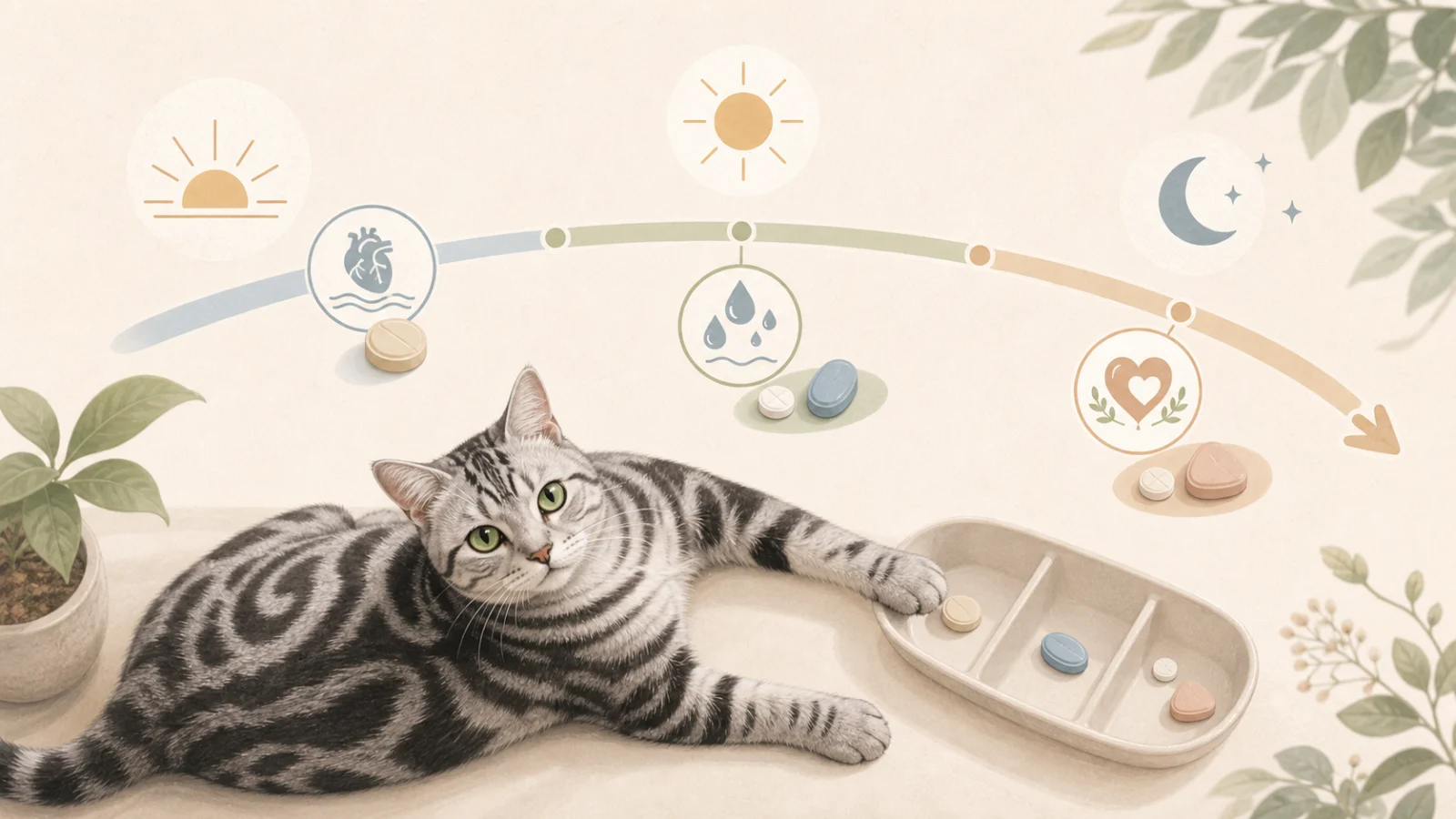
Sooner or later, the drug names start arriving: clopidogrel, furosemide, pimobendan, atenolol… The best way to understand them is not a list of ingredients but a timetable. HCM's drugs enter the stage in a fixed order, one per act of the disease — and once you know the order, both "why isn't my cat on anything?" and "why did the pills suddenly multiply?" answer themselves.
1. The whole timetable — which stage brings which drug
| Stage | Standard | Situational |
|---|---|---|
| B1 | Nothing — surveillance is the treatment | — |
| B2 | Clopidogrel (clot prevention) | Atenolol considered for severe obstruction (SAM) or tachycardia |
| C (after failure or a clot) | Furosemide + clopidogrel | Pimobendan (off-label); rivaroxaban added for high recurrence risk |
| D (refractory) | Furosemide → torasemide | Adjust the rest; palliative mindset |
Two principles jump out: drugs enter not to fix the heart but to prevent its complications (clots and water), and they multiply only when the stage moves. Which means: if the pills increased, the stage moved — time to reread the staging article.
2. Why B1 gets nothing — the history of failures sets you free
The frustration of "there's a disease, why no medicine?" is answered by history. Veterinary cardiology spent twenty years seriously testing drugs for asymptomatic HCM — and the candidates fell one by one.
| Candidate | The hope | The result |
|---|---|---|
| Atenolol (beta-blocker) | Slower heart rate, less myocardial strain | 5-year follow-up in asymptomatic cats — no survival benefit (Schober 2013) |
| Benazepril (ACE inhibitor) | Blocking RAAS to curb remodelling | Randomised placebo-controlled trial — no benefit shown (King 2019) |
| Ramipril · spironolactone | Less hypertrophy and fibrosis | No effect; spironolactone caused severe skin lesions in some cats |
| Diltiazem | Better relaxation | Failed to show survival benefit — effectively retired |
So "no drugs at B1" is not neglect — it is the conclusion of those trials (ACVIM 2020). A daily pill without benefit adds only stress and side effects. The candidate hoping to change this is rapamycin, now in clinical trials and covered in chapter 12 — the first drug aimed at the disease itself.
3. Clopidogrel — the most important half-tablet in this disease
- Evidence — in the FAT CAT trial it more than doubled the time to clot recurrence versus aspirin (443 vs 192 days); ACVIM recommends it preventively from B2, when clot risk rises
- Dose — usually 18.75 mg once daily (a quarter of the human 75 mg tablet). Cutting is a chore — ask about pharmacy splitting or recompounding into capsules
- The great obstacle is the taste — intensely bitter; touch it to the tongue once and the cat foams and never forgives. Capsule it or wrap it completely in a pill pocket or treat from the very first dose — keeping it off the tongue is the whole game
- Side effects are few — occasional vomiting or reduced appetite; visible bleeding tendencies are rare
- Do not stop — a drug that prevents an accident shows no visible effect, which makes quiet discontinuation the most common failure mode. Before surgery or dental work, discuss whether to pause it
4. Furosemide — stage C's lead, in summary only
When failure comes, the diuretic takes the lead. The rule is "the lowest dose that keeps the lungs dry", the compass is the sleeping breath rate, and the price is kidney strain — the full tightrope lives in the heart failure article, section 4. One point here: a diuretic treats a symptom, not the disease — it is never started before water exists (stage B).
5. Pimobendan — between promise and debate
- What — boosts contraction and opens vessels; standard in dogs, off-label in cats
- Evidence — a retrospective study of CHF cats reported longer survival on it (Reina-Doreste 2014), but an 83-cat randomised, placebo-controlled trial (Schober 2021) found no benefit at 180 days (section 8)
- Caution — in the many HCM cats with SAM (outflow obstruction), boosting contraction can worsen the obstruction; clinics legitimately differ, and that reflects divided evidence, not divided skill
- Your role — ask: "does my cat have SAM, and given that, what is pimobendan's cost-benefit here?"
6. Atenolol — demoted from prognosis drug to symptom drug
As section 2 showed, atenolol failed the "slow the disease" test. But it was not expelled — it changed seats: for cats (often young ones) whose severe SAM narrows the outflow with loud murmurs and fast rates, it serves as symptom relief, slowing the heart and easing the obstruction. Two cautions: beta-blockers can rebound (racing heart) if stopped abruptly — taper with your vet; and it is generally not newly started in active heart failure.
7. Pilling in practice — the craft of making medicine happen
- Never dry-pill and walk away — a tablet lodged in the oesophagus can cause inflammation and strictures. Follow every pill with a lick of churu or a sip or two of water
- Bitter drugs (clopidogrel) must be shielded — capsules, pill pockets, fully buried in food. One taste and the cat starts auditing that treat forever: the first impression is everything
- Missed dose — if it is nearly time for the next one, skip and resume on schedule. Never double up. When unsure, call
- Agree the priority — for the day not everything goes in (usually diuretic → clopidogrel → the rest), a pre-agreed order replaces guilt with a rule
- Log it — dose times and refusals in the app; "he keeps spitting it out lately" is the evidence that gets a formulation changed
- Declare the med list — at any other clinic, and before any anaesthesia (clopidogrel especially)
8. Every study so far, in one table
The trial results behind the "drug timetable" in sections 1–6. HCM drug research is full of failed trials, and that is the basis for "no drugs at B1". Three things to check as you read:
- Control group and randomisation — in this field, good retrospective results have repeatedly vanished in randomised trials
- What was measured — heart thickness and echo markers / quality of life and activity / survival. Survival trials carry the most weight
- Funding — trials supported by a drug maker are flagged in the last column
8-1. The preclinical stage: candidates that failed
| Study | Subjects · design | Result | What to note |
|---|---|---|---|
| Schober 2013 (atenolol) | 63 cats with preclinical HCM (42 atenolol, 21 untreated) + 31 healthy cats, 5-year observation | All-cause and cardiac death no different. Age and left atrial size predicted outcome | Not randomised (open-label observation). Source of the section 2 table |
| Coleman 2020 (atenolol) | 32 cats with subclinical HCM, randomised, double-blind, placebo, 6.25 mg twice daily for 6 months | Heart rate fell (157 vs 195), but quality of life and activity were no different | "No symptom benefit in cats without symptoms". Section 6 is about cats with severe obstruction |
| King 2019 (benazepril) | 151 cats with heart disease of various causes, randomised, blinded, placebo, up to 2 years | Time to treatment failure no different (hazard ratio 1.00). Left atrium, wall thickness and quality of life no different | Supported by the manufacturer (Novartis, now Elanco), employee authors |
| MacDonald 2006 (ramipril) | 26 Maine Coons with familial HCM, no heart failure, blinded, placebo, 1 year | No change in heart muscle mass, fibrosis or diastolic function | No effect even with 97% ACE suppression |
| MacDonald 2008 (spironolactone) | 26 Maine Coons with HCM, randomised, placebo, 4 months | No change in diastolic function or muscle mass. 4 of 13 developed severe ulcerative facial dermatitis and stopped | Source of section 2's "severe skin reactions in some" |
| Wall 2005 · Taillefer 2006 (diltiazem) | Extended-release diltiazem kinetics in 13 cats and use in 25 client cats / 21 cats with subclinical HCM, benazepril vs diltiazem for 6 months | At 60 mg, 9 of 25 (36%) had lethargy, GI upset or weight loss. No difference between the two drugs at 6 months | Background to section 2's "effectively retired". Not a large survival trial |
8-2. Drugs used at B2 and C
| Study | Subjects · design | Result | What to note |
|---|---|---|---|
| Hogan 2015 (FAT CAT) | 75 cats that survived a clot, randomised, double-blind, clopidogrel 18.75 mg vs aspirin | Time to recurrence 443 vs 192 days; to recurrence or cardiac death 346 vs 128 days | Basis for section 3. Only 15% had known heart disease before the clot |
| Brainard 2025 (SUPERCAT) | 45 cats recovered from a clot, randomised, double-masked, clopidogrel vs rivaroxaban alone, 2 years | Recurrence 37% vs 39%; time to recurrence 663 vs 513 days — no difference | Rivaroxaban alone protected similarly. Section 1's "combination" is not what this trial tested |
| Reina-Doreste 2014 (pimobendan) | Cats with HCM and CHF: pimobendan 27 vs matched controls 27, retrospective | Median survival 626 vs 103 days | Retrospective |
| Schober 2021 (pimobendan) | 83 cats with HCM and recent CHF, randomised, double-blind, placebo, 180 days | Success rate no different. Non-obstructive 32% vs 18%; obstructive 28.6% vs 60% (neither significant) | Exploratory trial. All authors had past funding from the manufacturer (Boehringer Ingelheim) |
In short, the only drug shown in a randomised trial to change outcomes is clopidogrel (clot recurrence), now joined by a trial showing rivaroxaban alone does about as well. Every preclinical candidate (atenolol, benazepril, ramipril, spironolactone) was no better than placebo, and pimobendan's good retrospective numbers were not confirmed in a randomised trial — which is why the section 1 timetable adds only complication-preventing drugs, stage by stage.
- Whether clopidogrel at B2 prevents a first clot — FAT CAT tested recurrence in cats that had already had one; B2 prevention is a guideline recommendation
- Clopidogrel plus rivaroxaban together (section 1) — the randomised trial tested each alone
- Whether atenolol changes symptoms or outcome in cats with severe obstruction (SAM) (section 6) — we found no controlled trial in that group alone
- Pimobendan in non-obstructive cats — the exploratory trial's positive lean (32% vs 18%) has not yet been confirmed
Study names link to the PubMed abstract. Evidence checked: 2026-11-18.
9. What to ask your vet
- "By my cat's stage, where on the timetable does this prescription sit?"
- "Can clopidogrel be recompounded into capsules? Pilling keeps failing."
- "Given SAM status, are pimobendan and atenolol each a net gain or loss here?"
- "Which of these drugs need lab rechecks, and how often? (diuretic = kidneys, potassium…)"
- "For each drug, what do I do if a day is missed?"
- "Could a newer treatment like rapamycin ever apply to this cat?"
10. Related
- Between B1 and B2 — the moment clopidogrel enters the timetable
- Heart failure — the diuretic tightrope in full
- The clot (ATE) — clopidogrel and the rivaroxaban combination
- Feeding the heart-disease cat — where supplements end and drugs begin