

When another disease comes too — old cats rarely carry one illness alone
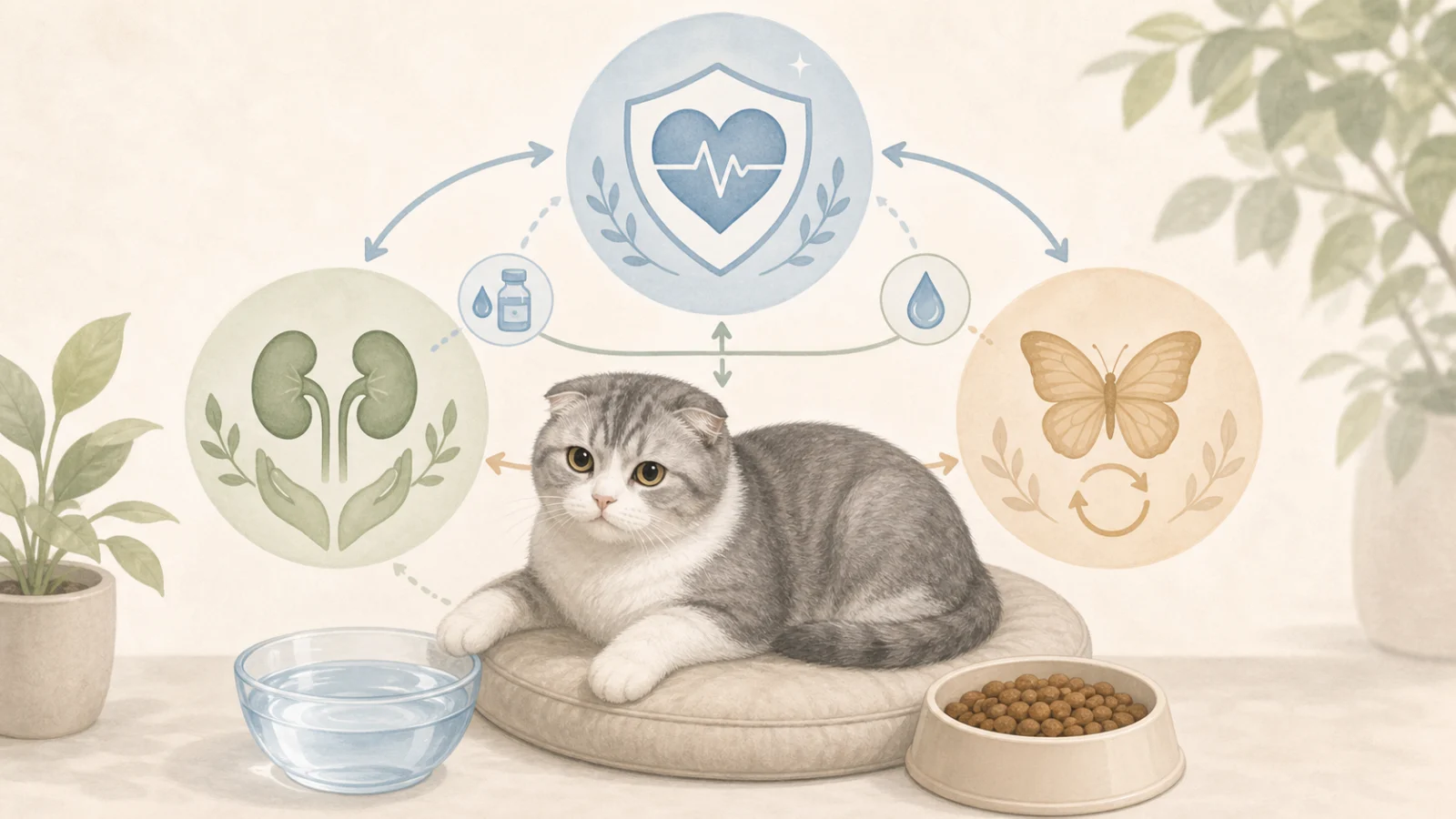
HCM is often found in older cats, and in an old cat's body, diseases rarely arrive alone. The kidneys may already be failing, the thyroid overactive, the blood pressure high — and these conditions make opposite demands. The heart asks for water to be taken away while the kidneys ask for more; the thyroid imitates the heart; hypertension disguises itself as heart disease.
This article is the map of that intersection. It is territory without perfect answers, so the goal is not memorising solutions but understanding the principles of negotiation — what to protect first, what to concede, and where the evidence for each call comes from.
1. Three ground rules of the intersection
- ① The disease that kills in minutes goes first — lungs flood on a scale of hours; kidney values worsen on a scale of weeks. When heart and kidneys collide acutely, secure the breathing, then help the kidneys recover
- ② In the chronic phase, trade "perfect" for "balanced" — with two diseases, both textbooks' targets cannot be hit at once. Kidney values held slightly high (permissive azotaemia) can be an intended compromise, not a failure
- ③ Two clinics, one information stream — cardiology at a referral centre, everything else locally is common. Keeping the full med list and latest results in the app, and sharing the whole picture at every visit on both sides, is the caregiver's most important job
2. Heart + kidneys — the water dilemma (the heart of this chapter)
| What the heart (HCM) wants | What the kidneys (CKD) want | |
|---|---|---|
| Water | Less — excess floods the lungs | More — dryness cuts filtration |
| Diuretics | The lifeline of heart failure | Dehydration and reduced flow push values up |
| Subcutaneous fluids | Dangerous — volume overload can trigger failure | The basic tool for correcting dehydration |
| Protein | Enough to protect muscle | Adjusted around phosphorus control |
The working rules of this dilemma:
- Diuretic at "the lowest dose that keeps the lungs dry" — higher doses raise creatinine (2024 data), and the case for reduction is a stable breathing-rate log. Details in Heart failure, section 4
- Subcutaneous fluids by cardiac permit, not kidney routine — what is standard for CKD alone can trigger failure in an HCM heart. Starting, continuing and dosing all require a vet who knows the cardiac stage and atrium; and while fluids are given, a rising breathing rate is the stop signal
- Redraw the kidney scale — for a cat on diuretics, the creatinine target is not "the normal range" but "this cat's stable line without symptoms." Slightly elevated and comfortable beats normal with wet lungs
- Consolidate rechecks — kidneys, electrolytes, blood pressure and urine in one visit; a recheck 1–2 weeks after any diuretic change serves both diseases
- The diet collision — cardiac feeding (ample protein) versus renal feeding (phosphorus restriction) is negotiated in the feeding article, section 6 and the CKD bible's comorbidity article — usually keep the phosphorus control, avoid cutting protein deeply, designed per cat
3. Heart + thyroid — the imitator, unmasked
- Over age 7, "thick heart walls" means check T4 first — hyperthyroidism whips the heart into an HCM-lookalike, and if the thyroid is the cause, the walls can thin again with treatment. The verdict on true HCM belongs to a repeat echo after the thyroid normalises
- Both together is common — if walls remain thick after thyroid control, stage it as concurrent HCM
- The butterfly effect of thyroid treatment — hyperthyroidism artificially props up kidney filtration, hiding CKD. Treat it and the hidden kidney numbers surface — that is disclosure, not deterioration. Comparing creatinine and SDMA before and after is standard, and this is the moment all three axes (heart, thyroid, kidney) are read together
- Severe tachycardia — atenolol may bridge the heart until the thyroid comes under control
4. Heart + hypertension — remove the disguise and the treatment appears
- High pressure also thickens walls — secondary hypertrophy from pushing against resistance. Here the real treatment is not a cardiac drug but amlodipine, and control can improve the walls
- The threshold — systolic 160 mmHg confirmed repeatedly warrants treatment (ACVIM/ISFM). Hypertension strikes eyes (acute blindness), brain and kidneys along with the heart — treating it pays broadly
- The measurement trap — "white-coat" rises of 20–30 from clinic stress are common. Quiet room, settling time, multiple readings; no lifelong prescription from a single 170
- Blood pressure is a standing item for any HCM cat — especially with CKD (hypertension's most common cause) on board
5. Designing the workup when diseases stack — once, together
- One integrated panel — kidneys (creatinine, SDMA, phosphorus, potassium) + T4 + blood pressure + CBC (including NLR·PNR) in one visit, one draw. Separate trips per disease multiply stress, cost and misses
- One recheck calendar — cardiac 3–6 months, renal 1–3, thyroid titration 2–4 weeks… bundle the overlapping cycles into "this cat's months are X and Y" and fix it in the app
- The med list as a living document — more drugs, more interactions. Every new prescription deserves the question "is this safe against the full current list?"
6. When anaesthesia becomes necessary — dental work and beyond
- Cardiac reassessment first — if the last echo is older than ~6 months, discuss updating it; stage and atrial status change the anaesthetic plan (drugs, fluid rates)
- Conservative fluid rates — intra-anaesthetic fluid overload is the classic trap. "Please keep fluids conservative because of the heart" is a sentence a caregiver is allowed to say
- Count the cost of postponing too — dental pain and infection burden the heart through appetite and inflammation (NLR!). "Too scared of anaesthesia, so we left it" is not automatically the safe choice — a prepared anaesthetic often beats neglect
7. Every study so far, in one table
Feline studies on heart disease with other illnesses alongside. Two things to check as you read:
- Where there is research and where there isn't — diuretics and kidney values, and thyroid or blood pressure and wall thickness, have studies; safe limits for subcutaneous fluids and anaesthetic plans are mostly expert opinion
- Design — mostly retrospective
7-1. Heart + kidney
| Study | Subjects · design | Result | What to note |
|---|---|---|---|
| Rogg 2025 | 116 cats with kidney values measured at least twice during heart-failure treatment, retrospective | Azotaemia in 44% already at diagnosis; kidney values rose during treatment in 66%. Higher furosemide doses went with rising creatinine, yet creatinine and kidney injury were not linked to long-term survival. Cats on an ACE inhibitor had fewer kidney-injury events | Source of section 2's "2024 study" (published online November 2024). Same direction as "slightly higher numbers with calm breathing is better" |
| Coleman 2026 (review) | Expert review of cats with concurrent heart and kidney disease | Fluids for the kidneys and diuretics for heart failure pull in opposite directions; overdoing one can injure the other organ | Background to section 2's "water dilemma". A literature and consensus summary, not a study |
7-2. Heart + thyroid
| Study | Subjects · design | Result | What to note |
|---|---|---|---|
| Weichselbaum 2005 | 91 hyperthyroid cats, echo before and 2–3 months after radioiodine | Pre-treatment abnormalities were mainly thicker ventricular walls, moving back towards normal after treatment; some cats showed new abnormalities afterwards | Basis for section 3's "walls can thin once the thyroid is treated — judge on a repeat echo" |
| Sangster 2014 | 23 hyperthyroid, 17 HCM and 19 healthy cats | NT-proBNP and troponin did not differ between hyperthyroid and HCM cats; both fell, with wall thickness, 3 months after radioiodine | Section 3's "mimicry" — even blood tests struggle to tell them apart |
| Peterson 2025 | 1,047 cats made euthyroid with radioiodine, retrospective | Azotaemia surfaced after treatment in 12%; median survival 2.8 vs 4.3 years | Basis for section 3's "masked kidney values come to light" |
| Szlosek 2020 | Treated hyperthyroid cats, retrospective laboratory database | Higher T4 went with lower creatinine, but not lower SDMA. After treatment, as cats gained weight, creatinine kept rising while SDMA stayed stable | Basis for section 3's "compare creatinine and SDMA before and after". Most authors are employees of the SDMA test company (IDEXX) |
7-3. Heart + blood pressure
| Study | Subjects · design | Result | What to note |
|---|---|---|---|
| Chetboul 2003 | 58 hypertensive cats among 188 referred, echocardiography | Hypertensive cats had thicker walls (septum 5.8 vs 3.7 mm) and abnormal LV geometry in 33 of 39; retinal lesions in 48% | Basis for section 4's "high blood pressure thickens walls too" |
| Belew 1999 | 13 colony cats with implanted pressure monitors, simulated vet visits | Systolic pressure during the exam averaged 17.6 mmHg above the 24-hour mean, ranging from −27 to +75 between cats; 22.3 on average in cats with kidney disease | Source of section 4's "white-coat effect". The "20–30" is at the upper side of the average — and some cats rise far more |
| Bijsmans 2015 | 265 cats with CKD + 133 healthy cats aged 9+, retrospective follow-up | About 40% of CKD cats were already hypertensive at diagnosis; others developed it later | Basis for section 4's "with CKD, blood pressure at every recheck" |
In short, the most direct evidence for "breathing first, negotiate with the kidneys" is a study (Rogg 2025) finding that diuretics raise kidney values but that this did not, in itself, shorten survival. Feline studies also support that thyroid disease and high blood pressure thicken the walls and that treatment can reverse it. How far subcutaneous fluids can go and how to plan anaesthesia, on the other hand, are matters of expert judgement more than research.
- How far subcutaneous fluids are safe in cats with HCM — we found no comparative study (review and expert opinion)
- Anaesthetic risk and fluid rates in cats with HCM — we did not find an anaesthesia study of HCM cats specifically
- Whether atenolol protects the heart during thyroid treatment — we found no controlled feline study
- Where "permitted azotaemia" ends — Rogg 2025 found no link with survival, but no research-based limit exists
Study names link to the PubMed abstract. Evidence checked: 2026-11-18.
8. What to ask your vet
- "Of heart, kidneys, thyroid and blood pressure, which have we actually checked in this cat? What is missing?"
- "(Heart+kidney) Is this a heart that can take subcutaneous fluids? If so, how much, and what is the stop signal?"
- "(Heart+kidney) Given this creatinine, where do we set this cat's acceptable line?"
- "(On thyroid treatment) When do we re-echo the heart and recheck the kidneys?"
- "Today's blood pressure — how many readings, and what were they? Could this be white-coat effect?"
- "(Before anaesthesia) What is the cardiac preparation and fluid plan?"
9. Related
- Heart failure — the cardiac half of the diuretic tightrope
- The CKD bible: when another disease comes too — the same crossroads, mapped from the kidney side
- Subcutaneous fluids at home — the technique itself
- Blood pressure at home — beating the white-coat effect
- Feeding the heart-disease cat — negotiating the diet collision