

Resting respiratory rate — one minute a day, the cheapest heart monitor
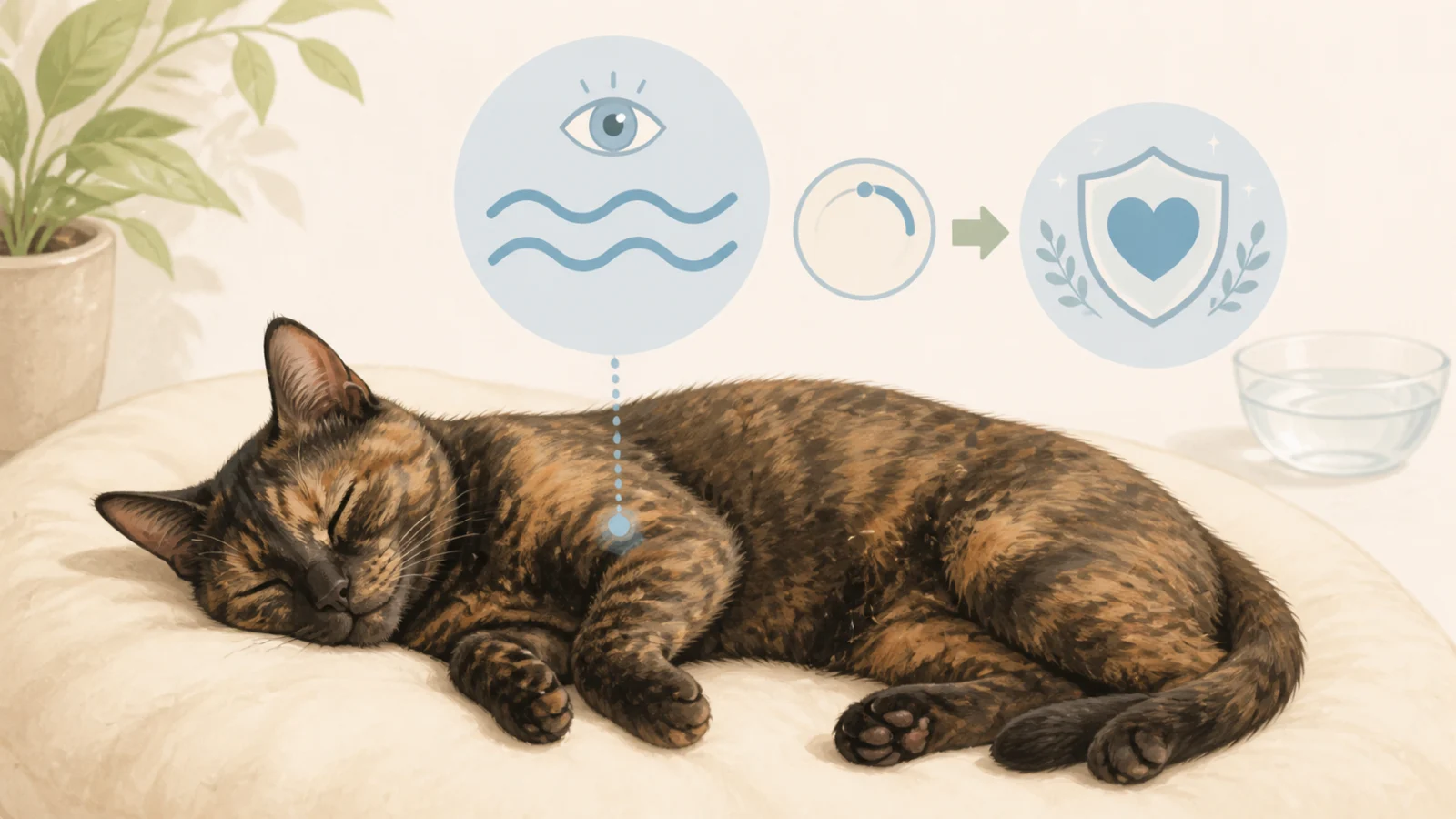
Becoming the caregiver of a heart-disease cat feels like it should involve buying expensive equipment. But the most important monitor for this disease is already in your home: your own eyes, watching a sleeping cat's chest for thirty seconds.
That is not an exaggeration. The earliest sign of congestive heart failure (fluid building in the lungs) is not coughing, not open-mouth breathing, not collapse — it is the sleeping breathing rate creeping upward. By the time visible signs appear it is already an emergency; the rising rate comes days earlier, and those days are the difference between the ER and a regular appointment. This article is everything about measuring that number correctly, reading it, and turning it into action.
1. Why this number, of all things
Cats are experts at hiding illness. As fluid starts to gather in the lungs they simply move less and curl up more, and the moment a caregiver "senses something wrong" usually comes late in the process.
But the breathing rate cannot be hidden. Fluid in the lungs shrinks the surface for oxygen exchange, and the body compensates by breathing faster — an involuntary reflex that shows even in sleep. Sleep, in fact, is when the number is most honest: waking respiration swings with heat, play and nerves, while the breathing of deep sleep reflects only the heart and lungs.
That is why cardiologists everywhere teach this measurement first, and why the ACVIM guidelines (2020) recommend it as the home-monitoring tool for cats at stage B2 and beyond.
2. What is normal — the numbers research measured
From the study in which owners measured their own cats at home (Ljungvall 2014):
- Healthy cats sleep at a median of about 21 breaths/min, almost all under 30
- Cats with stable subclinical heart disease (mild-to-moderate left atrial enlargement) are also under 30 — so a low rate does not mean no disease, but it does mean "the lungs are not filling right now"
- Cats whose heart failure is well controlled on treatment also slept at a median of 20/min (Porciello 2016) — staying under 30 is also a sign the treatment is working
| Sleeping rate (breaths/min) | Meaning | Action |
|---|---|---|
| Under 30 | Normal — active heart failure very unlikely | Log it, carry on |
| 30–40 | Caution zone — first suspect the measuring conditions | Re-measure in true deep sleep. If it repeats, call the clinic |
| Over 40 | Possible heart failure signal | Hospital that day (24-hour hospital at night) |
| Regardless of the number | Open-mouth breathing, abdominal effort, laboured breathing | Hospital now — this is not the moment for counting |
3. How to measure — exactly
- ① Timing — when the cat is deeply asleep: not right after play, food or grooming, but a few minutes into quiet sleep. Ideally at a similar time each day, e.g. before your own bedtime
- ② The unit — one breath is the chest rising AND falling. Counting the rise as one and the fall as another doubles the result — the single most common mistake
- ③ Duration — stopwatch on your phone, count 30 seconds, multiply by 2. 15 s × 4 magnifies a one-breath error fourfold, so avoid it; a full 60-second count is the most accurate when you have the patience
- ④ Record — put the number with the date into the app's care log. Memory leaves only vague anxiety ("has it been fast lately?"); a log leaves a trend
4. Five traps — when the number lies
| Trap | What happens | Fix |
|---|---|---|
| Measuring during purring | Breathing turns fast and irregular — uncountable | Wait until purring stops |
| During dreaming (REM) | Breathing speeds up briefly with twitching whiskers and paws — normal | Measure in fully relaxed deep sleep; if unsure, retry minutes later |
| Hot day, right after play | Rate rises for temperature control | Cooler hours, 30 minutes after rest |
| Curled position hides the chest | Lost count, inaccurate | Side-sleeping is your window; any spot where rise-and-fall is visible works |
| Panic at one high value | Anxiety → hourly measuring → a stressed cat | A single value is a discard. Re-measurement and trend decide |
5. Baseline and trend — stronger than any absolute number
Thirty is a good fence, but the sharper tool is your own cat's usual number. A cat that always slept at 16 and now sleeps at 26 is "still normal" — and up 60%. That is the kind of early signal that happens entirely inside the fence, and only a caregiver with a baseline can catch it.
- Build the baseline — measure daily for one week, starting now, and average it. That is your cat's zero
- Maintenance — B1: 2–3 times a week; B2: daily; on heart-failure treatment (C): once or twice daily
- What counts as a signal — ① above 40, ② 20%+ above baseline for 2–3 consecutive days, ③ a stepwise climb day after day. Any one of the three means it is time to call
6. The action rules — decided in advance, so nights don't shake you
- Step 1: check conditions, re-measure — was it hot, was the cat dreaming, had it just played? Fix the conditions and count again at the next deep sleep. Back under 30: done
- Step 2: repeated 30–40, or a rising trend — phone the clinic and bring the record (numbers plus video) to an earlier appointment. A caregiver who can say "since when, from what to what" delivers half the consult over the phone
- Step 3: above 40, or open-mouth/laboured breathing, pale or bluish tongue — hospital now. Cover the carrier with a towel, minimum people, quiet
- If on diuretics — ask whether you can agree a pre-arranged protocol: "if the rate goes above X, adjust the diuretic like this". Never increase doses on your own — but a rule agreed in advance protects the golden hours of the night
7. If your cat is being treated for heart failure — this number steers the diuretic
For a cat that has been through failure (stage C) and takes diuretics, this number graduates from early-warning to the compass of treatment. Well-controlled CHF cats slept at a median of 20/min, no different from healthy cats (Porciello 2016). Which means:
- Sleeping rate steadily under 30 → the current diuretic dose is doing its job
- The number starting to crawl back up → the earliest sign the lungs are refilling — time for a recheck and dose adjustment
- Conversely, diuretics tax the kidneys, so a reliably low rate is also evidence for trying a lower dose. In a cat with both heart and kidney disease, this log becomes decisive in that tightrope act (CKD with other diseases)
8. Every study so far, in one table
Where the "under 30" figure and the "count every day" advice come from. There are few studies on this, and most come from one research group that had owners count at home. Three things to check as you read:
- Who was studied — healthy cats / subclinical heart disease / treated heart failure. Each study measured the usual values for its group
- What was measured — sleeping respiratory rate and resting respiratory rate (awake but at rest) are different. Awake values run higher
- Funding — both respiratory-rate studies below declared no conflicts of interest
| Study | Subjects · design | Result | What to note |
|---|---|---|---|
| Ljungvall 2014 | 59 echocardiographically normal + 28 apparently healthy + 54 cats with subclinical heart disease. Owners counted at home on 8–10 occasions | Normal and healthy cats, and cats with mild or moderate left atrial enlargement: per-cat averages all under 30, median about 21 breaths/min. Cats with severe left atrial enlargement sometimes exceeded 30. Little day-to-day variation. Resting (awake) rates always higher than sleeping | The source of section 2's "under 30". The authors suggest further evaluation when the average is over 30 or several readings exceed 30 |
| Porciello 2016 | 22 cats with stable, treated left-sided heart failure (plus 51 dogs), owner-counted at home | Sleeping median 20 breaths/min (13–31). 4 cats ≥25, 1 cat ≥30. Unrelated to diuretic dose. Awake resting median 24, with 2 cats over 40 | The source of section 7's "well-controlled cats look like healthy cats". Also a reminder that awake readings can cause needless alarm |
| Fox 2018 (REVEAL) | 1,008 cats with subclinical hypertrophic cardiomyopathy + 722 healthy cats, retrospective follow-up across 21 countries | 30.5% of the heart-disease cats developed heart failure or a clot. Heart-failure risk 7.0% at 1 year · 19.9% at 5 years · 23.9% at 10 years | Why to keep counting even without symptoms. Did not measure respiratory rate |
| Luis Fuentes 2020 (ACVIM consensus) | American College of Veterinary Internal Medicine guidelines on feline cardiomyopathy | For cats with moderate or severe left atrial enlargement (B2), owners should at a minimum monitor respiratory rate at home. During heart-failure treatment, titrate the diuretic to keep it under 30 | The guideline itself grades the B2 advice as medium evidence and the diuretic target as low |
In short, "under 30" is a line that almost all healthy cats, stable heart-disease cats and well-treated heart-failure cats fall within, so it is a trustworthy fence. Both studies also found that a single cat's rate does not swing much day to day — which is why section 5's "a rising trend from your cat's usual value" carries weight.
- How many days after the rate starts rising heart failure follows — "a few days earlier" at the top of this article comes from physiology and clinical experience; we found no feline study that timed it
- "40 or more: go in" and "20% above usual" — practical rules built on the normal ranges above, not thresholds set by research
- Whether adjusting diuretics by home counts extends life — the guideline recommends it (low evidence), but no study has compared approaches
- Normal ranges when other illnesses such as CKD or anaemia are present — the studies above did not look at these cats separately
Study names link to the PubMed abstract. Evidence checked: 2026-11-18.
9. What to ask your vet
- "Given my cat's stage, how often should I measure?"
- "Above what number do I call, and above what number do I come straight in?"
- "(If on diuretics) can we set a pre-agreed rule for adjusting the dose based on the rate?"
- "Here are my numbers and a video — am I counting correctly?"
- "Before the next scheduled recheck, what change in this log should move the recheck earlier?"
10. Related
- The day of diagnosis — why this number joins stage and LA/Ao as the three essentials
- The HCM Bible — contents — heart failure, clots and medications fill in next
- CKD with other diseases — the heart-and-kidney tightrope