

NLR and PNR — the clot-risk signals hiding in an ordinary blood panel
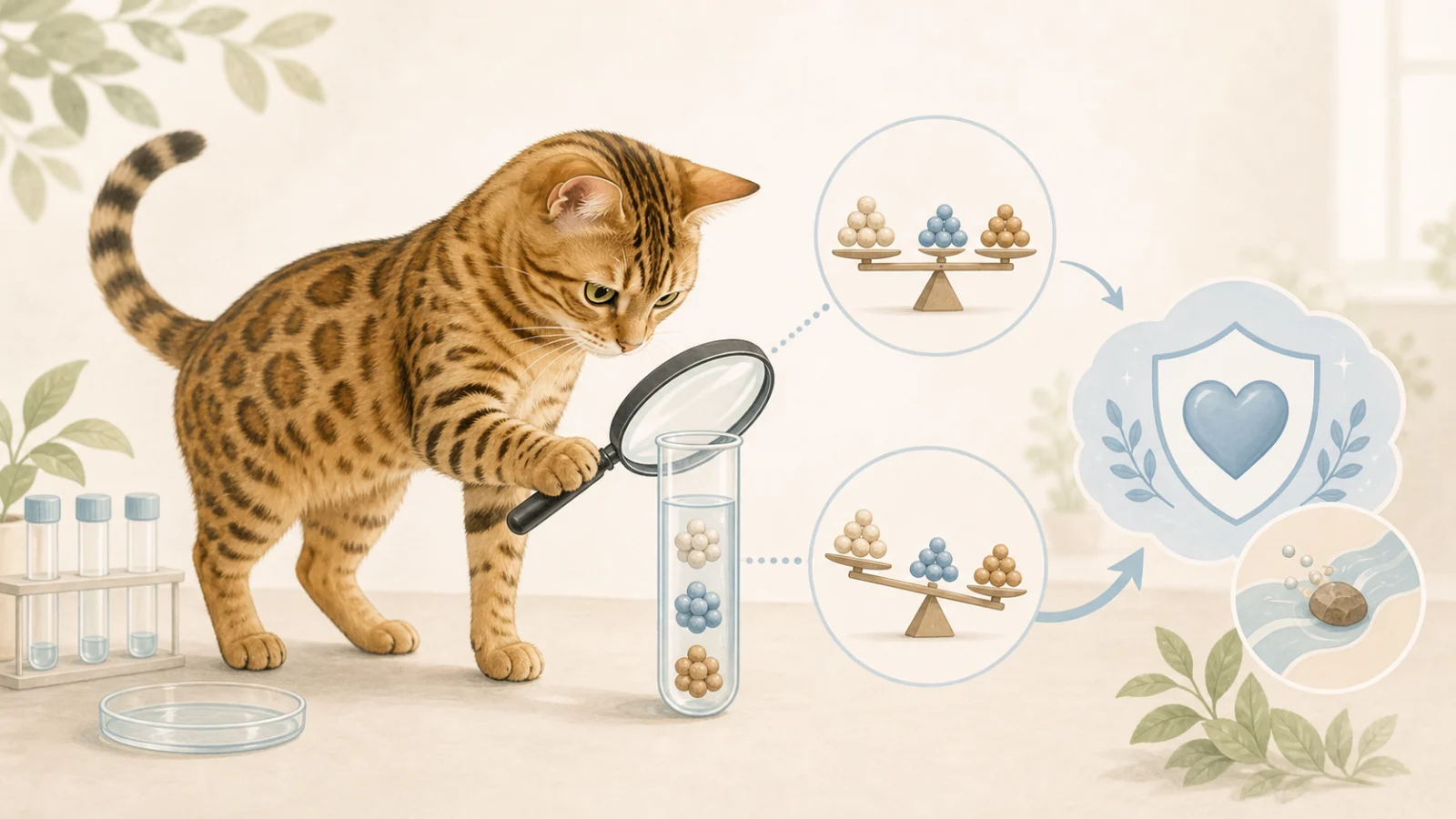
For an HCM caregiver, the most frightening word is the clot (CATE). Yet when we think of tools that gauge clot risk, only one comes to mind: the echocardiogram — expensive, specialist-dependent, months apart.
Recent research points somewhere else. Inside the ordinary blood panel (CBC) your cat already gets, two risk signals are hiding — they just need dividing. Neutrophils, lymphocytes, platelets: three numbers printed on every report that nobody thought to divide. This article covers what these two ratios (NLR and PNR) are, what the research has shown, and — just as important — how far to trust them.
1. Why white-cell ratios connect to clots
A clot is not simply "blood clumping by accident". When blood stagnates in the enlarged left atrium of an HCM heart, inflammation and platelet activation smoulder in that standing blood — the stage for a clot is being heated in advance. And that process leaves traces in the blood count:
- Neutrophils rise as body-wide inflammation grows
- Lymphocytes fall in chronic stress and disease
- Platelets fall because they are consumed where clots are forming — a falling count can mean they are being spent somewhere
Turn these into ratios — the size of the inflammation (NLR) and the trace of platelet consumption (PNR) — and a direction becomes visible even while each individual value sits inside its "normal range". Human cardiology used this first; studies validating it in feline HCM appeared in 2022 and 2025.
2. The calculation — thirty seconds with the report
| Ratio | Formula | Where on the report |
|---|---|---|
| NLR | Neutrophil count ÷ lymphocyte count | Neutrophils (NEU, Seg) ÷ Lymphocytes (LYM) — absolute counts (×10³/µL) |
| PNR | Platelet count ÷ neutrophil count | Platelets (PLT) ÷ Neutrophils — same units (×10³/µL) |
Example: neutrophils 6.2, lymphocytes 2.0, platelets 250 (all ×10³/µL) — NLR = 6.2 ÷ 2.0 = 3.1, PNR = 250 ÷ 6.2 = 40.3. Use absolute counts, not percentages, and match the units when a report prints them differently.
🧮 Thrombosis-risk self-calculator
Enter the absolute counts from the report (×10³/µL or K/µL) — not percentages.
※ A reference aid, not a diagnosis — treatment decisions belong with your vet. Values are not stored.
3. What the research showed — the numbers as published
The 2025 study (Yoon & Li, 110 cats) compared healthy cats, HCM cats, and cats that had actually thrown a clot (CATE):
| Healthy | HCM (subclinical to CHF) | Clot (CATE) | |
|---|---|---|---|
| NLR (median) | 2.1 | 3.3 | 5.8 |
| PNR (median) | 41.4 | 43.0 | 16.6 |
How to read it: NLR climbs stepwise from healthy to HCM to clot, while PNR collapses to less than half at the moment of a clot (platelets consumed, inflammation surging). Most striking: HCM cats with PNR below 40 had a 9.8-fold risk of cardiac death — a predictor that outperformed left atrial enlargement in this cohort.
The 2022 study (96 cats) backs the NLR side: cats in the top third of NLR had 10.3 times the cardiac-death risk of the bottom third; higher NLR correlated with a larger left atrium (0.64) and worse atrial function; and cats showing the echo precursor of a clot (spontaneous echo contrast) had a median NLR of 8.6 versus 2.1 without it.
4. So what number should worry you — a cautious guide
| Value | Where it sits in the studies | How to take it |
|---|---|---|
| NLR around 3 or below | Healthy-to-stable-HCM range | Log it; compare next time |
| NLR 4–5 and above | Entering the 2022 study's high-risk zone (specificity 95% at 4.46) | Once — confirm on recheck. Repeated — discuss moving the echo up |
| NLR 8 and above | The median territory of the clot-precursor group | Active discussion with your vet — atrial status, clopidogrel review |
| PNR 40 and above | Healthy-to-stable range | Log it |
| PNR below 40 | The 2025 study's 9.8-fold mortality zone | Once — re-test first (platelet clumping is common, section 5). Confirmed and repeated — discuss echo and antithrombotic strategy |
5. When these numbers lie — five traps
- Clinic stress — a frightened cat's neutrophils rise and lymphocytes fall, faking a high NLR. A value from a day of violent struggling reads high — compare trends under similar conditions
- Platelet clumping — feline platelets clump easily during blood draws, so machines undercount them. A suddenly low PNR calls first for the report's "PLT clump" flag or a blood-smear check — false low PNR is common
- Steroids — they raise neutrophils sharply and distort NLR. While your cat is on them, let this marker rest
- Other inflammation or infection — cystitis, dental disease and pancreatitis also raise NLR. This is a whole-body inflammation number, not a heart-only number
- Trusting a single value — same rule as the breathing rate: one value is a point; values stacked across rechecks are a direction
6. In practice — slot it into the recheck routine
- When to calculate — at every blood panel you already do (yearly or twice-yearly; more often on heart-failure treatment). No extra draw, no extra cost
- Record — NLR and PNR with the date in the app's care log; note the absolute neutrophil, lymphocyte and platelet counts too so values can be re-checked later
- Its partners — these numbers mean something next to LA/Ao and the resting breathing rate. All three worsening together is a strong signal; a ratio spiking alone means check section 5's traps first
- At B2 and beyond — the clopidogrel decision (ACVIM bases it on the left atrium) has probably been made; a worsening trend in these ratios can serve as a trigger to revisit it. The same logic applies to relapse surveillance in a cat that has already survived a clot (stage C)
7. Every study so far, in one table
Section 3's two studies, plus the feline studies you need alongside them when reading these numbers. Two things to check as you read:
- Size — both key studies are around 100 cats, with only 11 clot cats
- Comparison — NLR and PNR only mean something next to established markers such as left atrial size
| Study | Subjects · design | Result | What to note |
|---|---|---|---|
| Yoon 2025 | 42 healthy, 57 HCM (37 B1, 9 B2, 11 C) and 11 clot cats, prospective | Median NLR: healthy 2.1, HCM 3.3, clot 5.8. PNR: healthy 41.4, HCM 43.0, clot 16.6. PNR below 40 at HCM diagnosis: 9.8× the risk of cardiac death | Source of section 3's table and the "40" cut-off. Reported to outperform NLR and echo findings in early subclinical HCM. Single centre |
| Fries 2022 | 38 healthy + 58 HCM cats, prospective | Top NLR tertile: 10.3× the risk of cardiac death vs the bottom. NLR above 3.43: 82% sensitivity, 86% specificity; above 4.46: 95% specificity. Cats with smoke or thrombus: NLR 8.6 vs 2.1. Correlation with maximum left atrial size 0.64 (−0.85 with auricular function) | Source of sections 3–4's numbers. In the same study a left atrium ≥18 mm carried 9.5× the risk too — NLR doesn't replace the atrium |
| Norman 2001 | 359 feline blood samples, machine platelet counts vs blood smear | The machine put 71% below 200, but smears found only 3.1% — because of platelet clumping and the counting method | Basis for section 5's "false low PNR is common" |
| Payne 2013 | 282 UK cats with HCM, retrospective | Independent predictors of cardiac death: poor left atrial function, low LV systolic function, walls ≥9 mm. On simple analysis, left atrial size, gallop or arrhythmia, and smoke or thrombus also raised risk | Why section 6 says "read it next to LA/Ao" — the established risk marker is the left atrium |
In short, both studies point the same way: higher NLR and lower PNR go with a worse outlook. But each is a single-centre study of around 100 cats, and machine counts often read feline platelets too low, so PNR in particular needs rechecking. That matches this article's conclusion: use section 4's table not as diagnostic criteria but as a signal to bring rechecks and echoes forward.
- Whether acting on NLR/PNR (drugs or earlier echoes) improves outcomes — no study has tested it
- NLR/PNR trends in the same cat — both studies used a single time point; repeated-measurement trends are unvalidated
- How much clinic stress raises feline NLR — we found no feline study putting a number on it this time (section 5 is general principle)
- ACVIM guidance — not yet included; these are new markers
Study names link to the PubMed abstract. Evidence checked: 2026-11-18.
8. What to ask your vet
- "Could I have the absolute neutrophil, lymphocyte and platelet counts from this CBC (or a copy of the report)?"
- "The platelets read low — was clumping ruled out? Could we check a smear?"
- "NLR/PNR have worsened since the last test — is that a reason to move the echo up?"
- "Taking the left atrium and these ratios together, is it time to (re)discuss clopidogrel?"
- "My cat struggled badly during the draw — how much stress effect should we assume?"
9. Related
- Feeding the heart-disease cat — sodium, omega-3 and the dietary side
- Resting respiratory rate — the early signal you catch at home; this article's partner
- The day of diagnosis — why LA/Ao is this disease's fork in the road
- The HCM Bible — contents — the main clot (ATE) article follows in this chapter