Getting the most from your vet — the caregiver who brings data changes the consult
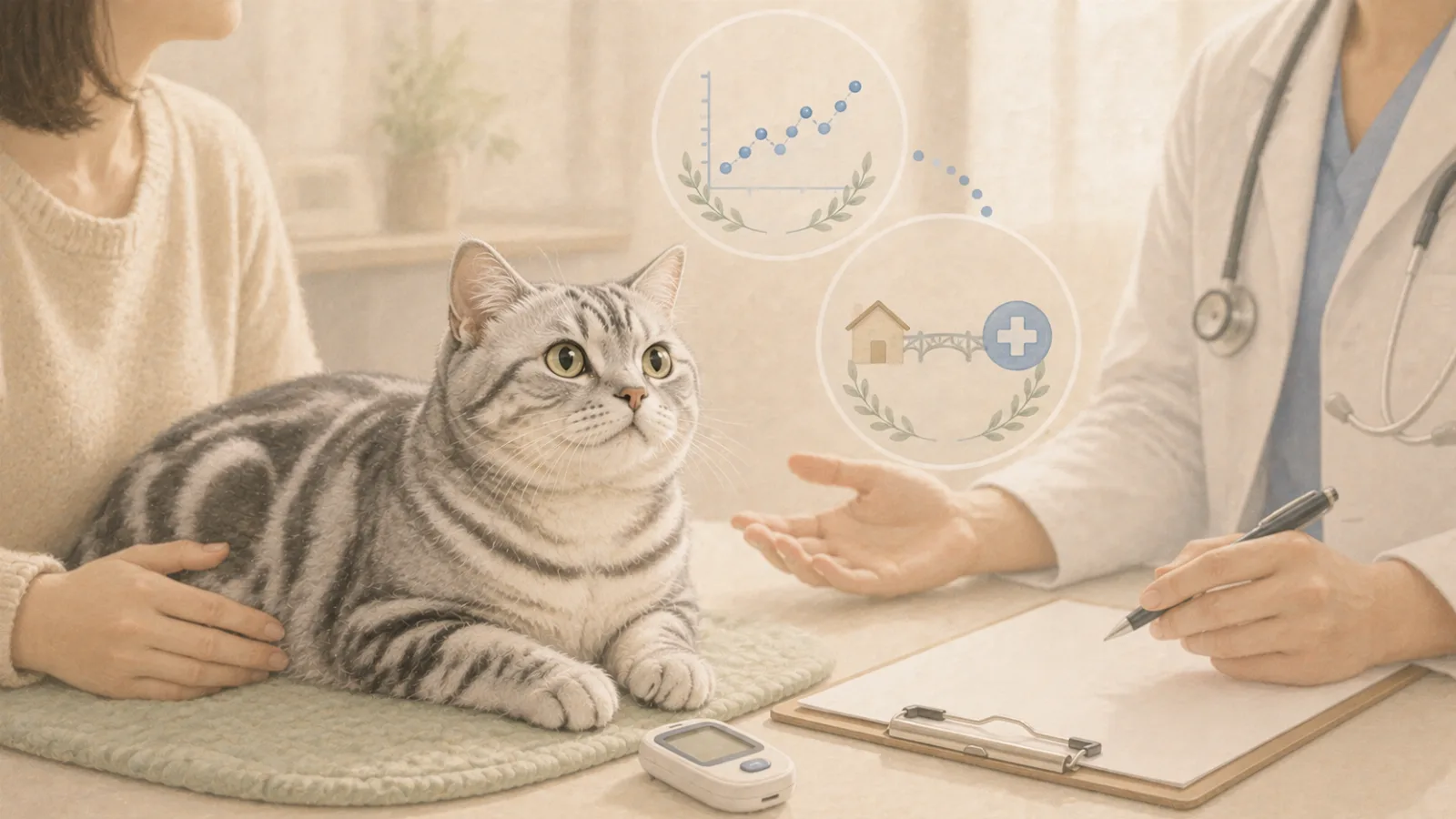
In most diseases the caregiver is the one who receives the hospital's observations. Diabetes is the reverse — the single most important data in this disease (everyday glucose) is something the hospital cannot measure. In a cat whose glucose leaps to 300–400 from the stress of a carrier and a waiting room, the clinic's number is often fiction.
So this disease's care has a special structure: the data is made at home; the interpretation and prescription happen at the clinic. The caregiver is not the consult's audience but the team's data officer. Using the hospital well means making your data well — and handing it over well.
One line — choose a clinic that supports home monitoring, bundle the rechecks into sets, and walk in with three things: records, history, questions.
And memorise the three ER sentences now — insulin type, last injection, whether on an SGLT2.
1. What makes this disease different — the number the clinic cannot take
- Stress hyperglycemia — chapter 02's phenomenon. Carrier, waiting room, needle: even a healthy cat can read 300–400. A glucose curve drawn at the clinic carries that distortion, so in a home-monitored cat, the home record is the primary data
- Hence the division of labour — home: glucose spots, curves, the Libre, weight, water intake, appetite, hypo events. Clinic: fructosamine (the undistorted referee), physical exam, kidney–thyroid–urine comorbidity surveillance, and interpretation and dosing decisions
- Dosing always belongs to the clinic — however good your data, the decision to change a dose is made with the vet. Keep the boundary between data officer and prescriber clean
2. Choosing the clinic — a diabetes checklist
- Do they support home monitoring? — the best litmus test. In an era when international guidelines recommend it as standard, a clinic that leads with opposition to it is a reason to reconsider
- Have they handled the Libre? — placement and interpretation experience makes titration far smoother
- Do they know the SGLT2 option? — not knowing does not make a bad clinic, but being able to discuss it matters (chapter 03)
- Can doses be discussed without a visit? — a phone/messenger channel for sending records and fine-tuning. In a stress-hyperglycemia disease, that channel is not a luxury; it is accuracy
- Night and emergency links — if not 24-hour themselves, which emergency hospital do they hand over to?
3. The recheck rhythm — bundle into sets
- Titration phases (post-diagnosis, dose changes) — short visits or data consults roughly every 1–2 weeks. This period's density builds the remission odds (chapter 04)
- Stable phases — a routine set roughly every 3–4 months: weight + exam + fructosamine + urine (infection watch) + kidney/thyroid bloods once or twice a year. Ask for it in one draw — kinder to cat and wallet alike (chapter 10)
- When control slips — switch from the routine set to the search set: IGF-1, T4, urine culture, fPL (chapter 09). When "shall we raise the dose again?" starts repeating, request the switch first
4. Before the consult — the three things to carry
- ① Records — glucose logs (spots, curves, Libre graphs), the weight trend, water intake. An app graph on your phone is plenty — one graph saves five minutes of narration
- ② History — dose-change dates, suspected hypo events, skipped days, food changes, care at other clinics (steroids!). A glucose graph without this history reads at half value
- ③ A question list — pick two or three from the "what to ask" sections that fit this season, and write them down. The question you think of in the consult room always arrives after the door closes
Spend the last minute of every consult on this sentence — "define the situations where we should contact you before the next recheck."
With the come-back thresholds in numbers, every anxious night in between becomes "within bounds — we're fine."
5. Using the visit-free consult
- Fine-tuning is often more accurate remotely — carrying the cat in clouds the data with stress; sending the home record sends the everyday truth. In titration phases, propose the structure "records + consult, visits only when needed"
- Channel and courtesy — ask first which channel and what frequency works; if there is a consult fee, pay it gladly — reviewing data is practice, not a favour
- The remote limit — weight, exam, fructosamine and comorbidity surveillance require the visit. Remote care is the bridge between routine sets, not their replacement
6. The emergency route — paved in advance
- Designate the 24-hour hospital today — name, phone, distance, and whether they manage diabetes/DKA, written onto the crisis card (chapter 08). Searching for an ER is a task to finish before the emergency exists
- The three ER sentences — ① insulin type and dose ② time of last injection ③ whether the cat takes an SGLT2 (normal-glucose DKA is possible — this one sentence redirects the workup). On the crisis card, they survive the panic
- Connect ER and regular vet — after emergency care, ask for the records to be shared with your regular clinic. Treatment run by two hospitals unaware of each other is the most dangerous kind
7. Second opinions — when and how
- When — ① prolonged poor control with no talk of the search set (IGF-1 and kin) ② standard requests (home monitoring, diet) repeatedly blocked ③ before big decisions like surgery or radiation. The acromegaly-suspicion zone in particular rewards an internal-medicine specialist's view
- How — openly, records in hand. "We would like another opinion" is a caregiver's right, not a discourtesy, and good vets take no offence. Returning to your regular vet afterwards is a common and natural ending
- But distinguish it from shopping — circling clinics until the desired answer appears is not a second opinion. When two specialists agree, that direction is probably right
8. What to ask your vet
- "We want to measure glucose at home — teach us the technique, and in what form should we bring the records?"
- "What channel and fee work for consulting on records without a visit?"
- "Please bundle the stable-phase routine set (weight, fructosamine, urine, kidney, thyroid) into one draw"
- "Define the thresholds for contacting you before the next recheck — numbers and signs"
- "Where should we go at night in an emergency, and can they manage DKA?"
9. Related
- Measuring glucose at home — making the data you will hand over
- Comorbidities — the search set to request when control slips
- Managing the crises — the crisis card and the emergency route
- The HCM Bible: getting the most from your vet — the heart disease edition
One line — this disease's care is completed where home data meets clinic interpretation.
Carry records, history and questions in; carry the come-back thresholds out — in front of a caregiver holding data, the quality of the consult changes.